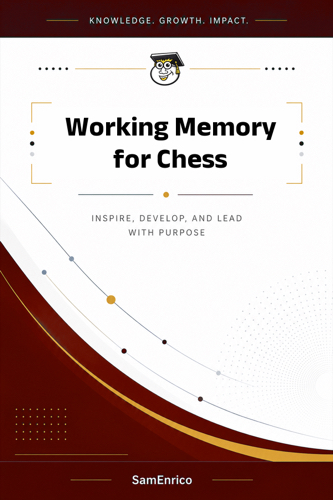
Working Memory for Chess eBook
Hold multiple moves and variations in mind during
by Lee Gustavo
Hold multiple moves and variations in mind during play.
Formats
Free sample
Chapter 1: The Lost Thread--Every chess player knows the feeling. You are sitting at the board, deeply engrossed in a complex position. You have just spent four minutes calculating a beautiful sequence—a sacrifice on h7, followed by a knight jump to g5, then a queen swing to h5. You have visualized every response your opponent could make. You have seen the checkmate three moves deep.
Confident, you reach for your bishop… and then you freeze. You cannot remember whether your opponent’s knight is still on f6 or whether it moved two moves ago in one of the branches. You forget which pawn is where. The beautiful line dissolves like smoke. You stare at the board, suddenly uncertain whether your sacrifice even works anymore.
You play something safe instead. You lose. After the game, a stronger player shows you that your original sacrifice was winning. You had seen it. You had calculated it correctly.
You just could not hold it in your head long enough to play it.This is not a failure of chess knowledge. It is not a lack of tactics training. It is not even a memory problem in the ordinary sense—you did not forget your keys or your mother’s birthday. This is a failure of working memory, and it is the single most underdiagnosed weakness in club-level chess.The Grand Illusion: Why Most Players Never Improve Past 1600Let us begin with a hard truth. You have probably been told that improving at chess is simple: study more tactics, learn your openings, play slower time controls, analyze your games.
This advice is not wrong. But it is incomplete. Thousands of players follow this formula year after year and never break through the 1600, 1800, or 2000 rating barrier. They solve hundreds of puzzles. They memorize opening lines ten moves deep.
They can explain the difference between a good bishop and a bad bishop. And yet, over the board, they freeze. They lose winning positions. They miss combinations that they would solve instantly in a puzzle book.Why? Because puzzles lie to you.
A puzzle presents a position and announces, quietly but unmistakably, “There is a win here.” This single piece of information is enormous. It tells you to keep calculating until you find something good. It tells you that your first idea is probably wrong—keep looking. It tells you that the position is not quiet. In a real game, no one gives you this signal.
You must decide when to calculate, when to trust your intuition, and when to stop. More importantly, you must hold the results of your calculation in your head while you compare multiple options.The missing ingredient is not more tactics. It is the ability to hold multiple moves and variations in your mind during active play without losing the thread. This book calls that ability “working memory for chess,” and it is trainable. But first, you must understand what it is, why it fails, and why almost everyone trains it incorrectly.RAM Versus ROM: The Hidden Distinction That Changes Everything Let us borrow a metaphor from your computer.
Your computer has two kinds of memory. ROM, or read-only memory, stores information permanently. It holds the operating system, the pre-installed software, and the basic instructions that never change. This memory is stable, reliable, and fast to access. RAM, or random-access memory, is where your computer does its active work.
It holds the documents you are currently editing, the web pages you have open, and the calculations you are performing right now. RAM is volatile. When you turn off the computer, RAM empties completely.Your brain works the same way. ROM in chess is recognition memory. It holds everything you have memorized: opening lines you have studied, tactical patterns you have seen hundreds of times, endgame principles you have internalized.
When you see a familiar fork, you do not calculate. You just know. That is ROM at work. ROM is fast, effortless, and reliable—as long as the position matches something you have seen before.RAM in chess is working memory. It holds the variations you are calculating right now.
It keeps track of where the pieces are after three moves of a sacrifice. It compares Line A (bishop takes h7) against Line B (queen to g4) without mixing them up. RAM is slow, effortful, and fragile. It can hold only about four to seven chunks of information at once. When the clock is ticking and your heart is pounding, RAM becomes even more fragile.Here is the secret that separates strong players from weak ones: most amateurs try to use RAM for everything.
They calculate every move from scratch, exhausting themselves. Strong players, by contrast, use ROM as much as possible. They have compressed thousands of patterns into long-term memory, freeing their RAM for the truly novel aspects of the position. The gap between a 1200 player and a 2200 player is not that the stronger player has a bigger RAM. It is that the stronger player has a more efficient ROM, and knows exactly when to switch between the two.The Cognitive Load Trap: Why Your Brain Feels Like It Is Drowning Cognitive load theory, developed by educational psychologist John Sweller in the 1980s, explains why chess calculation feels so exhausting.
Your working memory has a fixed capacity. That capacity is measured in “chunks,” not in seconds or moves. A chunk can be a single piece, a pawn structure, a tactical motif, or even an entire king position. The problem is that a novice sees the board as dozens of individual chunks—each piece, each square, each relationship. A grandmaster sees the same board as three or four chunks: “a kingside castled position with a fianchettoed bishop,” “a backward pawn on d6 that is the main weakness,” “a knight outpost on e5 that cannot be challenged.” The grandmaster’s chunks are larger and more meaningful.
Therefore, the grandmaster’s working memory is not less loaded—it is loaded with better information.Let us do the math. Suppose you are calculating three variations, each five moves deep. A move changes the position. So three variations of five moves each means tracking fifteen distinct positions. Even if you are only comparing the end positions, you are still holding the paths in your head.
Fifteen positions is far beyond the four-to-seven chunk capacity of working memory. You are doomed from the start—unless you chunk.If you chunk strategically, the numbers change. Instead of fifteen individual positions, you hold three strategic themes: “the kingside attack with the sacrificed bishop,” “the queenside pressure on the c6 pawn,” and “the endgame transition where I trade down to a won pawn ending.” Now you are holding three chunks, not fifteen. Your working memory is comfortable. You can calculate deeply without losing the thread.The tragedy is that most chess training ignores cognitive load entirely.
Puzzle books throw position after position at you, never teaching you how to compress information. Opening books drown you in variations without explaining how to group them. Tactics trainers measure your speed, not your efficiency. You have been training the wrong skill.The Blindfold King’s Pawn Test: Discovering Your Real Ceiling Before we go any further, you…
This is the end of the free sample. Get the eBook to keep going. Buy now
About this book
Details
- Author
- Lee Gustavo
- Publisher
- SamEnrico
- Language
- English
- Genre
- Non-Fiction, Self-Help, Chess Strategy
- Released
- 2026-06-07
- Pages (approx.)
- 126
- Available as
- eBook, Audiobook

Read better in the ZLOADR app
Your eBooks on your phone or tablet. Sign in with your SamEnrico account and start reading.
More by Lee Gustavo
 Second Generation TherapyLee Gustavo$11.99
 Nicotine Salt CessationLee Gustavo$11.99
 Caffeine Sleep Memory GuideLee Gustavo$11.99
 Skeeter Davis End WorldLee Gustavo$11.99
 The Stress Reset ButtonLee Gustavo$11.99
 Dirty Keto Weight Loss GuideLee Gustavo$11.99
 Borderline Relationship AngerLee Gustavo$11.99
 Tides of Enlightenment: The Scientific Revolution at SeaLee Gustavo$11.99
 The Siege of the Parthenon: Greece's Forgotten Hostage CrisisLee Gustavo$11.99
 How to Produce a FreezerLee Gustavo$11.99
 Ultimate Handbook Guide to Fuan : (China) Travel GuideLee Gustavo$11.99
 Middle East Sales Engineering GuideLee Gustavo$12.99