
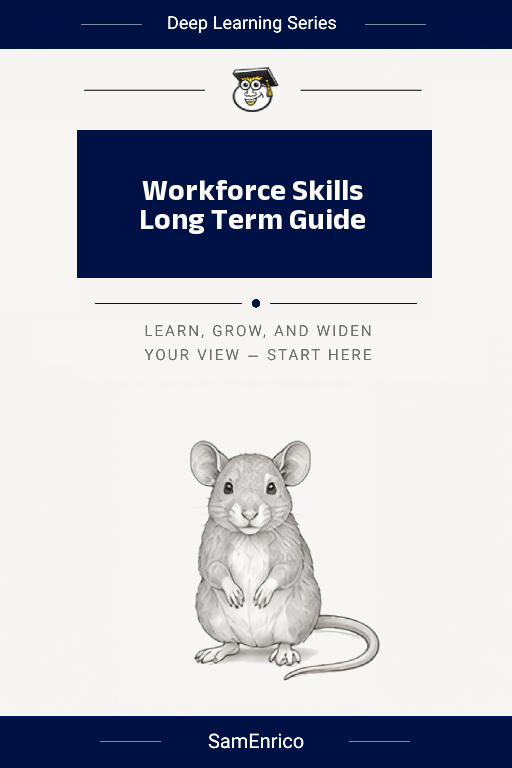
Non-FictionForecast & OutlookLong Range
Workforce Skills Long Term Guide eBook
Project far-future scenarios including human-AI co
by Boren Chance
Project far-future scenarios including human-AI collaboration, lifelong learning, and meta-skills.
Formats
Free sample
Chapter 1: Your Resume Is a Eulogy--–- Let me tell you something your career counselor won't: the piece of paper you spent hours perfecting, the one with the clean formatting and the impressive job titles and the bullet points about "increasing efficiency by 27%," is already obsolete. Not outdated. Not in need of a refresh. Obsolete. Like a floppy disk or a map folded in a glove compartment.
You have been climbing a ladder that no longer leans against any real wall.I learned this the hard way. Not from a book or a seminar, but from watching a forty-seven-year-old friend—we'll call her Mariana—get laid off from a telecommunications company where she had worked for nineteen years. Mariana was a "Senior Director of Regional Operations," a title she had earned over nearly two decades of climbing. She had performance reviews that glowed. She had a corner office with actual sunlight.
She had the ladder. And then she had a thirty-minute Zoom call where an HR representative she had never met read a script about "restructuring" and "evolving business needs."Nineteen years. Thirty minutes.Mariana spent the next eight months sending out her resume—that beautifully formatted eulogy to her career—to over four hundred job postings. She heard back from twelve. She got three first-round interviews.
Zero offers. Why? Because her resume said "Senior Director of Regional Operations," and the market was asking for "cross-functional task economy orchestrator with AI workflow fluency." She had the experience. She had the intelligence. She had the work ethic.
But she was speaking a language the new world had stopped listening to.This chapter is not a pep talk. It is an intervention. I am going to show you why your current understanding of career security is a dangerous illusion, why the job ladder has been replaced by something far more interesting, and how to stop mourning a world that no longer exists so you can start building one that does.The Funeral of the Linear Career For most of the twentieth century and the first two decades of the twenty-first, the deal was simple. You graduated from high school or college, you got an entry-level job, you worked hard, you got promoted, you repeated this process every two to five years, and somewhere around year thirty or forty, you retired with a gold watch and a pension or a 401(k). This was the social contract of work.
It was never perfect—it excluded many people, it punished the unlucky, it rewarded conformity over creativity—but it was stable enough that generations of workers built their identities, their mortgages, and their life plans around its predictable rhythms.That contract is now null and void. Not amended. Not renegotiated. Void.Consider the data. In 1980, the average Fortune 500 company had a lifespan of approximately thirty years.
By 2020, that lifespan had dropped to eighteen years. By 2025, it is projected to fall to twelve years. The half-life of a technical skill is now between two and five years, depending on the field. A nursing degree that was cutting-edge in 2018 already requires significant updating in areas like telemedicine, AI diagnostic tools, and automated patient record systems. A software engineer who learned React in 2020 is already competing with developers who have mastered AI-assisted coding environments that barely existed two years ago.But here is the deeper truth that data alone cannot capture.
The problem is not just that industries change faster. The problem is that the nature of change has changed. In the twentieth century, change was like a weather pattern: predictable seasons, gradual shifts, occasional storms you could see coming on the radar. Today, change is like a series of earth tremors that hit without warning, rearrange the landscape permanently, and then are followed by another tremor before you have finished assessing the damage from the first.I call this the end of the linear career. Linear means predictable, sequential, one thing after another.
Your career is no longer linear. It is not even circular or cyclical. It is a complex adaptive system—and you are the one who has to adapt.What Replaces the Ladder: The Skill Lattice If the ladder is gone, what takes its place? The answer is what I call the skill lattice—a networked web of transferable abilities that you can apply across industries, roles, and technological platforms.Let me be precise about this distinction. A ladder is vertical.
You climb from rung to rung, and each rung is higher than the last. Higher means more authority, more pay, more status, but also more narrow. The higher you climb on a ladder, the fewer places you can go. You become a specialist in one company's way of doing things, one industry's vocabulary, one technology stack's architecture. When that company restructures, that industry contracts, or that technology becomes obsolete, you have nowhere to climb.
You fall.A lattice, by contrast, is horizontal and diagonal as much as it is vertical. A lattice lets you move sideways into a different function, diagonally into a related field, or even downward into a more foundational learning position without losing status—because status is no longer measured by how high you are but by how many connections you have. In a lattice, your value is not your elevation. Your value is your connectivity: the number and quality of nodes in your skill network.Think of it this way. A traditional career ladder values depth to the exclusion of breadth.
The question is: "How expert are you in this one thing?" A skill lattice values depth and breadth. The question is: "How many different things can you do, and how well can you combine them?"Let me give you a concrete example. Two marketing professionals are laid off from the same company on the same day. Professional A has a linear career history: fifteen years in marketing, with increasingly senior titles, all at the same company, all focused on traditional print and television advertising. Professional B has a lattice career history: eight years in marketing, two years in product management, three years in data analytics, and freelance work in UX writing.
On paper, Professional A looks more "senior." But in the current labor market, Professional B is significantly more employable. Why? Because Professional B has deployable skills across multiple domains and can fill gaps in a way that Professional A cannot.This is not speculation. It is what labor economists call the "task economy"—a way of understanding work not as a collection of job titles but as a collection of tasks that can be recombined in infinite ways. In a task economy, your job title is a temporary container.
Your skills are the permanent contents.Unified Vocabulary: The Building Blocks of Your Lattice Before we go further, I need to introduce a vocabulary that we will use throughout this book. These terms appear across multiple chapters, and clarity here will save us confusion later.Task unit: The smallest atom of work. Not a job, not a role, not a project. A single, discrete, completable piece of work. Examples: "Summarize this quarterly earnings report," "Negotiate a deadline extension with a vendor," "Identify three alternative solutions to a client's problem," "Explain a…
This is the end of the free sample. Get the eBook to keep going. Buy now
About this book
Details
- Author
- Boren Chance
- Publisher
- SamEnrico
- Language
- English
- Genre
- Non-Fiction, Forecast & Outlook, Long Range
- Released
- 2026-05-29
- Pages (approx.)
- 148
- Available as
- eBook, Audiobook

Read better in the ZLOADR app
Your eBooks on your phone or tablet. Sign in with your SamEnrico account and start reading.
More by Boren Chance
 Bergman Light in DarknessBoren Chance$11.99
 Gardening Season PriorityBoren Chance$11.99
 CSGO Skin Gambling RecoveryBoren Chance$11.99
 Rapid Rapport TechniquesBoren Chance$11.99
 Upwork Client Interview PreparationBoren Chance$11.99
 Masada: The Last Stand of the ZealotsBoren Chance$11.99
 Project Management Glossary GuideBoren Chance$12.99
 Understanding MeningomyeloceleBoren Chance$17.99
 How to Become a Tube RepairerBoren Chance$11.99
 Robotics Team MentorBoren Chance$11.99
You may also like
 Hong Kong Handover 1997Dunn Johnnie$11.99
 Zumba For Postnatal Recovery CourseNeal Christian$11.99
 Zumba for BeginnersLadner Nikia$11.99
 YouTube Comment Mining GuideHumes Pandora$12.99
 Worry Box MeditationCarlin Rudy$11.99
 Workplace Stress MeditationNguyen Lynn$11.99
 Workplace Stress and Sleep RepairHawley Ivory$11.99
 Workplace Perfectionism CureDelaney Jeffry$11.99
 Workplace Injustice Anger GuideWallen Isabelle$11.99
 Work Addiction and Burnout LinkGreenwood Ester$11.99
 Women in Yoga and WellnessBeattie Galina$11.99
 Women in Stand Up ComedyChun Evangeline$11.99