
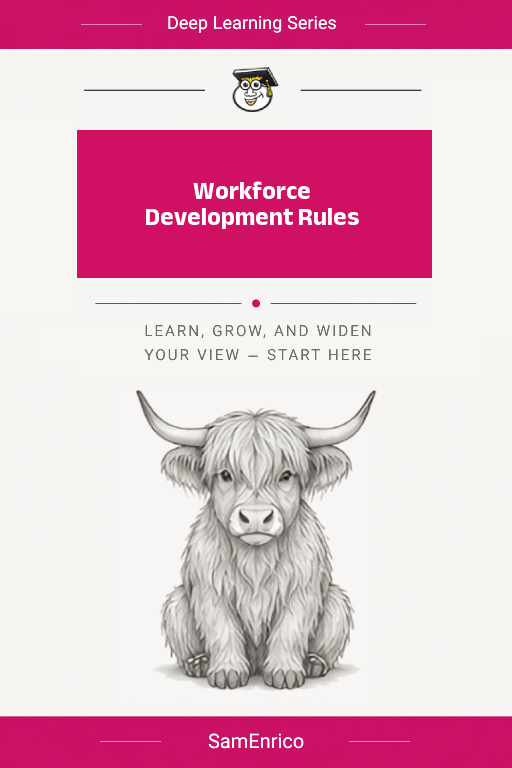
Workforce Development Rules eBook
Comply with Workforce Innovation and Opportunity A
by Meador Mose
Comply with Workforce Innovation and Opportunity Act regulations for edtech offering job training programs.
Formats
Free sample
Chapter 1: The Cartography Problem--Imagine you are a product manager at a fast-growing edtech company. Your team has built an elegant learning platform. Your completion rates are strong. Employers are clamoring for your graduates. A workforce development board in Ohio has heard about you and wants to put you on their approved training provider list.
You are thrilled.Then the paperwork arrives.It references something called 20 CFR Part 675. It asks for your "ETPL application" and your "ITA reimbursement structure." It wants to know if you are "Eligible" or "Qualified." It mentions something called a "local area" and a "Workforce Development Board" you have never heard of. Your compliance officer—if you have one—starts Googling frantically. Your CEO asks, "Can't we just sell to them like we sell to corporations?"The answer is no. And that no is why most edtech companies never see a dollar of the more than $3 billion in WIOA Title I funds available annually for job training.
It is not because their programs are ineffective. It is not because employers reject their graduates. It is because they cannot navigate the cartography problem: the complex, multi-layered map of the public workforce system.This chapter is your compass. Before we discuss compliance metrics, audit trails, or accessibility standards, we must first understand the terrain. The Workforce Innovation and Opportunity Act creates a federal-to-local governance structure that frustrates technology companies accustomed to direct sales, national contracts, and centralized decision-making.
You cannot call a single 800 number to get on the national training provider list, because no such list exists. You cannot email a single federal official to approve your curriculum, because that official does not have that authority. Instead, you must navigate three distinct levels of government, each with its own rules, timelines, and gatekeepers.Understanding this ecology is not academic. It is the difference between spending eighteen months spinning your wheels and successfully launching in your first labor market within ninety days. This chapter maps the entire system, introduces the key players you will need to persuade, and provides a practical framework for aligning your sales cycle with the workforce system's procurement cycle.
By the end, you will understand why local relationships matter more than federal recognition, why "Eligible" and "Qualified" are not synonyms, and how to stop thinking like a direct-to-consumer vendor and start thinking like a strategic partner to the public workforce system.The Federal Foundation: Where Rules Are Made, Not Approvals Granted At the highest level, the U.S. Department of Labor (DOL) and the U.S. Department of Education (ED) share responsibility for WIOA implementation. The DOL oversees Title I, which funds adult, dislocated worker, and youth workforce programs—the primary funding streams for job training. The ED oversees Title II, which funds adult education and literacy programs.
For most edtech providers offering occupational skills training, the DOL is your primary federal partner.But here is the critical insight that trips up most technology companies: the federal government does not approve training providers. The DOL sets the regulatory framework. It issues guidance. It negotiates performance targets with states. It withholds funds from underperforming states.
But it never, ever tells a local workforce board which online coding bootcamp, medical billing course, or HVAC certification program to approve. That decision is reserved for the states and, increasingly, for local boards.The DOL's primary mechanism for enforcing WIOA is the Unified State Plan. Every two to four years, each state must submit a plan to the DOL describing how it will administer workforce programs, including its criteria for approving training providers. The DOL reviews these plans for compliance with federal regulations, but it does not dictate local approval decisions. A state could theoretically approve almost any provider that meets minimum requirements, provided it follows its own published criteria.This means that federal regulations like 20 CFR Part 675 (which governs Eligible Training Provider Lists) establish the floor, not the ceiling.
States can add requirements. Local boards can add further requirements. By the time you reach the actual approval process, you may be facing rules that originated in federal law but have been filtered through state statutes, administrative codes, local board policies, and even individual case manager preferences.The practical implication is stark: you cannot comply your way to national approval, because national approval does not exist. You must learn to navigate fifty different state systems and hundreds of local board systems. This is the cartography problem.
And the map starts with the states.The State Level: Where Governors Set the Rules of the Road Each state's governor negotiates performance targets with the DOL and establishes the state's Eligible Training Provider List (ETPL) criteria. Some states, like Texas, have highly prescriptive administrative codes (40 Tex. Admin. Code § 840) that specify everything from instructor qualifications to facility requirements. Other states have relatively minimal requirements, trusting local boards to exercise discretion.
But every state has an ETPL, and every state requires training providers to apply for inclusion.The state-level ETPL is the first major gate. Without state approval, you cannot receive WIOA funds anywhere in that state, regardless of how enthusiastic a local board might be. However, state approval is rarely sufficient on its own. Most states require providers to seek local board approval as well, particularly for programs that will be delivered in specific geographic areas.This two-step process—state eligibility plus local qualification—creates confusion for edtech providers accustomed to single-point approvals. A typical technology company wants to build once, comply once, and sell everywhere.
The workforce system does not work that way. You will likely need to apply separately to each state where you want to operate, and then separately to each local board within that state where you want to serve participants.The variation between states is substantial. California, for example, requires training providers to demonstrate "demonstrated effectiveness" through performance outcomes, while some Midwestern states accept basic business credentials alone. The proposed Workforce Innovation Leader (WIL) Act would eventually create a two-tier system with higher performance standards for a "WIL List," but under current law, you must navigate this patchwork state by state.Chapter 2 provides a detailed tactical guide to ETPL applications, including a state-by-state comparison of requirements. For now, the key takeaway is that state-level approval is necessary but not sufficient.
The real action—and the real complexity—is at the local level.The Local Level: Where Decisions Actually Happen Local Workforce Development Boards (WDBs) are the heart of the public workforce system. There are approximately 550 WDBs across the United States, each covering a "local area" typically defined as a county or cluster of counties. Each WDB operates one or more American Job Centers (formerly known as One-Stop Career Centers), where job seekers receive case management, career counseling, and access to training funds.WDBs are not government agencies in the traditional sense. They are typically nonprofit corporations governed by local business leaders, elected officials, and community representatives. Federal law requires that a majority of WDB members come from the private sector.
This means that WDBs are theoretically business-friendly, but in practice, they are risk-averse. They are responsible for millions of dollars in federal funds and are audited regularly. Their default position is to approve only training providers they know and trust.WDBs…
This is the end of the free sample. Get the eBook to keep going. Buy now
About this book
Details
- Author
- Meador Mose
- Publisher
- SamEnrico
- Language
- English
- Genre
- Non-Fiction, Annual Checkup, Edtech, WIOA
- Released
- 2026-06-01
- Pages (approx.)
- 151
- Available as
- eBook, Audiobook

Read better in the ZLOADR app
Your eBooks on your phone or tablet. Sign in with your SamEnrico account and start reading.
More by Meador Mose
 Travel Insurance Agency RegisterMeador Mose$11.99
 Loving Kindness for Wedding Stress HandbookMeador Mose$11.99
 Inside the Antwerp Diamond HeistMeador Mose$11.99
 Moving Stress Couples GuideMeador Mose$11.99
 Pet Ownership Healthy AgingMeador Mose$11.99
 The Frozen Frontier: Hudson’s Bay Company and the Arctic’s Hidden SecretsMeador Mose$11.99
 Pandamonium: The Great Escape of Hsing-Hsing and Huan HuanMeador Mose$11.99
 Research AnalystMeador Mose$11.99
 Understanding Depressive Personality DisorderMeador Mose$17.99
 CompTIA Certification GuideMeador Mose$12.99
 Ultimate Handbook Guide to Suzhou : (China) Travel GuideMeador Mose$11.99