
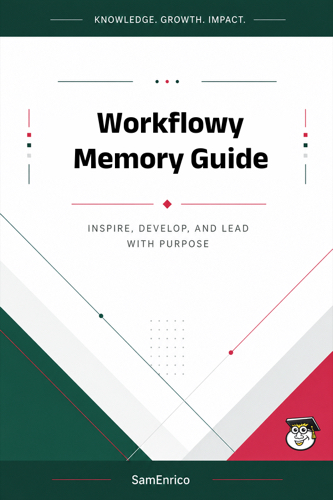
Workflowy Memory Guide eBook
Manage infinite nested lists for project and task
by Hyman Nikki
Manage infinite nested lists for project and task recall.
Formats
Free sample
Chapter 1: The Leaky Bucket--You wake up at 3:47 AM. Your eyes open not because of a noise or a dream, but because your brain has decided that this is the perfect moment to remind you about the email you forgot to send yesterday. Then comes the grocery list. Then the project deadline that is still three weeks away but somehow feels urgent right now. Then the dentist appointment you keep meaning to schedule.
Then the call to your mother. Then the weird sound your car has been making. Then—Your heart rate climbs. You check the clock. 3:48 AM.
You have been awake for sixty seconds, and already your mind is a browser with forty-seven tabs open, each one playing its own anxiety-inducing soundtrack. You try to go back to sleep, but your brain has other plans. It is not being malicious. It is being efficient. It is doing exactly what evolution designed it to do: holding onto incomplete tasks because, in a ancestral environment, forgetting where the water source was or which berries were poisonous could get you killed.The problem is that you no longer live in that environment.
You live in a world of endless notifications, shifting priorities, and a to-do list that multiplies faster than you can check items off. Your brain, magnificent as it is, was never built for this.This chapter is about why your memory feels like a leaky bucket. It is about the science of forgetting, the hidden cost of carrying unfinished tasks in your head, and why the solution is not a better to-do list or a stronger willpower. The solution is to build an external memory system that works the way your brain actually works. By the end of this chapter, you will understand exactly why you forget, why flat lists make it worse, and why nested lists—the kind you can build in Workflowy—are the closest thing to a prosthetic memory we have ever invented.The Weight of Unfinished Things Let us start with a story.
In the 1920s, a young psychologist named Bluma Zeigarnik was sitting in a café in Vienna. She noticed something peculiar about the waiters. They could remember complex, multi-item orders with astonishing accuracy—three coffees with milk, two teas, one hot chocolate with extra whipped cream, and a sandwich with no crust. But as soon as the customer paid and left, the waiter would completely forget the order. Not sort of forget.
Wipe it from memory as if it had never existed.Zeigarnik, who was a student of the famous psychologist Kurt Lewin, returned to her lab and designed a series of experiments. She gave people simple tasks—building structures out of clay, solving puzzles, arithmetic problems. For half the participants, she interrupted the tasks before they could finish. For the other half, she allowed them to complete the tasks. Later, she asked everyone to recall as many tasks as possible.The results were striking.
People remembered the interrupted tasks about twice as well as the completed ones. The unfinished tasks stuck in memory. The finished tasks faded.This became known as the Zeigarnik effect, and it is one of the most robust findings in cognitive psychology. The human brain has a powerful, automatic tendency to hold onto incomplete tasks. Once a task is finished, the brain releases its grip.
But until that moment, the task occupies a mental loop, popping into awareness at random moments—3:47 AM, during a meeting, while you are trying to read to your child.You have felt this. Every time you remember something you were supposed to do, you are experiencing the Zeigarnik effect in action. It is not a bug. It is a feature. Your brain is trying to help you survive by making sure you do not forget important unfinished business.The problem is that modern life generates an endless stream of unfinished business.
Emails that require responses. Messages that need replies. Projects that span weeks or months. Household repairs. Medical appointments.
Financial planning. Career development. Relationship maintenance. Personal growth. The list goes on, and on, and on.Zeigarnik did not have email.
She did not have Slack notifications or Twitter threads or Instagram DMs. She did not have forty-seven tabs open in her browser and another fifteen open in her head. If she were alive today, she would probably be less interested in waiters and more interested in why the average knowledge worker feels like they are drowning in half-finished thoughts.The true cost of the Zeigarnik effect is not just the annoyance of remembering things at inconvenient times. It is the constant, low-grade cognitive load that comes from carrying all those open loops in your head. Each unfinished task consumes a tiny amount of mental energy.
Individually, that energy is negligible. But multiply it by fifty tasks, or a hundred, or two hundred, and you are walking through life with a weighted vest on. You are tired not because you are doing too much, but because you are remembering too much.The Four-Slot Limit If the Zeigarnik effect explains why your brain holds onto unfinished tasks, cognitive load theory explains how much it can hold onto at once. And the answer is: not very much.In the 1950s, the psychologist George Miller published a famous paper titled "The Magical Number Seven, Plus or Minus Two." Miller argued that the human working memory—the part of your brain that holds information in conscious awareness—can hold approximately seven items at a time. Later research refined this estimate downward.
Most cognitive scientists now agree that the true limit is closer to four items. Four. That is it.Think about what that means. Your working memory can hold four discrete pieces of information at any given moment. If you are trying to remember a phone number, you can hold the seven digits by chunking them into groups—but that is still only a few chunks.
If you are trying to keep track of your grocery list, you can hold four items before things start falling out.Now consider the average workday. You have a project deadline. An email you need to respond to. A meeting in twenty minutes. A call you promised to make.
A document you need to review. A message from your partner about picking up the kids. A notification about a package delivery. A reminder to schedule a doctor's appointment. By 9:15 AM, you have already exceeded your working memory limit by an order of magnitude.What happens when you exceed the limit?
Your brain starts to make mistakes. You forget the email. You show up late to the meeting. You buy the wrong thing at the grocery store. You walk into a room and forget why.
These are not signs that you are losing your mind. They are signs that you are asking your working memory to do something it was never designed to do.Cognitive load theory, developed by the educational psychologist John Sweller, explains that working memory is not just limited in capacity. It is also easily overwhelmed by complexity. When you try to hold multiple pieces of information that interact with each other—for example, the steps of a project, the dependencies between tasks, the…
This is the end of the free sample. Get the eBook to keep going. Buy now
About this book
Details
- Author
- Hyman Nikki
- Publisher
- SamEnrico
- Language
- English
- Genre
- Non-Fiction, Self-Help, Workflowy
- Released
- 2026-06-07
- Pages (approx.)
- 133
- Available as
- eBook, Audiobook

Read better in the ZLOADR app
Your eBooks on your phone or tablet. Sign in with your SamEnrico account and start reading.
More by Hyman Nikki
 Retirement Savings Panic GuideHyman Nikki$11.99
 VSCO Aesthetic EnvyHyman Nikki$11.99
 Governor's Trade Mission JournalHyman Nikki$11.99
 Validating Foster Care ExperienceHyman Nikki$11.99
 Sleep After Learning GuideHyman Nikki$11.99
 Special Needs Parent Self Care GuideHyman Nikki$11.99
 Inspire Hypoglossal NerveHyman Nikki$11.99
 Pomodoro For Spaced RepetitionHyman Nikki$11.99
 Mozart and the Enlightenment: A Symphony of Reason and RevolutionHyman Nikki$11.99
 The Last Breath of the Library of AlexandriaHyman Nikki$11.99
 The Dogma 95 Revolution: Lars von Trier and the Birth of Raw CinemaHyman Nikki$11.99
 The Mineral Guide to GarnieriteHyman Nikki$11.99
You may also like
 Hong Kong Handover 1997Dunn Johnnie$11.99
 Zumba For Postnatal Recovery CourseNeal Christian$11.99
 Zumba for BeginnersLadner Nikia$11.99
 YouTube Comment Mining GuideHumes Pandora$12.99
 Worry Box MeditationCarlin Rudy$11.99
 Workplace Stress MeditationNguyen Lynn$11.99
 Workplace Stress and Sleep RepairHawley Ivory$11.99
 Workplace Perfectionism CureDelaney Jeffry$11.99
 Workplace Injustice Anger GuideWallen Isabelle$11.99
 Work Addiction and Burnout LinkGreenwood Ester$11.99
 Women in Yoga and WellnessBeattie Galina$11.99
 Women in Stand Up ComedyChun Evangeline$11.99