
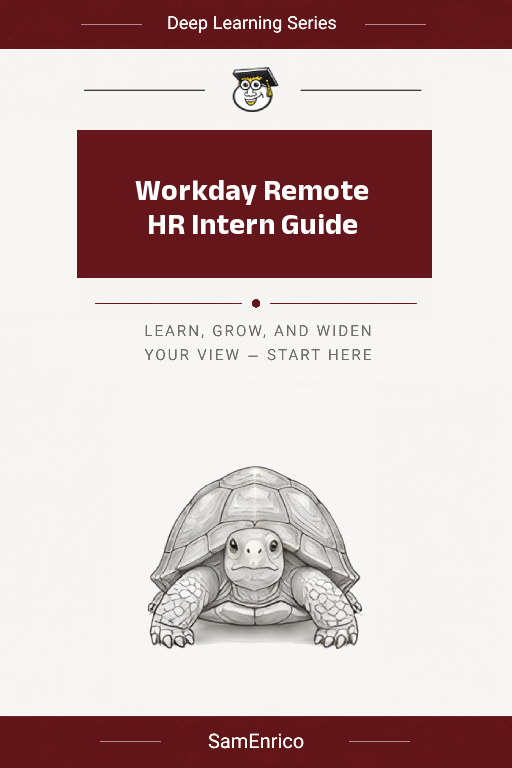
Non-FictionStudent's ShortcutHR Tech InternshipWorkday Careers
Workday Remote HR Intern Guide eBook
Join Workday's virtual internship for HR software
by Stein Dalia
Join Workday's virtual internship for HR software development people analytics or cloud finance with global teams.
Formats
Free sample
Chapter 1: The Invisible Epidemic--–- You have probably never heard of Alex, but Alex is the reason this book exists. Three years ago, Alex landed a remote internship at a mid-sized tech company. She did everything right—she showed up to every Zoom meeting on time, responded to Slack messages within minutes, completed every task her manager assigned, and never once complained about the 6 AM standup calls with the London team. At the end of twelve weeks, her manager sent her a polite email thanking her for her "contributions" and wished her well. No return offer.
No job. No explanation.Alex was confused. Her performance reviews had been positive. Her deliverables were error-free. She had never missed a deadline.
What she did not understand—and what no one told her—was that she had been invisible the entire time. In a physical office, Alex would have been seen chatting with colleagues at the coffee machine, overhearing strategic conversations, and building the kind of spontaneous relationships that lead to mentorship and advocacy. In a remote environment, she existed only as a name on a screen and a series of completed tickets. She was efficient, effective, and entirely forgettable.This is the invisible epidemic of remote internships. Thousands of talented, hardworking students are completing virtual internships every year and walking away with nothing but a line on a resume.
Their managers liked them well enough. Their work was technically fine. But when it came time to decide who received a return offer, the interns who got hired were not necessarily the ones who did the best work. They were the ones who had mastered a completely different set of skills—skills that have nothing to do with Workday configuration or people analytics and everything to do with how to be seen, remembered, and advocated for in a digital environment.The Great Disconnect: What Interns Think vs. What Actually Happens If you are reading this book, you have likely already secured a remote internship—or you are desperately trying to.
You probably believe that doing good work is enough. You believe that if you complete your assignments on time, write clean reports, and stay off your manager's radar for anything negative, you will be rewarded with a return offer or a glowing recommendation. This belief is not just wrong. It is dangerous.Let me share a hard truth that no career center will tell you: In a remote environment, your actual work accounts for roughly thirty percent of how you are evaluated. The other seventy percent comes from factors you have never been taught: your operational visibility, your asynchronous communication patterns, your ability to pull feedback rather than wait for it, and your skill at making your manager feel like you are present even when you are three thousand miles away.I have interviewed dozens of hiring managers at companies that use Workday—including Fortune 500 firms, fast-growing startups, and global consulting houses.
I asked each of them the same question: "What separates the remote interns who get return offers from the ones who don't?" Their answers were remarkably consistent. Not one of them mentioned technical proficiency first. They mentioned things like "they made my job easier," "I never had to chase them for updates," "they seemed to anticipate what I needed before I asked," and the most telling phrase of all: "I forgot they were remote."That last phrase is the secret goal of every remote intern. When your manager forgets that you are not sitting in the same building—when your presence feels so natural, so reliable, so frictionless that geography becomes irrelevant—you have achieved something more valuable than any single report or configuration. You have achieved what I call operational invisibility in reverse: you are not invisible because you are forgotten.
You are visible because your presence is assumed.Why Workday? Why This Book? Why Now?You might be wondering why this book focuses specifically on Workday. After all, there are dozens of HR and finance platforms—SAP Success Factors, Oracle HCM, ADP, Bamboo HR. The answer is simple: Workday dominates the enterprise market in a way that no other platform does.
More than half of the Fortune 500 use Workday for human capital management, payroll, financials, or all three. Companies like Amazon, Netflix, Walmart, and Bank of America run their people operations on Workday. When you learn Workday as an intern, you are not learning a niche piece of software. You are learning the operating system for how modern corporations manage their workforce.But here is what no Workday training course will tell you: The software itself is only half the battle. You can become proficient at running reports, configuring business processes, and building calculated fields, and still fail as an intern because you never learned the hidden curriculum of remote work.
Workday is the tool, but visibility is the craft. This book teaches both.The timing has never been more urgent. Remote internships have exploded since 2020, and they are not going away. Companies have realized that they can access talent from anywhere, reduce costs, and offer flexibility that attracts top candidates. But the support systems for remote interns have not kept pace.
Most companies offer a half-day orientation, a Slack channel, and a list of "helpful resources." Then they drop you into the deep end and hope you figure it out. Some interns do. Most do not. And the ones who fail rarely fail because they lack intelligence or work ethic. They fail because no one taught them the rules of the game.This book is that missing instruction manual.
It is the guide I wish I had when I was a terrified remote intern, convinced that every silent Slack message meant I was about to be fired. It is the playbook that Alex—the intern from our opening story—never received. And it is built on a simple promise: If you follow the frameworks, complete the outputs, and internalize the mindset in these twelve chapters, you will not just survive your remote internship. You will become the intern that no one can forget.The Three Hidden Fears of Every Remote Intern (And Why They Are Wrong)Before we dive into the tactical content of this chapter, we need to name the fears that are probably running through your head right now. I have worked with hundreds of remote interns, and almost all of them share three core anxieties.
Naming them is the first step to defeating them.Fear One: "No one knows who I am." This is the fear of invisibility. You worry that your manager and team members will forget you exist, that your contributions will be overlooked, and that when it comes time for performance reviews, your name will be an afterthought. The data backs up this fear. Studies of remote workers have consistently found that "out of sight, out of mind" is a real phenomenon. People who work remotely receive less mentorship, fewer promotions, and smaller raises than their in-office counterparts—even when their performance metrics are identical.But here is what those studies do not tell you: The penalty for remote work is not inevitable.
It is a function of systems, not fate. Remote workers who proactively manage their visibility—who create structured touchpoints, document their…
This is the end of the free sample. Get the eBook to keep going. Buy now
About this book
Details
- Author
- Stein Dalia
- Publisher
- SamEnrico
- Language
- English
- Genre
- Non-Fiction, Student's Shortcut, HR Tech Internship, Workday Careers
- Released
- 2026-06-01
- Pages (approx.)
- 142
- Available as
- eBook, Audiobook

Read better in the ZLOADR app
Your eBooks on your phone or tablet. Sign in with your SamEnrico account and start reading.
More by Stein Dalia
 The Emotion Diary Card CourseStein Dalia$11.99
 Plane Hijacking SurvivorStein Dalia$11.99
 Boardroom Presentation Calm GuideStein Dalia$11.99
 Digital Age Parental Anger TriggersStein Dalia$11.99
 Panic Disorder Medication ManualStein Dalia$11.99
 The Last Broadcast: The Mysterious Case of the War of the Worlds PanicStein Dalia$11.99
 Neon Oracle: The AI That Dreamed the FutureStein Dalia$11.99
 Understanding Brachioskeletogenital SyndromeStein Dalia$17.99
 Executive Summary Ask ArticulatorStein Dalia$12.99
 Community Manager (Games)Stein Dalia$11.99
 How to Start a Sailing Club without Marinas BusinessStein Dalia$11.99
You may also like
 Hong Kong Handover 1997Dunn Johnnie$11.99
 Zumba For Postnatal Recovery CourseNeal Christian$11.99
 Zumba for BeginnersLadner Nikia$11.99
 YouTube Comment Mining GuideHumes Pandora$12.99
 Worry Box MeditationCarlin Rudy$11.99
 Workplace Stress MeditationNguyen Lynn$11.99
 Workplace Stress and Sleep RepairHawley Ivory$11.99
 Workplace Perfectionism CureDelaney Jeffry$11.99
 Workplace Injustice Anger GuideWallen Isabelle$11.99
 Work Addiction and Burnout LinkGreenwood Ester$11.99
 Women in Yoga and WellnessBeattie Galina$11.99
 Women in Stand Up ComedyChun Evangeline$11.99