
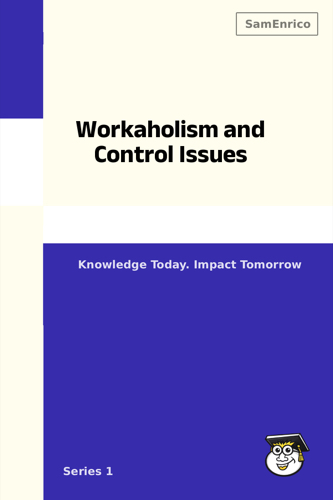
Workaholism and Control Issues
Explores how need for control drives overwork and
by Case Chantay
Explores how need for control drives overwork and offers acceptance and surrender practices.
Formats
About this book
Free sample
Chapter 1: The Compensation Contract--The first time you remember feeling safe, what did it cost you? Not in dollars—in vigilance. In the quiet, humming alertness that told you to watch, anticipate, and perform before anyone could ask. For most workaholics, safety was never free. It was earned through a contract signed before you knew what a contract was, written in a language of tears, raised voices, or worse—the silence that meant you had somehow failed again.
This chapter is about that contract: how it formed, why you still honor it, and what it costs you every single day you mistake overwork for love.The Unseen Agreement Every workaholic carries inside them an invisible document. It has no ink and no signature, but its terms are absolute. Psychologists might call it a cognitive schema or an adaptive coping mechanism. Twelve-step programs call it a character defect. But the most accurate name is also the simplest: the compensation contract.A compensation contract is an unconscious agreement you made in childhood, usually before the age of ten, that says: If I am perfect, anticipate every need, and control every outcome, I will be safe from blame, chaos, or abandonment.
You did not write this contract because you were weak. You wrote it because you were smart. You observed your environment—parents who fought, a caregiver who was unpredictable, a household where good news could turn into punishment without warning—and you figured out a survival strategy. You learned that certain behaviors reduced the frequency of bad things happening. You learned that extra effort, extra attention, and extra vigilance could buy you something priceless: predictability.The tragedy is not that you formed the contract.
The tragedy is that you never got to dissolve it. You took it with you from the living room to the classroom, from the classroom to the dorm, from the dorm to the office. And now, thirty years later, you are still working overtime not because you love your job but because somewhere in your nervous system, a child believes that if you stop performing, the floor will fall…
This is the end of the free sample. Get the eBook to keep going. Buy now
Contents
- Chapter 1
- Chapter 2
- Chapter 3
- Chapter 4
- Chapter 5
- Chapter 6
- Chapter 7
- Chapter 8
- Chapter 9
- Chapter 10
- Chapter 11
- Chapter 12
Details
- Author
- Case Chantay
- Publisher
- SamEnrico
- Language
- English
- Genre
- Non-Fiction, Self-Help, Control Issues
- Released
- 2026-06-09
- Pages (approx.)
- 136
- Available as
- eBook, Audiobook

Read better in the ZLOADR app
Your eBooks on your phone or tablet. Sign in with your SamEnrico account and start reading.
More by Case Chantay
 Empathy for Immigrant ExperienceCase Chantay$11.99
 French Revolution MusicCase Chantay$11.99
 Stress and Celiac DiseaseCase Chantay$11.99
 The Outback Aviators: Pioneering the Skies of AustraliaCase Chantay$11.99
 How to Produce Bar ICE PicksCase Chantay$11.99
 How to Become a Lubricating-machine TenderCase Chantay$11.99
 India Manager Gift CultureCase Chantay$12.99
 Cash Drawer ReconciliationCase Chantay$11.99
You may also like
 Stress Induced Control Issues GuideGreenwood Kellye$11.99
 Stress Induced Control FixHartwell Bronwyn$11.99
 Control Loss Anger GuideHer Trinidad$11.99
 Control Release Recovery GuideBoudreau Corrine$11.99
 Car Crash Dream Interpret GuideLangley Eddie$11.99
 Letting Go of Control WorkbookTorres Julian$11.99
 Control Related Anger GuideOrosco Doria$11.99
 Financial Control Freak ReleaseRandolph Alphonso$11.99
 Control Loss TriggersLarsen Ludie$11.99
 The Letting Go of Control GuideCanales Anya$11.99