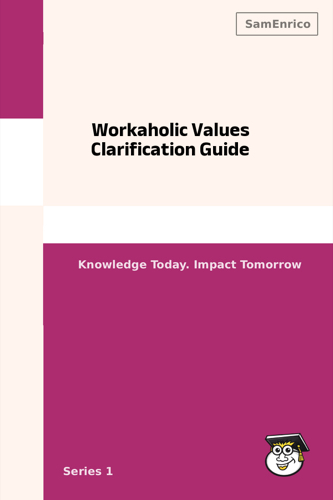
Workaholic Values Clarification Guide eBook
Identify personal values that conflict with overwo
by Metzger Suk
Identify personal values that conflict with overwork and align behavior accordingly.
Formats
Free sample
Chapter 1: The Identity Mirage--–- The first time Sarah missed her daughter’s school play, she told herself it was a one-time thing. The second time, she told herself the promotion depended on it. By the third time, she stopped making excuses because she had stopped noticing. Her daughter had stopped asking. Somewhere in the fog of back-to-back deadlines, late-night email binges, and the dull ache of exhaustion that had become her baseline, Sarah had stopped being a person who worked hard and started being a person who was her work.
When a colleague asked how she was, she answered with what she was finishing. When her husband planned a weekend away, she felt not excitement but anxiety about lost productivity. When she tried to take a vacation, she spent the first three days sick and the next two checking email from the hotel bathroom. She had become, in every way that mattered to her self-concept, a workaholic. And she had no idea who she would be without it.This chapter is for everyone who has ever felt that quiet, terrifying question lurking beneath the surface of their overstuffed calendar: If I stop working so hard, what’s left of me?
It is for the people who suspect their long hours are not purely about ambition but about something darker—anxiety, shame, avoidance, or the desperate need to feel valuable. And it is for those who have tried to cut back, only to find that the moment they slow down, an unbearable emptiness rushes in to fill the space where work used to be.The central argument of this chapter is simple but profound: the difference between working hard and being a workaholic is not the number of hours you log. It is whether your work has become your identity. When you work hard, work is something you do. When you are a workaholic, work is who you are.
And when work becomes your identity, any threat to your productivity feels like a threat to your very existence. You don’t choose to work late because it’s necessary; you work late because stopping would force you to confront the frightening question of what remains when the tasks are done.This chapter will help you distinguish between value-driven ambition (which can be healthy and fulfilling) and identity-driven overwork (which is never sustainable). It will show you how overwork becomes a proxy for self-worth, safety, and belonging—three fundamental human needs that work was never designed to meet. And it will provide a self-assessment to help you determine whether your work style is driven by authentic values or by shame, anxiety, and escape. By the end of this chapter, you will understand not just the mechanics of workaholism but the psychological architecture beneath it.
And you will be ready to begin the process of untangling who you are from what you do.The Hard Worker Versus the Workaholic: A Crucial Distinction Let us begin with a clarifying question: If you were forced to stop working for one month—completely, no email, no projects, no meetings—would you feel relieved or terrified? The hard worker, even one who is very ambitious, would feel some initial anxiety followed by a sense of opportunity: time for family, hobbies, rest, travel. The workaholic feels existential dread. Without work, they cannot answer the question “Who am I?” They have no other source of self-definition, no alternative identity to step into.This distinction matters because the solutions for overwork depend entirely on which category you fall into. The hard worker may benefit from better boundaries, time management, or delegation.
Their problem is logistical or behavioral. But the workaholic’s problem is existential. You cannot calendar your way out of an identity crisis. You cannot to-do-list your way out of needing to feel valuable. And you cannot time-block your way out of using work to escape from yourself.Here is a simple diagnostic to help you locate yourself on this spectrum.
Answer each question honestly, without justification:When someone asks you to describe yourself, does your job come up in the first two sentences?Do you feel restless, irritable, or anxious on weekends or vacations?Have you missed significant family events (birthdays, holidays, performances) due to work in the past year?Do you check work email or messages within 30 minutes of waking up?Do you feel guilty when you are not working, even if there is nothing urgent to do?Has anyone in your personal life told you that you work too much?Do you have hobbies or interests that have nothing to do with your career?If you retired tomorrow, would you have a clear sense of what you would do with your time?If you answered yes to four or more of these questions, you are likely operating from identity-driven overwork rather than pure ambition. And you are in the right place.How Work Becomes a Proxy for Self-Worth One of the most insidious features of workaholism is that it does not feel like a problem from the inside. It feels like dedication. It feels like responsibility. It feels like being the person everyone can count on.
But beneath that noble veneer, something else is usually operating: the desperate need to prove that you are enough.Here is the psychological mechanism: When you have no internal, stable sense of self-worth, you must constantly earn it from external sources. Work is an excellent source of external validation because it produces measurable, tangible results. You finished the report. You hit the target. You closed the deal.
You stayed late. Each of these achievements produces a brief spike of feeling valuable, capable, worthy. But because the feeling is external and temporary, it fades quickly—and you need another hit. So you work more, achieve more, produce more. But no amount of external achievement can fill an internal void.
This is why workaholism is sometimes called the “rat race for self-esteem”: you can never win, but you can never stop running.Consider the story of James, a corporate lawyer who worked eighty-hour weeks for fifteen years before his body forced him to stop. In his first week of medical leave following a minor heart attack, he called his office seventeen times. When his therapist asked why, he said, “If I’m not working, I’m nobody. I don’t have friends outside work. I don’t have hobbies.
I barely know my kids. Work is the only place I matter.” James had spent nearly two decades using productivity as a substitute for personhood. He had never learned to value himself for anything other than his output. And no amount of success had ever been enough to convince him that he was inherently worthy of love, rest, or attention.The tragic irony is that the workaholic’s strategy for earning self-worth ultimately destroys the very things that could provide it: health, relationships, creativity, and the capacity for joy. You cannot billable-hour your way to feeling loved.
You cannot spreadsheet your way to belonging. And you cannot out-earn the fundamental human need to be valued for who you are, not for what you produce.Work as Safety: The Illusion of Control For many…
This is the end of the free sample. Get the eBook to keep going. Buy now
About this book
Details
- Author
- Metzger Suk
- Publisher
- SamEnrico
- Language
- English
- Genre
- Non-Fiction, Self-Help, Values Work
- Released
- 2026-06-09
- Pages (approx.)
- 150
- Available as
- eBook, Audiobook

Read better in the ZLOADR app
Your eBooks on your phone or tablet. Sign in with your SamEnrico account and start reading.
More by Metzger Suk
 Microbreaks Burnout PreventionMetzger Suk$11.99
 Hale Irwin Grit BiographyMetzger Suk$11.99
 The Membership Site FunnelMetzger Suk$11.99
 Conversation Starters for DatingMetzger Suk$11.99
 The Frozen Depths: Mapping the Lost World of the Java TrenchMetzger Suk$11.99
 Pets.com: The Million-Dollar Puppy That Never WasMetzger Suk$11.99
 GSE MechanicMetzger Suk$11.99
 Product Launch Social MediaMetzger Suk$12.99
 Asana Business Planning GuideMetzger Suk$12.99
 How to Start a Hobby in Rock BalancingMetzger Suk$11.99
 Understanding Chudley–mccullough SyndromeMetzger Suk$17.99