
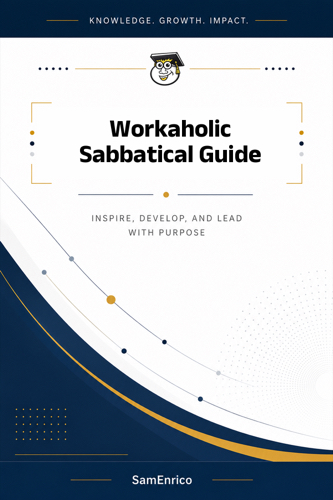
Non-FictionSelf-HelpSabbatical
Workaholic Sabbatical Guide eBook
Plans extended leave for deep reset.
Plans extended leave for deep reset.
Formats
Free sample
Chapter 1: The Golden Handcuffs--–- On a Tuesday morning in March, a forty-two-year-old corporate lawyer named Sarah found herself standing in her closet at 5:47 AM, holding two nearly identical navy blazers. She had been standing there for eleven minutes. Her train left in nineteen minutes. Her daughter needed a signed permission slip. Her husband had asked her twice if she was okay.
And Sarah could not, for the life of her, decide which blazer to wear—not because it mattered, but because her brain had stopped performing even basic executive functions. She would later describe this as the moment she realized that her ambition had become a cage. But at the time, she simply felt tired. Not sleepy-tired. The other kind.
The kind that lives in your bones and tells you that you have already run a marathon and someone is asking you to run another one, uphill, in the dark, for free.Sarah was a workaholic. She had never used that word for herself. She preferred "driven" or "passionate" or "someone who takes their career seriously." But the blazer incident was a symptom of something deeper. For fifteen years, she had built a life that looked, from the outside, like success: partner track, six-figure income, a corner office with actual windows, a house in the suburbs, two children in private school, and a retirement account that financial advisors called "aggressive." What no one saw was the daily arithmetic of exhaustion. The way she calculated how little sleep she could survive on (four hours and twelve minutes, it turned out).
The way she measured her worth in billable hours. The way she felt a spike of panic every Sunday afternoon, not because she dreaded Monday, but because she had already been answering emails since Saturday and still felt behind.Sarah is not unique. She is the reader of this book. She is you, perhaps, or someone you love. And this chapter exists to do one thing: to help you see the cage you are standing in, to name the bars, and to admit that the door has been unlocked this entire time.
You have just been too busy to notice.The Lie of the Corner Office Every workaholic tells themselves a story. The story has variations, but the plot is always the same: I am working this hard because I am building something. I am sacrificing now so I can rest later. I am different from other people—I actually love what I do. The story is seductive because it contains a grain of truth.
You may indeed love aspects of your work. You may be genuinely ambitious. You may have real financial obligations that require a high income. But the story becomes a lie when it stops being a description of your choices and starts being a justification for your suffering.The lie of the corner office is that the view is worth the climb. And for a while, it is.
The first promotion feels like validation. The first bonus feels like proof. The first time someone calls you indispensable, you feel a warmth that no salary can provide. But here is what the story leaves out: the view from the top is mostly just more work. The corner office has windows, but you are too busy to look out of them.
The corner office has a door, but you cannot close it because someone might need you. The corner office has a chair that costs more than some people's rent, but you spend so little time sitting in it that your back hurts from the two hours a day you actually occupy it.The lie is maintained by a conspiracy of silence. Your colleagues are also exhausted, but they pretend otherwise. Your boss praises your work ethic, because your work ethic makes them look good. Your family tells you they understand, because they have learned that arguing with your schedule is like arguing with the weather.
And you, the workaholic, nod along. You tell yourself that this is just what success looks like. You tell yourself that everyone feels this tired. You tell yourself that you will rest next month, next quarter, next year, after the merger, after the launch, after the kids are in college.But next month never comes. The merger leads to a reorg.
The launch leads to the next launch. The kids go to college, and you miss their senior recital because you had a client dinner you could not reschedule. The goalposts keep moving. And you keep running.The Three Drivers: Why You Can't Stop To understand the cage, you must understand what locks it. Through fifteen years of coaching workaholics and analyzing the research on compulsive overwork, I have identified three primary psychological drivers that keep high achievers trapped.
You may recognize yourself in one, two, or all three.Driver One: Validation The first driver is the need for external validation. This is not simple vanity. It is deeper and more desperate. The validation-seeking workaholic has learned, usually early in life, that their worth is contingent on performance. Perhaps they grew up in a household where achievements were celebrated but presence was not.
Perhaps they were the "smart one" or the "responsible one" and learned that love was conditional on产出. Perhaps they were never good enough in someone's eyes and have been trying to prove that person wrong ever since.The validation driver manifests as a hunger that cannot be satisfied. A promotion feels good for about two weeks. Then the workaholic starts worrying about the next level. A bonus feels good until they learn what a colleague made.
A compliment from the boss feels good until they wonder if the boss says the same thing to everyone. The validation seeker is like a person dying of thirst who is handed a glass of salt water: it offers temporary relief, but the underlying need only grows more urgent.Driver Two: Fear of Obsolescence The second driver is the fear of becoming irrelevant, replaceable, or obsolete. This driver is particularly common in industries that change rapidly—technology, finance, law, medicine, consulting. The workaholic believes, often unconsciously, that if they stop working, even for a short time, they will fall behind permanently. They imagine their skills degrading.
They imagine younger, hungrier colleagues passing them by. They imagine the company discovering that they were never essential at all.This driver creates a peculiar kind of exhaustion: the exhaustion of constantly proving that you still belong. The fear of obsolescence workaholic never feels secure. Every email unanswered is a potential sign of dropping the ball. Every project delegated is a risk that someone will discover they are not the only one who can do the work.
Every vacation is a test of whether the company will collapse without them—or worse, whether the company will run just fine, revealing that they were never as important as they thought.Driver Three: Golden Handcuffs The third driver is the most material and therefore the most seductive. Golden handcuffs refer to the lifestyle that requires relentless earning. A mortgage on a house you cannot afford without your bonus. Private school tuition. Car payments.
Vacation expectations. Retirement contributions. The golden handcuffs workaholic has built a life that depends on their income, and that income…
This is the end of the free sample. Get the eBook to keep going. Buy now
About this book
Details
- Author
- Diamond Tristan
- Publisher
- SamEnrico
- Language
- English
- Genre
- Non-Fiction, Self-Help, Sabbatical
- Released
- 2026-06-08
- Pages (approx.)
- 135
- Available as
- eBook, Audiobook

Read better in the ZLOADR app
Your eBooks on your phone or tablet. Sign in with your SamEnrico account and start reading.
More by Diamond Tristan
 Understanding Compulsive Overeating PatternsDiamond Tristan$11.99
 Titanic Stern Section AnalysisDiamond Tristan$11.99
 Small Talk for Professional ConferencesDiamond Tristan$11.99
 Alzheimer's Early Onset CrisisDiamond Tristan$11.99
 The Anger and Resentment GuideDiamond Tristan$11.99
 Attention TrainingDiamond Tristan$11.99
 Asking For Help GuideDiamond Tristan$11.99
 Anansi the Weaver and the Round TableDiamond Tristan$11.99
 The Alchemist and the Astronomer: A Love Written in the StarsDiamond Tristan$11.99
 How to Produce Hockey GoalsDiamond Tristan$11.99
 How to Produce Tanning ProductsDiamond Tristan$11.99
 International Franchise Marketing FundDiamond Tristan$12.99
You may also like
 Hong Kong Handover 1997Dunn Johnnie$11.99
 Zumba For Postnatal Recovery CourseNeal Christian$11.99
 Zumba for BeginnersLadner Nikia$11.99
 YouTube Comment Mining GuideHumes Pandora$12.99
 Worry Box MeditationCarlin Rudy$11.99
 Workplace Stress MeditationNguyen Lynn$11.99
 Workplace Stress and Sleep RepairHawley Ivory$11.99
 Workplace Perfectionism CureDelaney Jeffry$11.99
 Workplace Injustice Anger GuideWallen Isabelle$11.99
 Work Addiction and Burnout LinkGreenwood Ester$11.99
 Women in Yoga and WellnessBeattie Galina$11.99
 Women in Stand Up ComedyChun Evangeline$11.99