
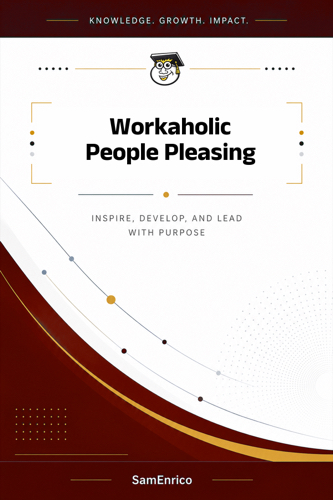
Non-FictionSelf-HelpPeople Pleasing
Workaholic People Pleasing eBook
Stop overworking to make others happy using this p
Stop overworking to make others happy using this practical guide.
Formats
Free sample
Chapter 1: The Kindness Kryptonite--–- Megan had just put her toddler to bed when her phone lit up with a group chat from her volunteer committee. "Does anyone have bandwidth to finish the grant application? Deadline is tomorrow at 9 AM and Sarah had an emergency." Megan had already worked a full day at her marketing job, had already skipped lunch to cover for a sick colleague, had already said yes to making cupcakes for the school bake sale. Her back ached. Her eyes blurred when she focused on the screen.
And yet, before she could think, her thumbs were typing: "I can do it. Send it over." She worked until 1 AM, submitted the application, and collapsed into bed. The next morning, a message from the committee chair: "You're a lifesaver, Megan!" That was the moment she realized something was deeply wrong. Not because she felt angry. Because she felt nothing at all.This is a book about the people who are admired for all the wrong reasons.
You are the one who always says yes. The one who stays late, shows up early, and never complains. The one everyone describes as "so reliable," "such a team player," "the backbone of this place." You have heard these compliments your entire life—from teachers, bosses, partners, friends, and family. They feel good, in the same way that a sugar rush feels good: briefly, intensely, and followed by a crash you cannot explain. You have built an identity around being helpful, and that identity has earned you promotions, loyalty, invitations, and praise.
So why do you feel so hollow?The answer is uncomfortable, and this chapter exists to make that discomfort unavoidable. Your kindness, as you have been practicing it, is not kindness at all. It is a survival strategy. It is a shield. It is a currency you trade for safety, approval, and the temporary relief of not being seen as difficult.
I call it the Kindness Kryptonite—because what looks like your greatest strength is actually the thing that is quietly, systematically, destroying you. And like kryptonite, it does not kill you quickly. It weakens you gradually, eroding your energy, your health, your relationships, and eventually, your ability to know what you actually want.This chapter is not here to make you feel bad about yourself. You have spent enough time feeling bad. This chapter is here to help you see clearly, because you cannot change a pattern you refuse to name.
We will begin by dismantling the most seductive lie of workaholic people-pleasing: the myth that your overwork is a kindness to others. Then we will introduce the concept of the "approval hangover"—the emotional crash that follows every fear-driven yes. You will learn to recognize the five hidden ways you are abandoning yourself every single day, often in moments that look like generosity. And you will take the first step toward recovery: distinguishing between a genuine yes (which costs you nothing) and a compulsive yes (which costs you everything).Let me be direct with you. If you are reading this book, you have probably already tried to change.
You have probably read articles about burnout. You have probably watched TED Talks about boundaries. You have probably told yourself that next week will be different. And then someone asked you for a favor, and you said yes before you could stop yourself. That is not a failure of willpower.
That is the Kindness Kryptonite at work. It has rewired your brain to treat other people's needs as emergencies and your own needs as optional. The good news is that neuroplasticity works both ways. What has been learned can be unlearned. But first, you have to see the kryptonite for what it is.The Great Lie: Your Overwork Is Not Kindness Let me tell you a story about Jennifer, a client who came to me after her second stress-related shingles outbreak in eighteen months.
Jennifer was a high school principal. She arrived at school at 6:30 AM, left at 7:30 PM, and spent her evenings answering emails from parents and teachers. She never said no to a meeting request. She never said no to a favor. She believed, with absolute sincerity, that this made her a good principal and a good person.
And in many ways, she was right. Her staff loved her. Her students succeeded. Her parents trusted her. But Jennifer had not taken a sick day in four years.
She had not had dinner with her spouse without checking her phone in two years. She had stopped exercising. She had stopped reading fiction, which had once been her greatest joy. She was admired by everyone and known by no one.When I asked Jennifer who in her life benefited from her overwork, she immediately listed her staff, her students, and her family. Then I asked her a different question: who in her life was harmed by her overwork?
She went silent. The answer, of course, was Jennifer. Her overwork was not kindness to others; it was slow violence against herself. And here is the paradox that this entire book will return to again and again: your overwork is not actually helping the people you think it is helping. It is teaching them to rely on you instead of developing their own capacity.
It is creating a system where you are indispensable, which sounds good but is actually a trap. Indispensable people cannot take vacations. Indispensable people cannot get sick. Indispensable people cannot have boundaries. When you make yourself indispensable, you are not being kind.
You are being a bottleneck.Consider the colleague whose work you keep doing. Every time you cover for them, you rob them of the opportunity to learn, to fail, to improve, or to ask for help from someone with appropriate capacity. Consider the friend who calls you every night to vent. Every time you listen past your own exhaustion, you rob them of the chance to develop other supports or to learn that you have needs too. Consider the family member who expects you to organize every holiday.
Every time you say yes to the eleventh hour request, you rob them of the experience of planning, of contributing, of seeing that the world does not end when they have to do the work themselves. Your overwork is not kindness. It is a form of control disguised as generosity. You are not helping. You are enabling.I know that sounds harsh.
I am saying it because the gentle approach has not worked. You have been told to "be kinder to yourself" and "set better boundaries" and "practice self-care." Those phrases have become hollow, another set of shoulds to feel guilty about failing. So let me say it plainly: your constant yes is not a virtue. It is a symptom. And the first step toward recovery is admitting that your kindness kryptonite has made you less kind—to yourself, yes, but also, paradoxically, to others.
Because the exhausted, resentful, secretly furious version of you is not the version anyone actually needs. The version of you who says yes to everything cannot show up fully for anything. You are stretched so thin that you are transparent. And transparency is not…
This is the end of the free sample. Get the eBook to keep going. Buy now
About this book
Details
- Author
- Ryan Guadalupe
- Publisher
- SamEnrico
- Language
- English
- Genre
- Non-Fiction, Self-Help, People Pleasing
- Released
- 2026-06-09
- Pages (approx.)
- 130
- Available as
- eBook, Audiobook

Read better in the ZLOADR app
Your eBooks on your phone or tablet. Sign in with your SamEnrico account and start reading.
More by Ryan Guadalupe
 The B Vitamin Complex GuideRyan Guadalupe$11.99
 Mnemonic Journal PracticeRyan Guadalupe$11.99
 Intention Setting MorningRyan Guadalupe$11.99
 Physical Activity Burnout RecoveryRyan Guadalupe$11.99
 Jumia Warehouse Storage GuideRyan Guadalupe$12.99
 Veterinarian Imposter GuideRyan Guadalupe$11.99
 Influence For Human ResourcesRyan Guadalupe$11.99
 Burn Community ResourcesRyan Guadalupe$11.99
 Quantum Horizons: The Explorers Who Redrew the WorldRyan Guadalupe$11.99
 The Lion Engineers of Aksum: Building Bridges to the WorldRyan Guadalupe$11.99
 English Setter: Gentle & BirdyRyan Guadalupe$11.99
 How to Produce Flags and WindsocksRyan Guadalupe$11.99
You may also like
 Hong Kong Handover 1997Dunn Johnnie$11.99
 Zumba For Postnatal Recovery CourseNeal Christian$11.99
 Zumba for BeginnersLadner Nikia$11.99
 YouTube Comment Mining GuideHumes Pandora$12.99
 Worry Box MeditationCarlin Rudy$11.99
 Workplace Stress MeditationNguyen Lynn$11.99
 Workplace Stress and Sleep RepairHawley Ivory$11.99
 Workplace Perfectionism CureDelaney Jeffry$11.99
 Workplace Injustice Anger GuideWallen Isabelle$11.99
 Work Addiction and Burnout LinkGreenwood Ester$11.99
 Women in Yoga and WellnessBeattie Galina$11.99
 Women in Stand Up ComedyChun Evangeline$11.99