
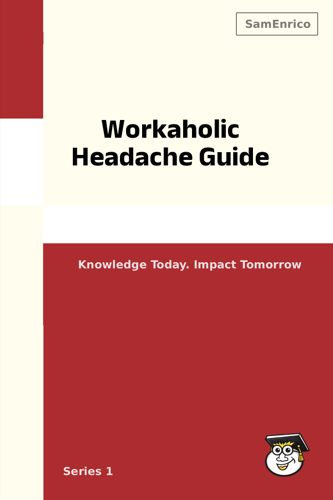
Workaholic Headache Guide eBook
Manages tension and migraine from overwork.
Manages tension and migraine from overwork.
Formats
Free sample
Chapter 1: The Promotion That Hurt--–- The email arrived at 9:47 AM on a Tuesday. You had been waiting for it for eleven months. When it finally appeared in your inbox—"Congratulations" in the subject line, a signature block with a fancier title, a salary increase that would make your parents proud—you felt exactly three seconds of joy. Then your left temple started to throb.This is the opening scene for hundreds of thousands of high-performers every year. The promotion you sacrificed for.
The bonus you earned. The recognition you deserved. And instead of champagne and celebration, you get an ice pack, a dark room, and the familiar sensation of your own body betraying you at the exact moment you should feel most victorious.There is a name for this phenomenon. The medical literature calls it a stress-induced migraine. Your colleagues call it "working hard." Your boss calls it "dedication." Your body calls it something else entirely: a signal that your operating strategy is failing.This chapter is not about how to work less.
It is not a manifesto for quitting your job and moving to a cabin in the woods. It is not another meditation app recommendation or a guilt trip about "work-life balance" from someone who has never had to make payroll. This chapter is about something far more practical and, for the workaholic brain, far more useful: understanding exactly why the behaviors that earn you promotions are the same behaviors that send you to the bathroom floor with an ice pack on your neck.The central contradiction of the modern knowledge worker can be stated in a single sentence: the traits that make you valuable in the workplace are the same traits that make you vulnerable to chronic head pain. Your relentless focus? It creates sustained muscle contraction in your neck and shoulders.
Your willingness to skip lunch and work through breaks? It dysregulates your blood sugar and triggers vascular instability. Your habit of answering emails at midnight? It floods your brain with cortisol exactly when it should be powering down for repair.Your headaches are not random. They are not bad luck.
They are not a sign that you are weak or broken or somehow less capable than your peers who seem to grind without consequence. Your headaches are precise biological memos from a nervous system that has run the numbers and concluded: this is unsustainable.The Reward-Pain Loop To understand why success hurts, you must first understand something that corporate culture will never tell you: the human nervous system did not evolve for spreadsheets, deadlines, quarterly reviews, or unlimited PTO policies. Your brain evolved for predators, famines, and tribal warfare. When your amygdala—the ancient fear center buried deep in your temporal lobe—detects a threat, it cannot tell the difference between a saber-toothed tiger and a passive-aggressive email from your boss. The response is identical.This is called the amygdala hijack, a term coined by psychologist Daniel Goleman.
When a deadline looms, your amygdala activates before your prefrontal cortex (the rational, planning part of your brain) can intervene. The result: your body prepares for physical combat. Your heart rate increases. Your muscles tense, particularly the trapezius muscles that run from the base of your skull to your shoulders. Your blood vessels constrict and dilate in specific patterns.
And your trigeminal nerve—the largest cranial nerve, responsible for sensation in your face and the motor functions of chewing—becomes inflamed.Here is where the reward-pain loop becomes cruel. The same hyper-arousal that allows you to focus intensely on a complex task—tuning out distractions, hyper-ventilating slightly, narrowing your attention to a single point—is physiologically indistinguishable from the stress response that triggers migraines. Your brain cannot give you focus without also giving you the chemical cascade that leads to pain. The difference is duration and recovery.A healthy stress response looks like this: threat detected, chemicals released, action taken, threat resolved, nervous system returns to baseline. This entire cycle takes minutes.
A workaholic's stress response looks very different: threat detected at 9 AM (the quarterly report is due Friday), chemicals released, action taken (work through lunch), threat not resolved (the report is not done, and now there is also tomorrow's presentation), more chemicals released, no return to baseline. By Friday, your cortisol levels are four times higher than when the week began. By Saturday morning, when you finally stop moving, the crash arrives.This is not a moral failing. It is not a lack of resilience. It is basic biology.
Cortisol and adrenaline are designed to be metabolized through physical movement. You are supposed to run from the tiger, then rest. When you sit at a desk for twelve hours, the chemicals circulate, building on themselves, inflaming every tissue they touch. The trigeminal nerve, which wraps around your temples like a crown of thorns, is particularly vulnerable to this chemical bath. When it becomes inflamed, it sends pain signals to the forehead, the eyes, the jaw, and the back of the skull.The Difference Between Engagement and Addiction Before we go any further, a critical distinction must be made.
Not everyone who works hard is a workaholic. Not every long hour leads to a migraine. The difference between healthy high performance and pathological overwork is not visible from the outside. It is an internal distinction, measured not by output but by relationship to work.Healthy work engagement has three defining characteristics. First, it is energizing.
You finish a hard day feeling tired but satisfied, not depleted and hollow. Second, it is bounded. When you leave work, you leave work—not just physically but mentally. You are not reviewing email in the shower or rehearsing tomorrow's meeting while brushing your teeth. Third, it is restorative.
After rest, you feel genuinely recovered, not guilty about resting.Work addiction looks very different. The compulsive overworker experiences work not as a choice but as a compulsion. You work not because you want to but because stopping feels dangerous. The defining feature of addiction—whether to alcohol, gambling, or work—is continued use despite negative consequences. Your headaches are a negative consequence.
So is your strained relationship with your partner. So is the fact that you cannot remember the last weekend you spent without pain. If you are still working at the same intensity despite these costs, you are not dedicated. You are addicted.The research on workaholism is clear. A 2016 study published in the Journal of Occupational Health Psychology followed 1,600 workers over three years and found that workaholics—defined as those who worked compulsively and had difficulty disconnecting—had significantly higher rates of migraine, tension headache, and insomnia than high-performing non-workaholics who worked similar hours but without the compulsive element.
The difference was not hours worked. It was the relationship to those hours.Take the case of Maria, a partner at a law firm who came to see a headache specialist after fifteen years of weekend migraines. Maria worked sixty to seventy hours per week, which was not unusual for her firm. Her colleagues worked similar hours but did not experience the same debilitating Saturday morning crashes. The difference, it turned out, was not workload.
It was what Maria did during her work hours that her colleagues did not.Maria never took a lunch break. She…
This is the end of the free sample. Get the eBook to keep going. Buy now
About this book
Details
- Author
- Arevalo Claudine
- Publisher
- SamEnrico
- Language
- English
- Genre
- Non-Fiction, Self-Help, Headache
- Released
- 2026-06-06
- Pages (approx.)
- 136
- Available as
- eBook, Audiobook

Read better in the ZLOADR app
Your eBooks on your phone or tablet. Sign in with your SamEnrico account and start reading.
More by Arevalo Claudine
 Lavender Field RestArevalo Claudine$11.99
 Walking Meditation For Tai ChiArevalo Claudine$11.99
 Apollo Agriculture ExitArevalo Claudine$12.99
 Grief Exposure TherapyArevalo Claudine$11.99
 Small Talk for Car RidesArevalo Claudine$11.99
 Setting Boundaries With ParentsArevalo Claudine$11.99
 GAD And Travel AnxietyArevalo Claudine$11.99
 GAD And DepressionArevalo Claudine$11.99
 Hippocrates: The Birth of Medical EthicsArevalo Claudine$11.99
 Bloodlines and Bullets: The Copycat Mafia Wars of MedellínArevalo Claudine$11.99
 Mastering The Art of SumoArevalo Claudine$11.99
 How to Produce Tablet Computer Screens and Screen DigitizersArevalo Claudine$11.99
You may also like
 Hong Kong Handover 1997Dunn Johnnie$11.99
 Zumba For Postnatal Recovery CourseNeal Christian$11.99
 Zumba for BeginnersLadner Nikia$11.99
 YouTube Comment Mining GuideHumes Pandora$12.99
 Worry Box MeditationCarlin Rudy$11.99
 Workplace Stress MeditationNguyen Lynn$11.99
 Workplace Stress and Sleep RepairHawley Ivory$11.99
 Workplace Perfectionism CureDelaney Jeffry$11.99
 Workplace Injustice Anger GuideWallen Isabelle$11.99
 Work Addiction and Burnout LinkGreenwood Ester$11.99
 Women in Yoga and WellnessBeattie Galina$11.99
 Women in Stand Up ComedyChun Evangeline$11.99