
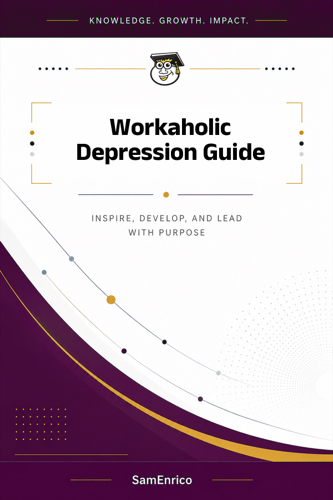
Non-FictionSelf-HelpDepression
Workaholic Depression Guide eBook
Address low mood that fuels or results from overwo
Address low mood that fuels or results from overworking using this guide.
Formats
Free sample
Chapter 1: The Best-Dressed Problem--–- The email arrived at 11:47 PM on a Tuesday. "Congratulations on the promotion," it read. "Your dedication is an inspiration to the entire team." Sarah closed her laptop and sat in the dark of her home office, the blue light still ghosting across her face. She had just worked sixteen hours straight, eaten a protein bar for dinner, and missed her daughter's school play for the third time this year. She was thirty-seven years old, had recently been prescribed her first antidepressant, and could not remember the last time she had laughed without checking her phone immediately afterward.
She was, by every external metric, a success story. And she was falling apart.This is the paradox of the workaholic. When an alcoholic stumbles into work still drunk from the night before, colleagues worry. When a gambler empties their savings account, friends intervene. But when Sarah works sixteen hours, skips meals, cancels plans, and runs herself into exhaustion, she gets promoted.
She gets applause. She gets a feature in the company newsletter under the headline "Going Above and Beyond." The very behaviors that destroy her are the behaviors that earn her admiration. Work addiction is the best-dressed problem of the twenty-first century, and it is quietly killing millions of people who believe they are just ambitious.This chapter exists to rip off the disguise. By the time you finish reading, you will understand why your overwork feels different from ordinary hard work, why society keeps rewarding you for self-destruction, and—most importantly—which door you need to walk through to begin真正的 healing. Because here is the truth that no Linked In influencer will tell you: workaholism is not a badge of honor.
It is a coping mechanism for unaddressed emotional pain. And the longer you wear it, the sicker you become.The High-Performer's Trap Let us begin with a distinction that will save your life if you take it seriously. There is a difference between a hard worker and a workaholic, and the difference is not about hours logged or money earned. It is about choice, compulsion, and what happens when you stop.A hard worker chooses to work intensely. When the workday ends, they end.
They may feel tired, but they do not feel guilty for resting. They may check email after hours occasionally, but they do not feel panicked when they cannot. Their identity is not staked entirely on their output. They work hard because they value excellence, but they also value sleep, relationships, hobbies, and the simple pleasure of doing nothing. They have a switch.
They can turn it off.A workaholic, by contrast, does not choose to work. They are driven to work by an internal discomfort that only work seems to quiet. When they stop working, they feel anxious, restless, worthless, or numb. They check email in bed, at dinner, in the bathroom, during their child's soccer game. Their identity is fused with their productivity—when they work well, they feel like someone; when they work poorly or not at all, they feel like no one.
They do not have a switch. They have a runaway engine.Here is the clinical reality, drawn from the research of Dr. Bryan Robinson and the diagnostic criteria used by Workaholics Anonymous: workaholism is not about loving your job too much. It is about using work to regulate your internal emotional state. You work not because you want to, but because the alternative—stillness, boredom, loneliness, self-reflection—feels unbearable.
Work becomes your primary, and often only, tool for managing anxiety, depression, shame, or grief. And like any tool used too exclusively, it eventually breaks.But here is where the trap snaps shut. Because our culture worships productivity, your workaholism will be rewarded long after it has started destroying you. Your boss will praise your "dedication" while you develop insomnia. Your colleagues will envy your "drive" while you lose the ability to feel joy.
Your family will admire your "success" while you become a ghost at the dinner table. The very people who love you will applaud you into an early grave, because they cannot see the difference between passion and compulsion—and neither can you.The Three Doors: Which One Brought You Here?Here is where most books on workaholism go wrong. They assume there is one cause, one story, one path to recovery. But in my work with hundreds of overworked, depressed professionals, I have found that workaholism enters through three distinct doors. Your door determines your solution.
Walk through the wrong door, and you will spend years treating the symptom while the cause rages on.Door One: The Internal Beliefs Door You walk through this door if your workaholism is driven by what you believe about yourself and the world. These beliefs are often unconscious, installed in childhood or reinforced by a lifetime of achievement pressure. They sound like: "I must be perfect or I am worthless." "Rest is laziness." "My value as a human being equals my professional output." "If I slow down, everything will fall apart."People behind Door One are often high-achieving perfectionists. They were the straight-A students, the star athletes, the children of demanding parents who gave love conditionally. They learned early that achievement earned approval, and approval felt like safety.
Now, as adults, they cannot rest because rest triggers the old terror: if I am not producing, I am not lovable. Their workaholism is a cognitive distortion dressed up as work ethic.If this is your door, your recovery will focus on cognitive restructuring—changing the beliefs that drive your behavior. You will need to learn that your worth is not your output, that rest is not earned but required, and that imperfection is not catastrophe. We will begin this work in Chapter 3.Door Two: The Emotional Avoidance Door You walk through this door if your workaholism is driven by a need to escape painful feelings. You are not working because you believe you should; you are working because when you stop, you feel something you cannot tolerate.
Maybe it is grief from a loss you never processed. Maybe it is loneliness that emerges when the distractions fade. Maybe it is a low-grade depression that work temporarily numbs.People behind Door Two are often emotionally avoidant. They may have grown up in households where feelings were dismissed or dangerous. They learned to distract, to busy themselves, to stay in motion because stillness invited unwanted visitors.
Their workaholism is a mood-regulation strategy—ineffective in the long term but effective enough in the moment to keep them trapped.If this is your door, your recovery will focus on distress tolerance and emotional processing. You will need to learn that feelings are not emergencies, that you can sit with discomfort without dying, and that the emotions you are avoiding are not your enemies but your messengers. Chapter 2 will help you map your emotional cycles.Door Three: The Environmental Pressure Door You walk through this door if your workaholism is driven primarily by your workplace culture. You are not a perfectionist by nature. You are not avoiding deep emotional pain.
You are simply employed by an organization that demands what no human can sustainably give. You are expected to reply…
This is the end of the free sample. Get the eBook to keep going. Buy now
About this book
Details
- Author
- Kruger Norberto
- Publisher
- SamEnrico
- Language
- English
- Genre
- Non-Fiction, Self-Help, Depression
- Released
- 2026-06-06
- Pages (approx.)
- 104
- Available as
- eBook, Audiobook

Read better in the ZLOADR app
Your eBooks on your phone or tablet. Sign in with your SamEnrico account and start reading.
More by Kruger Norberto
 Morning Routine Audio GuideKruger Norberto$11.99
 Real vs Reel Social MediaKruger Norberto$11.99
 The Calcium HandbookKruger Norberto$11.99
 Forgetting Curve MasteryKruger Norberto$11.99
 Loci for Memory AthletesKruger Norberto$11.99
 Influence For Social WorkersKruger Norberto$11.99
 Algerian War IndependenceKruger Norberto$11.99
 Vince Lombardi: The Blueprint for GreatnessKruger Norberto$11.99
 Beanie Babies: The Million-Dollar Stuffed Craze That Took the World by StormKruger Norberto$11.99
 How to Produce Saxophone MouthpiecesKruger Norberto$11.99
 How to Produce FlagstoneKruger Norberto$11.99
 English Toy Spaniel: Sweet & QuietKruger Norberto$11.99
You may also like
 Hong Kong Handover 1997Dunn Johnnie$11.99
 Zumba For Postnatal Recovery CourseNeal Christian$11.99
 Zumba for BeginnersLadner Nikia$11.99
 YouTube Comment Mining GuideHumes Pandora$12.99
 Worry Box MeditationCarlin Rudy$11.99
 Workplace Stress MeditationNguyen Lynn$11.99
 Workplace Stress and Sleep RepairHawley Ivory$11.99
 Workplace Perfectionism CureDelaney Jeffry$11.99
 Workplace Injustice Anger GuideWallen Isabelle$11.99
 Work Addiction and Burnout LinkGreenwood Ester$11.99
 Women in Yoga and WellnessBeattie Galina$11.99
 Women in Stand Up ComedyChun Evangeline$11.99