
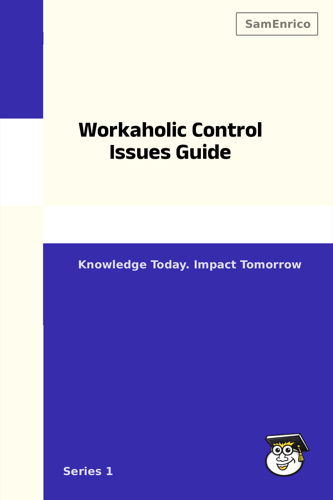
Non-FictionSelf-HelpControl Release
Workaholic Control Issues Guide eBook
Release the need to micromanage every task using t
Release the need to micromanage every task using this practical workbook.
Formats
Free sample
Chapter 1: The Control Trap--–- You answer emails at 11:47 PM on a Friday, not because anyone asked, but because the red notification badge on your phone feels like an accusation. You review your team’s work after they have already submitted it, finding tiny errors that don’t matter—a misplaced comma here, a slightly off font size there—and you fix them yourself because it’s faster than explaining. You tell yourself you are being diligent. You tell yourself you are the only one who cares enough. You tell yourself that if you stop, everything will fall apart.This chapter is not about laziness.
It is not about lowering your standards or becoming the kind of manager who shrugs while the ship sinks. This chapter is about a much more uncomfortable possibility: that your need to control every variable is not making things better. It is making things worse. And you have been rewarded for it your entire career, which is precisely why you cannot see the problem.Let me tell you about David. David was a regional sales director for a mid-sized software company.
He was the first person in the office and the last to leave. He reviewed every proposal his team sent to clients, sometimes staying up until 2 AM rewriting entire sections. His team stopped making decisions without his approval because every time they tried, he changed their work anyway. His boss praised him for his “attention to detail” and “commitment to excellence.” David was promoted three times in five years.Then David’s wife left him. His doctor told him his blood pressure was dangerously high.
His team’s turnover rate hit forty percent. And David still could not stop.The problem with workaholic control issues is that they are invisible to the person who has them. Unlike substance abuse, where the negative consequences are obvious and immediate, the consequences of over-control are delayed and diffused. Your team suffers in silence. Your family learns not to expect you at dinner.
Your body sends signals you ignore. And all the while, your organization gives you bonuses and awards and tells you that you are indispensable.This chapter will help you see what you have been unable to see. By the end, you will understand the difference between productive intensity and destructive control. You will identify which of the three control archetypes fits you best. You will complete a diagnostic assessment that will give you a baseline score to track your progress through this book.
And most importantly, you will begin to question a belief you have held for years: that your control is the only thing holding everything together.The High-Functioning Addict Workaholism is the only addiction that comes with a corner office. No one throws an intervention for the person who works sixteen-hour days. No one sends a concerned email about the manager who reviews every document three times. Instead, we give them awards. We put them on magazine covers.
We ask them to speak at conferences about their “secrets to success.”This is the first and most dangerous barrier to change. You have been reinforced for your controlling behavior hundreds or thousands of times. Every time you caught a mistake that no one else saw, you felt a rush of validation. Every time your boss praised your thoroughness, you felt a surge of pride. Every time a project succeeded because you intervened at the last minute, you thought, “See?
I was right to check.”But here is what you did not see: the mistakes you never caught because you were too busy checking other things. The projects that succeeded despite your intervention, not because of it. The team members who stopped trying because they learned that their work would be redone anyway. The ideas that never got generated because your team was waiting for your approval instead of thinking for themselves.The research on workaholism is clear: it is not correlated with better outcomes. A meta-analysis of forty-three studies found that workaholism is associated with higher burnout, worse physical health, poorer family functioning, and—most surprisingly—no significant increase in job performance.
Working harder does not mean working smarter. Controlling more does not mean achieving more.Yet the myth persists because of a cognitive bias called the “illusion of control.” When things go well, we attribute the success to our own actions. When things go wrong, we attribute the failure to external factors. The micromanager who reviews every detail believes that the project succeeded because of their review, ignoring the possibility that the team would have succeeded anyway. The workaholic who answers emails at midnight believes that their responsiveness prevented a crisis, ignoring the crises that never happened because the team was waiting for them to respond.The first step out of this trap is to recognize that you are in it.
This chapter is that recognition.Productive Intensity vs. Destructive Control Not all hard work is workaholism. Not all attention to detail is micromanagement. The key distinction is between productive intensity and destructive control.Productive intensity is temporary, focused effort on a clear goal, followed by recovery. The surgeon who performs a twelve-hour operation is not a workaholic; they are intensely focused on a specific task with a defined endpoint.
The athlete who trains for six hours a day before a competition is not addicted to exercise; they are preparing for a known event. The manager who stays late for one week to close a quarterly deal is not a micromanager; they are responding to a temporary surge in demand.Destructive control is chronic, diffuse, and driven by anxiety. It has no off switch. It does not end when the goal is achieved because there is always another goal. It spills over into every domain of life, not because the demands require it, but because the person cannot stop.
The workaholic checks email on vacation not because there is an emergency but because the silence feels wrong. The micromanager reviews completed work not because errors are likely but because the act of reviewing reduces their anxiety.Here is a diagnostic question: When was the last time you felt truly finished? Not “finished enough to move to the next task,” but finished—complete, satisfied, able to stop without guilt. If you cannot remember, you are likely operating in destructive control.Another diagnostic question: Does your intensity have an off ramp? If you knew with absolute certainty that no negative consequences would occur if you stopped working for three days, would you stop?
Or would you keep working anyway because the work itself has become the point? The ability to disengage is the single best predictor of whether hard work is healthy or destructive.The Three Control Archetypes Through years of research and clinical practice, I have identified three distinct patterns of workaholic control. Most readers will recognize themselves in one of these archetypes, though some will see elements of two or three. Read each description carefully and note which resonates most strongly.Archetype One: The Perfectionist The Perfectionist is driven by a terror of mistakes. They believe that any error, no matter how small, is catastrophic.
A typo in an internal email feels like a career-ending disaster. A slightly off-color in a presentation slide feels like…
This is the end of the free sample. Get the eBook to keep going. Buy now
About this book
Details
- Author
- Barrios Gregory
- Publisher
- SamEnrico
- Language
- English
- Genre
- Non-Fiction, Self-Help, Control Release
- Released
- 2026-06-06
- Pages (approx.)
- 142
- Available as
- eBook, Audiobook

Read better in the ZLOADR app
Your eBooks on your phone or tablet. Sign in with your SamEnrico account and start reading.
More by Barrios Gregory
 Social Media Boundaries GuideBarrios Gregory$11.99
 Body Scan Morning PracticeBarrios Gregory$11.99
 The Omega 3 Fatty Acid GuideBarrios Gregory$11.99
 Kwame Nkrumah Pan African VisionBarrios Gregory$11.99
 Persuasion For EngineersBarrios Gregory$11.99
 Burn Hydration NeedsBarrios Gregory$11.99
 The Gladiator Games of Pompeii: Blood, Art, and the Birth of SpectacleBarrios Gregory$11.99
 The Silent Revolution: How the Women of Greenham Common Changed the WorldBarrios Gregory$11.99
 How to Start a Cotton-type Fabrics Business (Beginners Guide)Barrios Gregory$11.99
 A Collector's Handbook to the Austin 3000 Mk IiBarrios Gregory$11.99
 Intel SAFe for Chip StartupsBarrios Gregory$12.99
 Amazon Sales Tax GuideBarrios Gregory$12.99
You may also like
 Hong Kong Handover 1997Dunn Johnnie$11.99
 Zumba For Postnatal Recovery CourseNeal Christian$11.99
 Zumba for BeginnersLadner Nikia$11.99
 YouTube Comment Mining GuideHumes Pandora$12.99
 Worry Box MeditationCarlin Rudy$11.99
 Workplace Stress MeditationNguyen Lynn$11.99
 Workplace Stress and Sleep RepairHawley Ivory$11.99
 Workplace Perfectionism CureDelaney Jeffry$11.99
 Workplace Injustice Anger GuideWallen Isabelle$11.99
 Work Addiction and Burnout LinkGreenwood Ester$11.99
 Women in Yoga and WellnessBeattie Galina$11.99
 Women in Stand Up ComedyChun Evangeline$11.99