
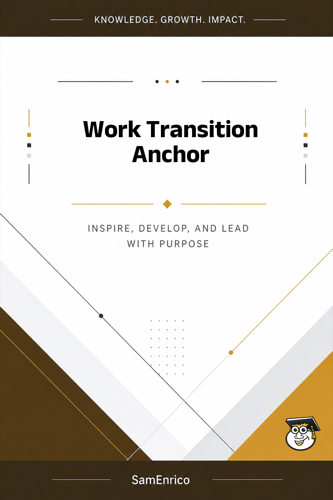
Work Transition Anchor eBook
Install mental shift between home and work modes.
Install mental shift between home and work modes.
Formats
Free sample
Chapter 1: The Invisible Thief...--The first time I noticed the thief, I was standing in my kitchen with a spatula in one hand and a dead smartphone in the other. My daughter was telling me about her day—something about a playground dispute involving a purple crayon and an unspoken rule about whose turn it was to slide first—and I realized I had not heard a single word she had said. I had been composing an email in my head. A follow-up to a client who had asked a question at 4:47 PM, which I had answered at 4:52 PM, but which I was now, at 6:30 PM, rewriting because I had decided my original response was insufficiently diplomatic. My body was in the kitchen.
My hand was flipping a pancake. My eyes were looking at my daughter’s mouth moving. But my mind was forty-five minutes in the past, sitting in front of a glowing rectangle, worrying about a subjunctive clause.The thief had struck again.I call it the Invisible Thief because it leaves no physical evidence. You cannot photograph it. You cannot install an alarm system against it.
You cannot point to a security camera and say, “There. That is when it happened.” The thief steals something far more valuable than jewelry or cash. It steals your presence. It steals the gap between work and home. It steals the silence where a transition is supposed to live.And here is the most disturbing part: you invite it in.Every time you check your email while helping with homework, you open the door.
Every time you answer a Slack message from the dinner table, you set out a welcome mat. Every time you say “just one more thing” before closing your laptop, you pour the thief a glass of wine and offer it a comfortable chair. The thief does not break in. It walks through the front door that you left unlocked, hangs up its coat, and makes itself at home in the space between your ears.This chapter is about naming that thief, understanding how it operates, and—most importantly—learning that the problem is not your workload, your boss, or your lack of discipline. The problem is the absence of a ritualized transition.
And that absence has a name, a mechanism, and a cure.The Commute That Never Was Let us begin with a simple fact that sounds like a paradox: the worst thing that ever happened to work-life balance was the elimination of the commute.On its face, this makes no sense. Commuting is universally despised. Traffic jams. Crowded trains. Expensive gas.
Time stolen from sleep, from family, from exercise. For decades, the dream of remote work was precisely the dream of killing the commute. No more losing two hours of your life every day to asphalt and signal delays. No more arriving home already exhausted from the mere act of traveling.And yet.The commute, for all its misery, served one invaluable psychological function that no one appreciated until it was gone. It served as an involuntary buffer.Think about what happened during a typical commute.
You left your workplace—a physical building with a door and a parking lot and a security badge—and you entered a liminal space. The car or the train belonged to neither work nor home. You could not do your job (unless you were dangerously texting while driving). You could not fully be at home (because you were not there yet). So you did something that now seems almost miraculous: you decompressed.
You listened to music. You stared out a window. You let your mind wander. You arrived at your front door not as the same person who had left the office, but as a slightly different version—a version who had spent fifteen or thirty or sixty minutes allowing work thoughts to dissipate like steam from a kettle.That was the involuntary buffer. You did not have to design it.
You did not have to be disciplined about it. You simply got in your car or boarded your train, and the transition happened automatically.Then remote work arrived.The physical commute vanished. And with it, the involuntary buffer vanished too.Now consider what replaced it. For most remote workers, the transition from work to home now takes approximately three seconds. It is the time between closing a laptop and looking up at a family member.
Three seconds. That is not a transition. That is a whiplash. And the human brain was never designed to switch modes that quickly.Cognitive Residue: The Glitter That Ruins Everything I want to introduce a term that will appear throughout this book, and I want to introduce it only once, in full detail, so that we never need to re-explain it. The term is cognitive residue.Imagine that you have spent an afternoon crafting a careful email to a difficult client.
You have weighed every word. You have second-guessed your tone. You have deleted three versions before settling on a fourth that feels just diplomatic enough to avoid offense while still protecting your interests. Finally, at 5:15 PM, you hit send.Now imagine that you close your laptop at 5:30 PM. You walk into the kitchen.
Your partner asks how your day was. And instead of saying “fine” or “busy,” you find yourself still rephrasing that email in your head. Should you have used “respectfully” instead of “unfortunately”? Did you come across as defensive? What if the client misinterprets your tone and escalates to your boss?That is cognitive residue.
It is the persistence of work-related thoughts—tasks, worries, conversations, decisions—after you have physically left the work environment. It is the mental glitter that spills from the work container into the home container, and once it spills, it gets everywhere. It sticks to dinner conversation. It clings to bedtime stories. It attaches itself to the edges of your awareness while you are trying to watch a movie or play a board game or simply sit on the couch and breathe.Cognitive residue is not the same as simply “thinking about work.” Thinking about work is intentional and bounded.
You might choose to reflect on a project while driving home, and then set it aside. Cognitive residue is unintentional and unbounded. It intrudes without permission. It refuses to leave when asked. It operates like a browser tab playing a video in the background while you are trying to read a different page—you can hear it, you are distracted by it, but you cannot quite find the tab to close it.The research on cognitive residue is sobering.
A 2019 study published in the Journal of Applied Psychology followed remote workers over six months and found that those who reported higher levels of cognitive residue also reported significantly lower levels of marital satisfaction, lower quality of sleep, and higher rates of emotional exhaustion—even when their actual working hours were shorter than those of their office-based counterparts. In other words, the problem was not how much they worked. The problem was how poorly they transitioned.Mode Confusion: When the Brain Cannot Decide Cognitive residue has a close cousin, and that cousin is called mode confusion.Mode confusion is what…
This is the end of the free sample. Get the eBook to keep going. Buy now
About this book
Details
- Author
- Browder Mirna
- Publisher
- SamEnrico
- Language
- English
- Genre
- Non-Fiction, Self-Help, Work Life
- Released
- 2026-06-06
- Pages (approx.)
- 134
- Available as
- eBook, Audiobook

Read better in the ZLOADR app
Your eBooks on your phone or tablet. Sign in with your SamEnrico account and start reading.
More by Browder Mirna
 The Empathy ChallengeBrowder Mirna$11.99
 Post Hypnotic Triggers CourseBrowder Mirna$11.99
 International REIT GuideBrowder Mirna$11.99
 Rapid Palace ConstructionBrowder Mirna$11.99
 The ED and Pornography LinkBrowder Mirna$11.99
 Parent of Medically Complex ChildBrowder Mirna$11.99
 ED and Porn Induced DysfunctionBrowder Mirna$11.99
 The Djinn Knight of Camelot: A Saracen’s OathBrowder Mirna$11.99
 Silicon Shadows: The War Beneath the ChipsBrowder Mirna$11.99
 Employment Law: Hiring, Firing & Workplace RightsBrowder Mirna$11.99
 How to Produce FeedBrowder Mirna$11.99
 Pinterest VA Productivity WorkflowBrowder Mirna$12.99
You may also like
 Hong Kong Handover 1997Dunn Johnnie$11.99
 Zumba For Postnatal Recovery CourseNeal Christian$11.99
 Zumba for BeginnersLadner Nikia$11.99
 YouTube Comment Mining GuideHumes Pandora$12.99
 Worry Box MeditationCarlin Rudy$11.99
 Workplace Stress MeditationNguyen Lynn$11.99
 Workplace Stress and Sleep RepairHawley Ivory$11.99
 Workplace Perfectionism CureDelaney Jeffry$11.99
 Workplace Injustice Anger GuideWallen Isabelle$11.99
 Work Addiction and Burnout LinkGreenwood Ester$11.99
 Women in Yoga and WellnessBeattie Galina$11.99
 Women in Stand Up ComedyChun Evangeline$11.99