
Work Life Integration Guide eBook
Blend professional and personal demands without fe
by Kern Tajuana
Blend professional and personal demands without feeling torn or overwhelmed.
Formats
Free sample
Chapter 1: The Balance Trap--–- The first time Elena cried in her car, it was a Tuesday. She had just left the office at 6:47 PM—early, by her standards—after missing her daughter’s school play for the third time in two years. The dashboard clock glowed 7:03 PM. She had forty-two minutes to pick up takeout, help with homework, and pretend she hadn't spent the last hour drafting a response to a client who would probably ignore it until morning. As she sat in the parking lot of the strip mall, phone buzzing with three new emails, she whispered to herself: “I just need to balance things better.
If I could just find the right system, the right calendar, the right amount of willpower, I could do it all.”Elena had read fourteen articles on work-life balance. She had tried time-blocking, pomodoro timers, and a digital detox that lasted exactly one weekend. She had moved her yoga mat into her office, then moved it back out. She had told herself that if she could just be more disciplined, more efficient, more something, she would finally feel like she wasn't failing everyone at once.But here she was. Crying in a Honda Civic, holding a bag of cold pad thai, feeling like a fraud.Elena is not real.
But you know her. You may be her. And the reason Elena cannot find balance is not because she lacks discipline or desire. It is because the thing she is chasing—perfect, equal, static balance—does not exist.This chapter is not about giving you another planner or a morning routine that requires waking up at 4 AM. It is about dismantling the most destructive myth in modern work culture: that you can, should, or ever will achieve a perfect 50/50 split between your professional and personal life.
And then, once that myth is gone, replacing it with something that actually works.The See-Saw That Never Stops Moving Imagine a see-saw. On one side sits Work. On the other side sits Life. The goal of “balance,” as it is commonly sold to us, is to keep both sides perfectly level. Equal weight.
Equal time. No wobbling.Now imagine trying to balance that see-saw while someone adds and removes weight from both sides at random, without warning. A deadline moves up. A child gets sick. A client sends an emergency request at 6 PM.
A parent needs help. Your boss quits, and suddenly you are doing two jobs. Your partner travels for work, and suddenly you are doing two roles at home.The see-saw never stops moving. And every time it tilts, you feel like you have failed.This is the lived experience of millions of working adults. According to a 2023 Gallup survey, 67% of employed adults report feeling “torn” between work and personal responsibilities at least once a week.
Among working parents, that number jumps to 81%. Yet the same survey found that only 12% believe they have achieved “good work-life balance.” The other 88% are chasing a target that research suggests is not just difficult to hit, but definitionally impossible.Why impossible? Because balance implies equilibrium. Equilibrium implies stasis. And stasis does not exist in a human life.
You are not a machine that can be calibrated once and left to run. You are a dynamic, emotional, responsive organism living in a world that is equally dynamic. The very idea of “balance” sets you up to fail because it measures success by the absence of motion—and motion is guaranteed.The Origins of a Toxic Metaphor Where did this metaphor come from? The term “work-life balance” first appeared in the late 1970s in the United Kingdom, used primarily in discussions about workplace flexibility for women with children. It was a progressive idea for its time: acknowledging that workers had lives outside the factory or office.
But the metaphor was borrowed from accounting—balancing ledgers, balancing budgets—and it carried with it the assumption that work and life are opposing forces that must be held in equal tension.By the 1990s, the phrase had exploded. Self-help books, corporate wellness programs, and magazine covers all promised the secret to balance. The unspoken message was always the same: if you cannot balance, the flaw is in you. You are not organized enough, not disciplined enough, not committed enough to your priorities.This is what the philosopher Alain de Botton calls a “cruel optimism”—a cultural promise that sounds good but actually harms you because its fulfillment is impossible. You chase balance, you fail, you blame yourself, you try harder, you fail again.
The cycle does not produce balance. It produces shame, exhaustion, and a quiet sense that you are the only one struggling.You are not.Spillover Theory: The Science of Why Balance Fails Let us introduce a concept that will anchor this entire book: spillover theory. Developed by sociologists Rosalind Barnett and Grace Baruch in the 1980s, and later expanded by researchers like Ellen Ernst Kossek and Patricia Voydanoff, spillover theory describes how emotions, behaviors, skills, and stress flow from one domain of life to another.Here is what spillover theory tells us: you cannot leave work at work. And you cannot leave home at home.When you have a terrible meeting with your boss, your cortisol levels spike. That cortisol does not magically disappear the moment you walk through your front door.
It circulates in your bloodstream for hours, affecting your mood, your patience, and even your immune system. This is negative spillover. Work stress follows you home, and you snap at your partner over nothing.But the reverse is also true. When you have a joyful morning with your children, that feeling of connection and playfulness does not vanish when you sit down at your desk. It shapes how you collaborate with colleagues, how you respond to frustration, and how creative you feel.
This is positive spillover. A happy home life can make you better at work.The key word here is spill. You cannot stop liquid from moving once it has been poured. You can only shape where it flows and what it touches.This is why the see-saw metaphor fails. A see-saw assumes separation.
Work on one side. Life on the other. But spillover theory tells us that work and life are not separate. They are permeable. They bleed into each other constantly, whether you want them to or not.
The question is not how to stop the bleeding. The question is how to make the bleeding work for you.The Guilt Loop: How Balance Culture Tortures You Let us name something that you have almost certainly felt but may not have named: the guilt loop.The guilt loop works like this. You are at work. You think about your child at home, or the laundry that is piling up, or the fact that you have not called your parents in two weeks. You feel guilty for neglecting your personal life.
So you leave work early, or you check out mentally, or you decide to make it up by working from home the next day.Then you are at home. You think about the email you did not send, the deadline that is approaching, the project that needs…
This is the end of the free sample. Get the eBook to keep going. Buy now
About this book
Details
- Author
- Kern Tajuana
- Publisher
- SamEnrico
- Language
- English
- Genre
- Non-Fiction, Self-Help, Work Life Balance
- Released
- 2026-06-08
- Pages (approx.)
- 143
- Available as
- eBook, Audiobook

Read better in the ZLOADR app
Your eBooks on your phone or tablet. Sign in with your SamEnrico account and start reading.
More by Kern Tajuana
 Citation Rules for MLA Only PrimerKern Tajuana$11.99
 Expectation Detox HandbookKern Tajuana$11.99
 Upwork Escrow Protection GuideKern Tajuana$11.99
 GST Registration Amendment Process WorkbookKern Tajuana$11.99
 Single Income Career Transition GuideKern Tajuana$11.99
 Child Star Memoir Literary GuideKern Tajuana$11.99
 Scott Peterson Death Row LettersKern Tajuana$11.99
 Affection During Stress GuideKern Tajuana$11.99
 The Silent Conquerors: The Untold Story of the First All-Female Himalayan ExpeditionKern Tajuana$11.99
 The Meroë Plague Chronicles: Kush's Ancient Medical TriumphsKern Tajuana$11.99
 The Great Penguin Highway: A Waddle Across ContinentsKern Tajuana$11.99
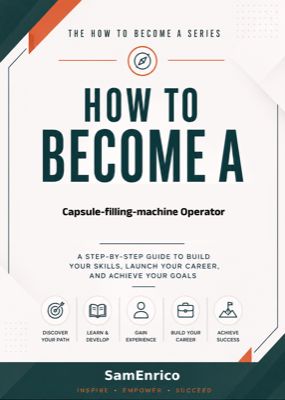 How to Become a Capsule-filling-machine OperatorKern Tajuana$11.99
You may also like
 Workaholism Recovery WorkbookBrowne Lucrecia$11.99
 Work Stress Home Peace ManualFrazier Elena$11.99
 The Remote Work Shutdown RitualCalvin Danyel$11.99
 Requesting Time Off WorkBurchfield Khadijah$11.99
 Parental Anger After Work HoursPritchett Almeta$11.99
 Anger After Work Hours GuideHerring Jonelle$11.99
 Work Life Integration PlanBarclay Milda$11.99
 The Work Life Balance for WorkaholicsRosenberg Inger$11.99
 Work Stress Home SpilloverGordon Debbie$11.99
 WFH Schedule OptimizationAlmeida Dario$11.99
 Work Stress Home Relationship GuideVilla Verline$11.99
 End Of Workday RitualWooten Wen$11.99