
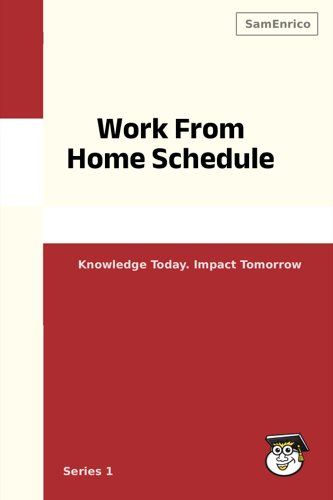
Non-FictionSelf-HelpSchedulingRoutine
Work From Home Schedule eBook
Design daily and weekly routines that maximize rem
by Finch Rhett
Design daily and weekly routines that maximize remote productivity.
Formats
Free sample
Chapter 1: The Panic Clock--Every remote worker knows the feeling. It arrives around 2:47 PM on a Tuesday, though it has no respect for clocks. Your laptop has been open for seven hours. You have switched between email, Slack, a spreadsheet, and a document so many times that you cannot remember what you were originally trying to accomplish. Your neck hurts.
You have not left the house. You ate lunch over the keyboard—something involving bread and crumbs now lodged between the G and H keys. And yet, when you look at your to-do list, you have checked off exactly two items. Neither was the important one.This is the Panic Clock. It is not a real clock.
It is the internal sensation that time is slipping away while you remain stuck in place. It is the feeling of being simultaneously overwhelmed and unproductive. It is the voice that whispers: You have been working all day. Why haven't you done anything?If you work from home, you know this voice intimately. It visits you during the 3 PM slump.
It visits you when you close your laptop at 6 PM and realize you cannot remember a single thing you accomplished. It visits you on Sunday night when you dread Monday morning not because you hate your job, but because you know another week of chaos awaits.Here is the truth the productivity industry does not want you to hear: Your schedule is not the problem. Your lack of a schedule is.But wait—you have a schedule. You have meetings in your calendar. You have a to-do list.
You have good intentions. You even have a fancy productivity app that you downloaded after reading a blog post about time blocking. So why does it still feel like you are drowning in shallow water?Because most remote workers confuse busyness with productivity. They confuse responding with progressing. They confuse movement with direction.
And until you understand the difference, no amount of scheduling will save you.The Great Remote Work Lie Let us start with a simple question: Why did you start working from home?Perhaps you wanted flexibility. Perhaps your company went remote during the pandemic and never returned. Perhaps you are a freelancer or entrepreneur who chose this life. Whatever the reason, you likely believed that working from home would give you something—more time with family, fewer commutes, greater autonomy, the ability to work in sweatpants.And for a while, it delivered. That first month of remote work felt like freedom.
You slept later. You made coffee in your own kitchen. You took a lunchtime walk. You marveled at how much energy you had without the soul-crushing commute.Then something shifted. The boundaries blurred.
Your kitchen table became your desk. Your bedroom became your overflow office. Your phone became a leash. The freedom you once celebrated began to feel like a cage with invisible bars.Here is the lie: Working from home is easier than working in an office.It is not easier. It is harder in ways that are invisible until you live them.
In an office, the environment does half the work for you. You show up at a certain time because everyone else does. You take lunch because the cafeteria closes. You leave at 5 PM because the lights dim. Your environment provides a schedule whether you like it or not.At home, there is no environmental scaffolding.
There is only you, your laptop, and an infinite abyss of time that somehow manages to be both too much and not enough. You have all day, yet you accomplish nothing. You have no meetings, yet you feel exhausted. You are home, yet you never truly rest.This is the paradox of remote work. And the only way out is to build something that the office gave you for free: a schedule that works with your brain, not against it.Why Most Schedules Fail Before They Start Before we build anything, we must understand why previous attempts have failed.
If you are reading this book, you have likely tried to schedule your day before. Perhaps you used Google Calendar. Perhaps you bought a paper planner. Perhaps you tried the Pomodoro Technique, time blocking, or the mythical "ideal morning routine" you saw on Instagram.Why did those efforts crumble?There are three common reasons, and none of them are your fault.Reason One: You started with work. Almost every scheduling system begins with work.
Block 9 AM to 11 AM for deep work. Block 11 AM to 12 PM for email. Block 1 PM to 3 PM for meetings. Work comes first, and then—if there is any time left—you squeeze in life. This approach is backwards.
When you schedule work first, life becomes the leftover. And leftovers always get pushed aside.Reason Two: You ignored your biology. Not everyone is a morning person. Not everyone hits peak focus at 8 AM. Not everyone can do creative work in the afternoon.
Yet most scheduling advice assumes a one-size-fits-all chronotype—usually the early-rising CEO who exercises at 5 AM and closes deals by 9 AM. If you are not that person, you have been trying to fit your square brain into a round schedule. No wonder it hurts.Reason Three: You tried to do everything every day. The most common scheduling mistake is believing that each day must contain a little bit of everything—a little deep work, a little email, a little admin, a little learning, a little meetings. This fragments your attention into tiny pieces.
You never get traction on anything because you are always switching. A jack of all trades is a master of none, and a schedule of all tasks is a master of burnout.The good news is that these failures are not evidence that you lack discipline. They are evidence that you have been using the wrong tools. In the chapters ahead, we will replace each of these broken approaches with something better. But first, we need to lay the foundation.
And that foundation begins with a single, uncomfortable question.The One Question That Changes Everything Here is the question: What are you saying no to?Most people cannot answer this. They say yes to every meeting, every email, every request, every Slack message, every "quick question." Their schedule is not a plan—it is a reaction. They are not driving the car; they are sitting in the back seat while the car drives itself into a ditch.A schedule is not a list of things you will do. A schedule is a list of things you will do and a list of things you will not do. If you have not defined the second list, you do not have a schedule.
You have a wishlist.This chapter introduces a concept that will appear throughout the book: the Not-To-Do List. While most productivity books obsess over what you should do, this book argues that what you refuse to do is equally important—perhaps more so.Your Not-To-Do List will grow over time, but here are three items that belong on every remote worker's list:1. I will not check email before completing my first deep work block. Email is reactive. It trains your brain to respond to other people's priorities.…
This is the end of the free sample. Get the eBook to keep going. Buy now
About this book
Details
- Author
- Finch Rhett
- Publisher
- SamEnrico
- Language
- English
- Genre
- Non-Fiction, Self-Help, Scheduling, Routine
- Released
- 2026-06-09
- Pages (approx.)
- 126
- Available as
- eBook, Audiobook

Read better in the ZLOADR app
Your eBooks on your phone or tablet. Sign in with your SamEnrico account and start reading.
More by Finch Rhett
 Dental Forensic AnthropologyFinch Rhett$11.99
 Keto Breastfeeding GuideFinch Rhett$11.99
 Teresa of Ávila Eucharistic DevotionFinch Rhett$11.99
 The Freelance Bookkeeper Startup GuideFinch Rhett$11.99
 The Golden Quill of the Nile: The Lost Verses of Ancient KemetFinch Rhett$11.99
 Zektzerite MiningFinch Rhett$11.99
 Starbucks Pivot StoryFinch Rhett$12.99
 Faceless YouTube Health ChannelFinch Rhett$12.99
 Learn to Play the Khol (Mrdanga)Finch Rhett$11.99
 How to Start a Fire Extinguishing Chemicals Business (Beginners Guide)Finch Rhett$11.99
You may also like
 Hong Kong Handover 1997Dunn Johnnie$11.99
 Zumba For Postnatal Recovery CourseNeal Christian$11.99
 Zumba for BeginnersLadner Nikia$11.99
 YouTube Comment Mining GuideHumes Pandora$12.99
 Worry Box MeditationCarlin Rudy$11.99
 Workplace Stress MeditationNguyen Lynn$11.99
 Workplace Stress and Sleep RepairHawley Ivory$11.99
 Workplace Perfectionism CureDelaney Jeffry$11.99
 Workplace Injustice Anger GuideWallen Isabelle$11.99
 Work Addiction and Burnout LinkGreenwood Ester$11.99
 Women in Yoga and WellnessBeattie Galina$11.99
 Women in Stand Up ComedyChun Evangeline$11.99