
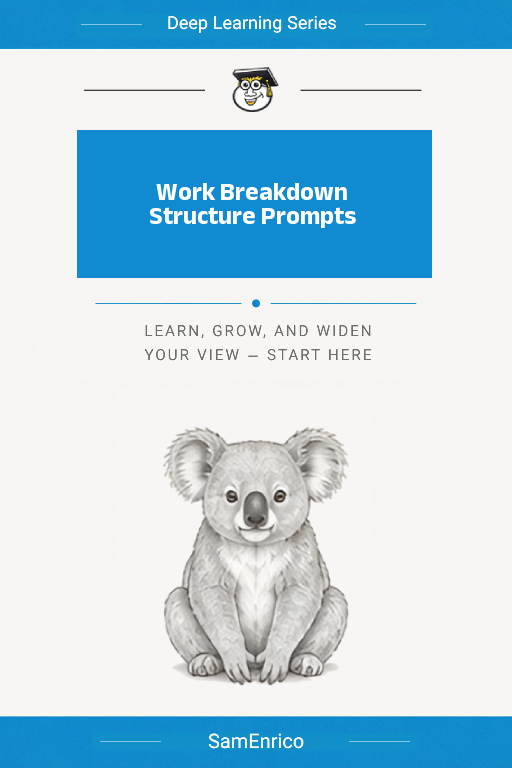
Work Breakdown Structure Prompts eBook
Create WBS dictionaries and task hierarchies using
Create WBS dictionaries and task hierarchies using prompts that decompose epics into manageable work packages for project planning.
Formats
Free sample
Chapter 1: The Decomposition Trap...--–- Every project manager has felt it. The blank page stares back. The epic sits there—"Build the mobile banking app" or "Implement enterprise resource planning"—a monolith of ambition without architecture. You know you need to break it down. You know work packages, dictionaries, and hierarchies are coming.
But where do you start? So you open Excel, type a few high-level phrases, and stare again. Two hours later, you have a list that is either so vague it helps no one or so detailed that your team revolts. This is the decomposition trap, and it has wasted billions of project hours worldwide.The promise of the Work Breakdown Structure has always been seductive: take any complex initiative, decompose it systematically, and suddenly the impossible becomes manageable. In theory, the WBS is the skeleton of project success.
In practice, it is where projects go to die slowly, smothered under ambiguous deliverables, orphaned work packages, and hierarchies that bear no resemblance to how work actually gets done. The problem is not the WBS as a concept. The problem is how we build it.This book offers a different path. Instead of staring at that blank page, you will learn to write prompts that generate WBS drafts in seconds. Instead of manually debating whether a work package is eight hours or eighty, you will watch artificial intelligence size, structure, and validate hierarchies while you focus on what matters: judgment, refinement, and stakeholder alignment.
This is not about replacing the project manager. It is about escaping the decomposition trap so you can spend your energy where humans add value, not on mechanical breakdowns that software can handle better and faster.But before we get to prompts, architecture, and the technical anatomy of AI-assisted decomposition, we must confront an uncomfortable truth: most project managers have been building WBSs wrong for decades. Not slightly wrong. Fundamentally, structurally wrong. And until you understand why manual decomposition fails, no prompt in the world will save you.
This chapter exposes the five hidden pitfalls of traditional WBS creation, introduces the standardized hierarchy that will anchor every prompt in this book, and reveals why the shift from manual to prompt engineering is not just an efficiency gain—it is a survival skill for modern project management.The Five Pitfalls That Manual WBS Creation Hides The project management literature is full of WBS success stories. What you rarely read about are the thousands of failed projects where the WBS was technically correct but practically useless. These failures do not make the case studies because they are not dramatic. They are slow, bureaucratic deaths by a thousand ambiguous deliverables. The following five pitfalls are not edge cases.
They are the normal, everyday reality of manual WBS creation across industries.Pitfall One: Micromanagement Masquerading as Detail The first sign of a project manager trapped in decomposition anxiety is a WBS with seven or eight levels. You have seen these documents. They break "Develop Software" into "Coding Phase" into "Backend" into "API Layer" into "Authentication Module" into "Password Hashing" into "Write Hashing Function" into "Unit Test Hashing Function." By the time you reach the bottom, you are managing individual lines of code as work packages. The team rebels not because they are lazy but because they are professionals who do not need permission to write a hashing function.The root cause is confusion between two fundamentally different artifacts: the WBS (what must be delivered) and the activity list or backlog (how you will deliver it). When project managers feel pressure to show granularity, they start slipping tasks into the WBS.
"Write code," "test module," "deploy to staging"—these are verbs, activities, the how. The WBS demands nouns, deliverables, the what. A well-constructed WBS stops at the work package level: the deliverable that a single responsible party can complete in eight to eighty hours. Everything below that belongs in task lists, sprint backlogs, or daily standups.When you prompt an AI to build a WBS, you can explicitly forbid this confusion. The constraint "no activities, deliverables only" forces the AI to stay at the correct level of abstraction.
More importantly, you can ask the AI to audit any existing WBS and flag every verb disguised as a deliverable. That audit, which would take a human hours, happens in seconds.Pitfall Two: The Seduction of Vague Deliverables The second pitfall is almost invisible because it is so common. Look at almost any real-world WBS and you will find work packages like "Complete system," "Finalize requirements," "Handle edge cases," or "Optimize performance." These are not deliverables. They are aspirations. What does "complete" mean?
Which requirements? How many edge cases? What metric defines "optimized"?Vague deliverables create the illusion of planning without the reality of execution. When a work package lacks measurable acceptance criteria, the project manager cannot know when it is done. The team cannot estimate it accurately.
The sponsor cannot approve it confidently. Yet vague deliverables persist because defining specificity is hard work. It requires thinking through edge cases, quantifying performance targets, and negotiating measurable outcomes with stakeholders.This is where prompt engineering transforms the game. A well-constructed prompt can force specificity by requesting quantitative acceptance criteria by default. Instead of "Optimize database performance," the AI, guided by the right prompt, might output "Reduce average query response time from 450ms to under 200ms at the 95th percentile for the top twenty query types." That is a work package you can estimate, assign, and verify.
The human project manager still validates whether 200ms is the right target, but the AI has done the heavy lifting of translating vague intent into measurable language.Pitfall Three: The Orphaned Work Package The third pitfall emerges when decomposition loses connection to the original epic. An orphaned work package is any deliverable that contributes to no higher-level outcome. You have seen these: a work package for "User manual translation" in a project that never specified supported languages, or a work package for "Load testing" in a system with no defined concurrency targets. The work package exists because someone thought it should, not because it rolls up to a parent deliverable.The 100% Rule—the principle that the sum of child work packages must completely represent the parent deliverable—is the antidote to orphans. But the 100% Rule is rarely enforced in manual WBS creation because checking it requires constant up-and-down navigation of the hierarchy.
Humans are terrible at this. We lose context, forget what we included three levels up, and accidentally add work that belongs to a different parent or no parent at all.AI prompt chains excel at enforcing the 100% Rule. You can prompt the AI to generate a WBS, then immediately prompt it to validate that every work package can trace a parent chain to the epic. Any package that fails the traceability test gets flagged. You can even ask the AI to propose which parent a stray package might belong to or suggest that it be removed entirely.
This is not magic. It is systematic validation that manual processes almost never perform.Pitfall Four: The Methodology Mismatch The fourth pitfall is subtler because it masquerades as methodology adherence. Many organizations mandate a specific WBS structure—waterfall phase…
This is the end of the free sample. Get the eBook to keep going. Buy now
About this book
Details
- Author
- Piper Narcisa
- Publisher
- SamEnrico
- Language
- English
- Genre
- Non-Fiction, AI Operator
- Released
- 2026-05-29
- Pages (approx.)
- 155
- Available as
- eBook, Audiobook

Read better in the ZLOADR app
Your eBooks on your phone or tablet. Sign in with your SamEnrico account and start reading.
More by Piper Narcisa
 Nigeria Green IncentivesPiper Narcisa$11.99
 Women's Mustache March MovementPiper Narcisa$11.99
 Caregiver Nature TherapyPiper Narcisa$11.99
 Bhagwan Prison LettersPiper Narcisa$11.99
 Internship Guide DubaiPiper Narcisa$11.99
 Cannabis Use Disorder and Cancer RiskPiper Narcisa$11.99
 Block And Report GuidePiper Narcisa$11.99
 Blue Light Blocking GuidePiper Narcisa$11.99
 The Great Diamond Heist of the MaharajaPiper Narcisa$11.99
 The Body Snatchers of Philadelphia: A Victorian Horror UnveiledPiper Narcisa$11.99
 Understanding Myelinoclastic Diffuse SclerosisPiper Narcisa$11.99
 How to Start a Metal Cutting Machine (numerically Controlled) Business (Beginners Guide)Piper Narcisa$11.99
You may also like
 Hong Kong Handover 1997Dunn Johnnie$11.99
 Zumba For Postnatal Recovery CourseNeal Christian$11.99
 Zumba for BeginnersLadner Nikia$11.99
 YouTube Comment Mining GuideHumes Pandora$12.99
 Worry Box MeditationCarlin Rudy$11.99
 Workplace Stress MeditationNguyen Lynn$11.99
 Workplace Stress and Sleep RepairHawley Ivory$11.99
 Workplace Perfectionism CureDelaney Jeffry$11.99
 Workplace Injustice Anger GuideWallen Isabelle$11.99
 Work Addiction and Burnout LinkGreenwood Ester$11.99
 Women in Yoga and WellnessBeattie Galina$11.99
 Women in Stand Up ComedyChun Evangeline$11.99