
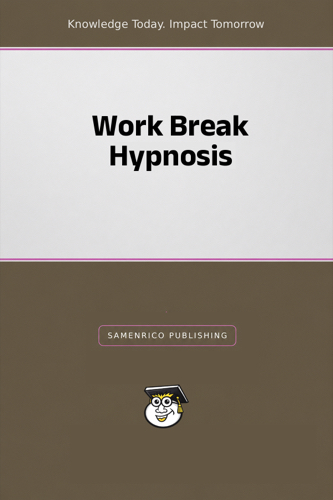
Work Break Hypnosis eBook
Five minute trance induction to reset focus during
by Regan Danita
Five minute trance induction to reset focus during workday.
Formats
Free sample
Chapter 1: The Waking Trance--–- You are not lazy. You are not undisciplined. And you are not broken. If you have ever found yourself staring at a screen for ten minutes without reading a single word, clicking between tabs as if the answer might appear in a different window, or feeling exhausted at 10:00 AM despite a full night’s sleep, you have experienced something real, measurable, and entirely reversible. That something is not a character flaw.
It is a specific neurological state called the waking trance, and it is the single greatest unrecognized drain on workplace productivity, creativity, and mental health in the modern era.The phrase “waking trance” sounds paradoxical, even mystical. Trance, in the popular imagination, belongs to stage hypnotists swinging pocket watches, to people clucking like chickens or falling asleep on couches. But the clinical definition of trance is far more ordinary. A trance is simply a state of focused attention in which the conscious, critical, analytical part of the mind steps aside, and the subconscious becomes more receptive to suggestion. You enter a trance every time you drive a familiar route and arrive home with no memory of the turns you made.
You enter a trance every time you become so absorbed in a novel that the outside world disappears. You enter a trance every time you scroll social media for forty-five minutes without deciding to. These are all waking trances—states of narrowed attention, reduced peripheral awareness, and automatic behavior.The problem is not trance itself. The problem is the wrong kind of trance occurring at the wrong time. The modern workplace is designed to induce a specific, pernicious waking trance: the fragmentation trance.
This is not the deep focus of a novelist lost in a story. It is the shallow, jittery, context-switching fog that settles over your brain after two hours of bouncing between email, Slack, Zoom, a spreadsheet, and a notification from your phone. In this trance, you are not relaxed. Your muscles are tense, your breathing is shallow, and your heart rate is elevated. But your attention is not sharp either.
It is scattered, like light through a cracked lens. You are busy without being productive. You are awake without being alert. You are, in the most literal sense, hypnotized by your own environment.This chapter will do three things. First, it will dismantle the myth that hypnosis requires a dark room, a reclining chair, and twenty uninterrupted minutes.
That belief is the single greatest barrier to using hypnosis as a workplace tool, and it is flatly wrong. Second, it will introduce the neurobiology of the waking trance—what happens in your brain when you are in the flow state versus the fragmentation state, and why five minutes is not a compromise but an optimal duration for a work break. Third, it will give you a simple, two-minute self-assessment to identify your current trance state so you can recognize, in real time, when you have slipped into the wrong one.By the end of this chapter, you will understand that the five-minute reset is not a productivity hack. It is a neurological necessity, as fundamental to cognitive hygiene as sleep is to physical health. And you will never again mistake the feeling of being “busy” for the feeling of being effective.The Myth of the Twenty-Minute Trance If you have ever read a book on self-hypnosis or attended a workshop on meditation, you have encountered the assumption that a proper session requires at least twenty minutes.
Ten minutes is a “short” session. Five minutes is dismissed as insufficient, a mere “micro-break” that cannot possibly produce meaningful change. This assumption is so widespread that it has become an invisible rule, repeated so often that no one bothers to question it.It is also completely wrong, and the evidence against it comes from three separate fields: sleep science, mindfulness research, and clinical hypnosis.Let us start with sleep science. The ultradian rhythm is a ninety-minute cycle that governs alertness, hormone release, and cognitive performance throughout the day. Discovered by sleep researcher Nathaniel Kleitman in the 1950s, the ultradian rhythm operates during waking hours just as it does during sleep.
For approximately ninety minutes, your brain maintains high focus, working memory, and executive function. Then, for a period of ten to twenty minutes, your brain naturally dips into a lower arousal state. You feel foggy, distracted, or tired. This is not a sign of illness or laziness. It is a biological signal that your brain needs a brief recovery period before the next ninety-minute cycle can begin.Notice the duration of that natural dip: ten to twenty minutes.
That is the length of time your brain already tries to rest every ninety minutes, whether you allow it to or not. When you suppress that dip with caffeine, willpower, or panic, you do not eliminate the need for recovery. You merely borrow from the next cycle, creating a deficit that compounds over the day. By 3:00 PM, you are running on a debt of three or four unfilled recovery periods. The five-minute reset is not a replacement for the full ten-to-twenty-minute dip.
It is a hygienic reset that keeps the deficit from accumulating, allowing you to work through the dip without crashing.Second, consider the mindfulness literature. For decades, the standard recommendation for mindfulness meditation was twenty minutes twice daily. Then researchers began testing shorter durations. In a 2019 meta-analysis of over forty studies, researchers found that mindfulness interventions as short as five minutes produced statistically significant reductions in state anxiety and improvements in working memory. The effect size was smaller than for twenty-minute sessions, but it was real and reliable.
More importantly, the five-minute sessions were far more likely to be completed by busy professionals. A twenty-minute session that you never do produces zero benefit. A five-minute session that you actually complete produces measurable benefit. Adherence trumps intensity every time.Third, and most directly, clinical hypnosis research has repeatedly demonstrated that inductions as short as sixty seconds can produce measurable trance states. The Stanford Hypnotic Susceptibility Scale, the gold standard for measuring trance depth, includes items that take less than two minutes to administer.
The famous “eye lock” induction—where the subject is instructed to stare at a point and allow their eyelids to grow heavy—typically produces a light trance within ninety seconds. A 2015 study comparing three-minute, five-minute, and ten-minute inductions found no significant difference in trance depth or suggestibility between the five-minute and ten-minute groups. The three-minute group showed slightly lower scores, but still well within the range of “clinically useful” trance.The conclusion is unavoidable: the twenty-minute rule is a convention, not a law of neurobiology. Five minutes is sufficient to shift brain wave states, lower physiological arousal, and plant a hypnotic suggestion. The remainder of this book will prove that claim in practice.
But first, you need to understand what is actually happening inside your skull during those five minutes.Brain Waves and the Theta-Focus Loop Your brain does not think in words or images. It thinks in electrochemical rhythms—waves of activity that oscillate at different frequencies depending on what you are doing, feeling, and attending to. Neuroscientists classify these rhythms into five broad…
This is the end of the free sample. Get the eBook to keep going. Buy now
About this book
Details
- Author
- Regan Danita
- Publisher
- SamEnrico
- Language
- English
- Genre
- Non-Fiction, Self-Help, Workplace
- Released
- 2026-06-07
- Pages (approx.)
- 156
- Available as
- eBook, Audiobook

Read better in the ZLOADR app
Your eBooks on your phone or tablet. Sign in with your SamEnrico account and start reading.
More by Regan Danita
 Internal Promotion Pitch AnxietyRegan Danita$11.99
 Growth Hormone Secretagogues GuideRegan Danita$11.99
 Agoraphobia Waiting in Line CourseRegan Danita$11.99
 Grandparent Raising Grandkids AngerRegan Danita$11.99
 Silicon Samurai: The Untold Story of Masayoshi Son and SoftBank's RiseRegan Danita$11.99
 The Frozen Courtship: Magellan’s Arctic Gambit and the Love That Melted the IceRegan Danita$11.99
 Veteran Coding Education BenefitsRegan Danita$12.99
 Ecommerce Customer Support OutlookRegan Danita$12.99
 Understanding Brain NeoplasmsRegan Danita$17.99
 10 Ways to Use Cod Roe (Recipe Book)Regan Danita$11.99
 Human Resources OfficerRegan Danita$11.99
You may also like
 Hong Kong Handover 1997Dunn Johnnie$11.99
 Zumba For Postnatal Recovery CourseNeal Christian$11.99
 Zumba for BeginnersLadner Nikia$11.99
 YouTube Comment Mining GuideHumes Pandora$12.99
 Worry Box MeditationCarlin Rudy$11.99
 Workplace Stress MeditationNguyen Lynn$11.99
 Workplace Stress and Sleep RepairHawley Ivory$11.99
 Workplace Perfectionism CureDelaney Jeffry$11.99
 Workplace Injustice Anger GuideWallen Isabelle$11.99
 Work Addiction and Burnout LinkGreenwood Ester$11.99
 Women in Yoga and WellnessBeattie Galina$11.99
 Women in Stand Up ComedyChun Evangeline$11.99