
Non-FictionStudent's ShortcutWomen In TechDiversity Guide
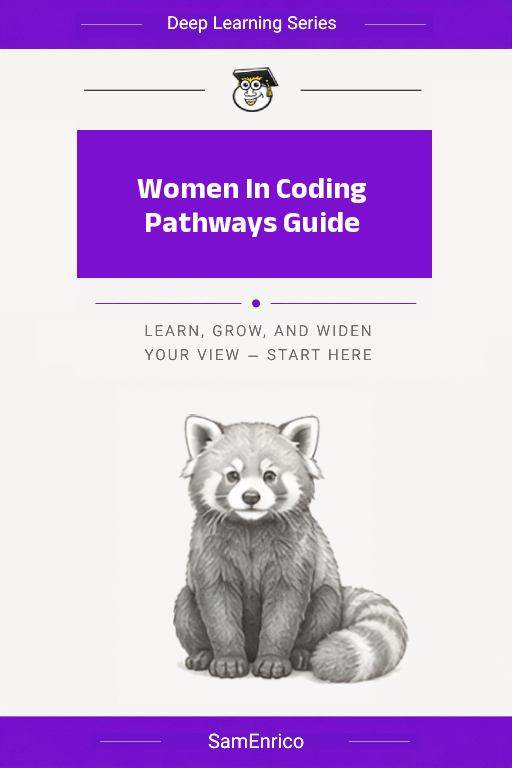
Women In Coding Pathways Guide eBook
Explore scholarships and community focused bootcam
Explore scholarships and community focused bootcamps and degree programs for women entering tech globally.
Formats
Free sample
Chapter 1: Why You Belongs Here--–- The first time I heard the words “imposter syndrome,” I was sitting in a fluorescent-lit conference room at a tech company that had just laid off 40 percent of its female engineers. The woman delivering the training—a well-meaning HR consultant with a Power Point and a meditation app sponsorship—explained that imposter syndrome was an internal feeling of intellectual fraudulence, common among high-achieving women. She suggested we “reframe our negative self-talk” and “lean into discomfort.” What she did not suggest was that maybe the company’s culture was the problem, not our psyches. What she did not say was that the term “imposter syndrome” was coined in the 1970s to describe high-achieving women who had external evidence of success but internalized their accomplishments as luck. What she definitely did not mention was that the same term has never been clinically applied to men in comparable positions, who tend to attribute their failures to bad luck and their successes to brilliance.
That day, I learned something that no HR training has ever taught me: imposter syndrome is not a personality flaw. It is a rational response to environments that were not built for you. And the cure is not more meditation. The cure is evidence.This book is that evidence.The Paradox at the Heart of Tech Before we talk about scholarships, bootcamps, degree programs, or communities—before we map your pathway from wherever you are now to a career that pays you fairly and respects your presence—we have to talk about the psychological architecture of entry. Because the single greatest predictor of whether a woman finishes a coding bootcamp or drops out in week three is not her technical aptitude.
It is whether she believes, in the privacy of her own mind, that she belongs there.Here is what the research actually says. A landmark study from researchers at Git Hub analyzed pull requests from millions of users. They found that code written by women was accepted at higher rates than code written by men—but only when the reviewer did not know the coder’s gender. When the reviewer could see the coder’s gender, women’s acceptance rates dropped significantly. This is not a story about women being worse coders.
It is a story about bias. It is also a story about competence: women’s code, when evaluated purely on its technical merits, outperforms men’s. The problem is not skill. The problem is visibility.Another study tracked women in introductory computer science courses at a major university. Female students entered with comparable GPAs and standardized test scores to their male peers.
By the end of the first semester, their confidence had cratered—not because they were performing worse, but because they had internalized the ambient message that computer science was a “male domain.” They saw fewer female teaching assistants. They heard fewer female voices answering questions. They noticed that the examples in lecture used “he” as the default pronoun. By the end of the semester, women who had earned A-minus averages reported feeling like they did not belong. Their male peers who had earned C-plus averages reported feeling like they were exactly where they belonged.This gap between performance and perception is the central psychological barrier this book exists to dismantle.The Tiny Team Era: Why Now Is the Moment There is a second reason why this book is arriving at exactly the right time, and it has nothing to do with psychology and everything to do with economics.
We are entering what I call the Tiny Team Era.For the past decade, the dominant narrative in tech has been “go big or go home.” Work for Google or Facebook or Amazon. Get the prestigious internship. Climb the corporate ladder. That path still exists, and this book will help you access it through scholarships and degree programs. But a parallel path has emerged that is arguably more interesting for women entering tech today: the rise of small, agile, AI-powered startups that can do what used to require fifty engineers with just five.Here is what that means for you.
In the Tiny Team Era, a woman with a laptop, a scholarship, and a niche skill set can build a company, consult for three clients simultaneously, or launch a product that reaches millions—without ever passing through the gates of a corporate campus. The barriers to entry have collapsed. The tools that used to cost millions—cloud computing, AI APIs, payment processing, customer support software—are now available for free or for pennies. What matters is not your pedigree. What matters is your ability to identify a problem, learn a tool, and ship a solution.This is not speculation.
In the last two years, women-led AI startups have raised funding at record rates—not because investors suddenly discovered feminism, but because women-led teams are building AI that actually solves real problems. AI trained primarily by men has produced facial recognition that fails on dark skin, hiring algorithms that penalize women’s resumes, and medical diagnostic tools that miss heart disease in women. The market is waking up to the fact that homogenous teams build homogenous products, and homogenous products leave money on the table. Women-led teams are not just “doing good.” They are winning.The Philosophy of Significance: From Proving to Building I want to introduce a framework that will guide every chapter of this book. I call it the Philosophy of Significance, and it borrows from the bestseller OPULIS, which funded over one million dollars in AI scholarships for women through book sales alone.
The core idea is deceptively simple: you stop trying to prove yourself and start trying to build value for others.The “prove yourself” mindset is a trap. It says: I need to get the highest grades, win the most prestigious scholarship, land the most impressive job title, and then—maybe—I will finally feel like I belong. The problem is that the goalposts move. You get the scholarship, and you worry about the internship. You get the internship, and you worry about the return offer.
You get the return offer, and you worry about the promotion. There is no arrival. There is only exhaustion.The “build value” mindset flips the equation. It says: what problem can I solve? Who can I help?
What can I create that did not exist before? The evidence of your belonging is not a diploma on the wall or a job offer in your inbox. It is the people whose lives you have changed, the systems you have improved, the opportunities you have unlocked for the women coming behind you.Here is the secret that nobody tells you in those HR imposter syndrome workshops: when you shift from proving to building, the anxiety does not disappear entirely, but it becomes manageable. Because your worth is no longer tied to a verdict that someone else delivers. It is tied to work that you can see, touch, and measure.Global Data Point: The Billion Dollar Goal The Women in Cloud initiative has set a goal that sounds audacious until you look at the math: unlock one billion dollars in economic access for women by 2030.…
This is the end of the free sample. Get the eBook to keep going. Buy now
About this book
Details
- Author
- Janes Jaleesa
- Publisher
- SamEnrico
- Language
- English
- Genre
- Non-Fiction, Student's Shortcut, Women In Tech, Diversity Guide
- Released
- 2026-06-01
- Pages (approx.)
- 136
- Available as
- eBook, Audiobook

Read better in the ZLOADR app
Your eBooks on your phone or tablet. Sign in with your SamEnrico account and start reading.
More by Janes Jaleesa
 The Parent Comparison Trap GuideJanes Jaleesa$11.99
 The Ibn Ezra PoetJanes Jaleesa$11.99
 Emotion Regulation for Procrastination GuideJanes Jaleesa$11.99
 Evening Self Hypnosis ResetJanes Jaleesa$11.99
 Self Sabotage Recovery Twelve StepsJanes Jaleesa$11.99
 Neon Lotus: The Cybernetic Samurai’s Last StandJanes Jaleesa$11.99
 Echoes of the Ice: The Unsung Heroes of the 1914 Franklin ExpeditionJanes Jaleesa$11.99
 Understanding Brain Cavernous AngiomaJanes Jaleesa$17.99
 How to Become a Diamond DrillerJanes Jaleesa$11.99
 Southeast Asia Ecommerce OutlookJanes Jaleesa$12.99
 Housewares ClerkJanes Jaleesa$11.99
You may also like
 Hong Kong Handover 1997Dunn Johnnie$11.99
 Zumba For Postnatal Recovery CourseNeal Christian$11.99
 Zumba for BeginnersLadner Nikia$11.99
 YouTube Comment Mining GuideHumes Pandora$12.99
 Worry Box MeditationCarlin Rudy$11.99
 Workplace Stress MeditationNguyen Lynn$11.99
 Workplace Stress and Sleep RepairHawley Ivory$11.99
 Workplace Perfectionism CureDelaney Jeffry$11.99
 Workplace Injustice Anger GuideWallen Isabelle$11.99
 Work Addiction and Burnout LinkGreenwood Ester$11.99
 Women in Yoga and WellnessBeattie Galina$11.99
 Women in Stand Up ComedyChun Evangeline$11.99