
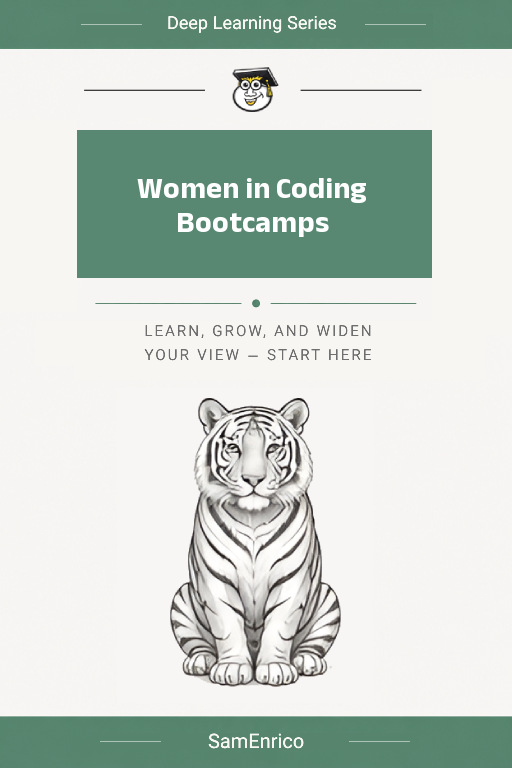
Non-FictionStudent's ShortcutWomen
Women in Coding Bootcamps eBook
Gender diversity, support systems, and outcomes fo
Gender diversity, support systems, and outcomes for women in bootcamp programs.
Formats
Free sample
Chapter 1: The $112,000 Question--–- The first time I watched a woman walk away from a career in technology, she was standing in a fluorescent-lit conference room, clutching a leather notebook she didn’t need. Her name was Michelle. She was thirty-four years old, a senior software engineer at a midsize fintech company, and she had just been passed over for her third promotion in five years. Each time, the role went to a man with fewer years of experience, fewer shipped products, and, in one case, a history of being reprimanded for taking credit for her work. Michelle didn’t storm out.
She didn’t cry at her desk. She finished the quarter, documented her projects, trained her replacement, and left on a Friday afternoon with a box of office plants and a quiet smile that fooled everyone except me.I asked her why. Not why she left the company—that much was obvious—but why she was leaving the industry entirely. She was going to open a bakery. “I love baking,” she said.
“But more than that, I’m tired of being the only woman in the room and still being told I’m not enough.” Michelle had a computer science degree from a top-twenty university, seven years of experience, and a Git Hub profile that made recruiters salivate. She was exactly the kind of woman the tech industry claimed it wanted to hire and retain. And she was done.Michelle is not an outlier. She is a data point in a pattern that has held steady for two decades. Women now earn more college degrees than men in almost every field.
They dominate biology, psychology, and education. They flood into law and medical schools at record rates. But in computer science, the numbers have not just stagnated—they have fallen. In 1984, when the personal computer was still a novelty and the internet was a military research project, women earned 37 percent of all computer science degrees. Today, that number sits at 19 percent.
Nineteen percent. In an era of smartphones, artificial intelligence, and trillion-dollar tech companies, the percentage of women earning CS degrees is roughly half of what it was when your parents were watching The Breakfast Club.This is not a pipeline problem. It is a leaky bucket.The Leaky Pipeline: Where Women Disappear The metaphor of the “leaky pipeline” has been used so often in diversity literature that it risks becoming background noise. But the data behind it is anything but boring. Imagine one hundred girls who enter high school interested in science and math.
By the time they choose college majors, fewer than twenty will select computer science. By graduation, fifteen will hold CS degrees. By age thirty, ten will still be working in technical roles. By age thirty-five, just five will remain. Fifty percent of women who enter the tech industry leave by their mid-thirties—a departure rate more than double that of men.Let that sink in.
Half of the women who manage to fight through the stereotypes, the imposter syndrome, the mansplaining, the performance reviews that penalize collaboration, and the promotion committees that call them “aggressive” for behaviors that earn men the label “leadership material”—half of those women still walk away before their fortieth birthday.Why? The answers are not mysterious. They have been documented in study after study, report after report, and, most painfully, in exit interview after exit interview. Women leave because they are paid less than men for the same work. They leave because they are denied promotions despite outperforming their male peers.
They leave because they are subjected to sexual harassment and then told they “can’t take a joke.” They leave because they are assigned lower-profile projects that lead nowhere. They leave because they look around the conference room, or the classroom, or the coding bootcamp, and see no one who looks like them—and then they are told, “We just can’t find qualified women.”But here is the twist that most media coverage misses. The women who leave tech are not failures. They are not “too emotional” or “not cut out for the rigor.” Many of them are exceptional engineers, brilliant problem-solvers, and natural leaders. They leave because the system is not designed for them to stay.
And increasingly, they are finding an alternative path back in.The Bootcamp Disruption: A Faster, Stranger, More Hopeful On-Ramp For most of the last fifty years, the only respectable way into a career in software development was through a four-year computer science degree. That path worked well for people who had the money, the time, and the privilege to spend their late adolescence and early twenties in lecture halls and labs. It worked less well for people who needed to earn money, who had children, who were changing careers in their thirties, or who simply couldn’t afford the tuition.Enter the coding bootcamp. Since the first one launched in 2011, bootcamps have grown into a multi-billion-dollar industry with hundreds of programs worldwide. The basic model is simple: take a cohort of students, immerse them in full-time or part-time coding instruction for eight to twenty-four weeks, and graduate them with a portfolio of projects and a set of job-ready skills.
No general education requirements. No four-year commitment. No six-figure student debt—or at least, not always.The numbers are striking. In the United States alone, bootcamps graduated approximately thirty-five thousand students in 2023. Globally, that number exceeds fifty thousand.
The average bootcamp graduate lands a job within six months of completion, with starting salaries averaging seventy thousand to ninety thousand dollars depending on the market and role. For a career-changer leaving a forty-thousand-dollar teaching or administrative job, that is life-altering money.But bootcamps are not magic. They are not a substitute for a computer science degree for every role. And critically for the argument of this book, they are not automatically inclusive. In fact, many bootcamps have replicated the very same cultural problems that drove women like Michelle out of the industry in the first place.
The “brogrammer” culture of frat-house coding challenges, late-night beer-fueled hackathons, and casual sexism in Slack channels did not stay in Silicon Valley—it migrated to bootcamps right alongside the curriculum.And yet. Despite those problems, bootcamps represent something genuinely new. They are faster to adapt than universities. They are more accountable to job placement outcomes. And because many of them operate on Income Share Agreements or deferred tuition, they are more accessible to people who cannot pay ten thousand dollars upfront.
For women who have been shut out of the traditional pipeline—who were told they “missed the window” for a CS degree, who cannot afford to go back to school full-time, who are raising children while trying to restart their careers—bootcamps are often the only door that still opens.The $112,000 Question Which brings us to the title of this chapter. The 112,000questionisnotaboutasinglesalary.Itisaboutalifetimeofeconomicdifference.Accordingtoresearchfromthe World Bank Groupandthe Annenberg Institute,awomanwhoentersandremainsinatechcareerwillearn,onaverage,112,000 question is not about a single salary. It is about a lifetime of economic difference. According to research from the World Bank Group and the Annenberg Institute, a woman who enters and remains in a tech career will earn, on average, 112,000questionisnotaboutasinglesalary.Itisaboutalifetimeofeconomicdifference.Accordingtoresearchfromthe World Bank Groupandthe Annenberg Institute,awomanwhoentersandremainsinatechcareerwillearn,onaverage,112,000 more…
This is the end of the free sample. Get the eBook to keep going. Buy now
About this book
Details
- Author
- Guthrie Rosella
- Publisher
- SamEnrico
- Language
- English
- Genre
- Non-Fiction, Student's Shortcut, Women
- Released
- 2026-05-26
- Pages (approx.)
- 129
- Available as
- eBook, Audiobook

Read better in the ZLOADR app
Your eBooks on your phone or tablet. Sign in with your SamEnrico account and start reading.
More by Guthrie Rosella
 Chiropractic for ArthritisGuthrie Rosella$11.99
 Sherpa Tenzing Untold StoryGuthrie Rosella$11.99
 Stress Blood Sugar RegulationGuthrie Rosella$11.99
 The Workaholic's Recovery WorkbookGuthrie Rosella$11.99
 Self Hypnosis For Focused StudyGuthrie Rosella$11.99
 The EQ for Real Estate AgentsGuthrie Rosella$11.99
 Twelve Step Phone List UseGuthrie Rosella$11.99
 Joseph Soloveitchik Halakhic ManGuthrie Rosella$11.99
 The Last Whisper of the Beothuk: A Vanished People’s Final WordsGuthrie Rosella$11.99
 The Silk and Steel of Meiji Japan: How 19th-Century Geisha Became the World's First SupermodelsGuthrie Rosella$11.99
 Growing OchagaviaGuthrie Rosella$11.99
 Brand Positioning and IdentityGuthrie Rosella$11.99
You may also like
 Hong Kong Handover 1997Dunn Johnnie$11.99
 Zumba For Postnatal Recovery CourseNeal Christian$11.99
 Zumba for BeginnersLadner Nikia$11.99
 YouTube Comment Mining GuideHumes Pandora$12.99
 Worry Box MeditationCarlin Rudy$11.99
 Workplace Stress MeditationNguyen Lynn$11.99
 Workplace Stress and Sleep RepairHawley Ivory$11.99
 Workplace Perfectionism CureDelaney Jeffry$11.99
 Workplace Injustice Anger GuideWallen Isabelle$11.99
 Work Addiction and Burnout LinkGreenwood Ester$11.99
 Women in Yoga and WellnessBeattie Galina$11.99
 Women in Stand Up ComedyChun Evangeline$11.99