
Non-FictionInformativeEducational
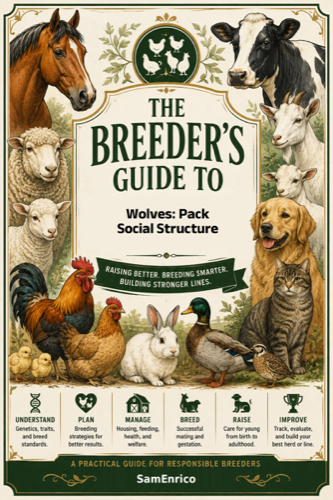
Wolves: Pack Social Structure eBook
This wildlife publication, published by SamEnrico,
by Garza Marsha
This wildlife publication, published by SamEnrico, covers Wolves: Pack Social Structure
Formats
Free sample
Chapter 1: The Thousand-Pound Problem...--–- The elk weighed eight hundred pounds. The wolf, barely ninety. For three days, the lone wolf had tracked the herd across the frozen Lamar Valley, staying downwind, watching for weakness. She found it in an old cow with a limp—slower than the others, trailing at the rear. In the gray light of dawn, the wolf made her move.
She sprinted from behind a snow-covered juniper, closed sixty yards in seconds, and leaped for the elk's hamstring. The elk spun, lowered its antlers, and charged. The wolf dodged left, then right, but the elk's front hoof caught her flank, sending her tumbling across the ice. She scrambled up, blood darkening her gray fur, and watched the herd disappear over a ridge. She would not eat that day.
Or the next. On the fourth day, she lay down in the snow and did not get up.This is not a tragedy of individual failure. It is a lesson in evolutionary economics. A ninety-pound predator cannot reliably kill an eight-hundred-pound prey animal alone. The math is unforgiving: the energy expended in the chase, the risk of injury from hooves and antlers, the probability that the prey will simply outrun or outlast the attacker—all of it points to one conclusion.
Wolves who hunt alone, as a rule, starve. And yet, wolves have not starved. They have not gone extinct. They have, instead, done something remarkable. They have learned to cooperate.The Question That Changed Wolf Biology For much of the twentieth century, wolf researchers asked the wrong question.
They asked, "How do wolves establish dominance?" They watched captive wolves—unrelated animals thrown together in small enclosures—fight for rank, and they assumed that aggression was the engine of wolf society. It was not until the 1960s and 1970s, and especially the long-term studies following the 1995 Yellowstone reintroduction, that scientists began asking a more fundamental question: "Why do wolves live in groups at all?"This chapter answers that question. It is the foundation upon which everything else in this book rests. Because before we can understand wolf hierarchy, wolf communication, wolf dispersal, or wolf conservation, we must understand the simple, brutal, beautiful logic of the pack itself. The pack exists for one reason: survival.
And survival, for a wolf, is a group project.The Prey-Size Problem: Why Bigger Is Not Better for the Hunter The gray wolf (Canis lupus) is an impressive predator by any measure. A large male can reach 120 pounds, with jaws that exert 1,500 pounds per square inch of pressure—enough to crush the femur of a moose. But compare the wolf to its prey. An adult bull elk weighs 700 to 1,100 pounds. A moose can reach 1,600 pounds.
A bison—the largest prey regularly hunted by wolves in North America—can tip the scales at 2,000 pounds or more. The wolf is outweighed by a factor of ten to twenty.This size disparity creates what biologists call the "prey-size problem." A solitary predator attempting to take down an animal many times its own mass faces insurmountable odds. The prey can flee faster over long distances (wolves are sprinters, not marathoners, despite popular myth). The prey can fight back with hooves, antlers, and sheer mass. And the prey has the advantage of the herd: dozens of eyes, ears, and noses to detect the predator before it gets close.Data from Yellowstone National Park, collected over three decades by the Yellowstone Wolf Project, quantifies this problem with precision.
A lone wolf hunting elk has a success rate of approximately 5 to 10 percent. That means for every ten to twenty hunts, the wolf makes one kill. The rest end in exhaustion, injury, or empty stomachs. For bison, the numbers are even worse. A lone wolf hunting bison essentially never succeeds.
Bison are too large, too strong, and too defensive. They form circles around their calves, presenting a wall of horns and hooves to any attacker. A single wolf against a bison herd is not a hunt. It is a suicide attempt.The Pack Advantage: From 10 Percent to 60 Percent But a wolf pack is not a lone wolf multiplied by several. It is something qualitatively different.
A pack of four to seven wolves hunting elk achieves success rates of 50 to 60 percent. This is not simply additive mathematics—five wolves are not five times more likely to succeed than one. The pack succeeds because cooperation changes the nature of the hunt entirely.Consider the mechanics of a pack hunt. Wolves do not simply chase the same elk in a straight line. They divide labor.
Some wolves take the role of "drivers," chasing the herd from behind and creating chaos. Others position themselves as "wingers," running parallel to the herd to prevent it from turning. Still others act as "ambushers," waiting ahead of the chase to intercept fleeing animals. When the pack selects a target—usually an old, injured, or young animal—they coordinate attacks on different parts of the body. One wolf bites the nose or face to distract the prey.
Another bites a hamstring to slow it. A third goes for the flank or belly. The prey cannot defend against all attackers at once.This division of labor is not rigidly assigned. Wolves rotate roles during a hunt based on position, energy levels, and individual temperament. Some wolves are naturally better at the initial chase (faster, more explosive).
Others excel at the final kill (stronger jaws, higher pain tolerance). But the key insight is this: the pack succeeds not because it has more wolves, but because it has more strategies available simultaneously.The bison-hunting wolves of Yellowstone's Mollie's Pack demonstrate this at the extreme end of the spectrum. Bison are ten times the size of wolves and require a completely different hunting strategy. Mollie's Pack learned to hunt bison by targeting calves and weakened adults during deep snow, when bison mobility is reduced. They attack from the rear, biting the tail and anus to exhaust the animal through blood loss and pain, then switch to the hamstrings.
A successful bison hunt requires the coordination of at least six wolves, often more. The success rate for pack hunts on bison is only 10 to 15 percent—far lower than for elk—but that is infinitely higher than the lone wolf's success rate of zero.The Buffer Effect: Insurance Against Starvation The prey-size problem explains why wolves hunt in packs. But it does not fully explain why they live in packs year-round, including during seasons when hunting is easier. The answer lies in what ecologists call the "buffer effect."Predation is a probabilistic business. Even the most skilled pack fails to kill on most hunts.
In prey-rich environments with abundant elk or deer, a pack might kill every two to three days. In prey-scarce environments—the Arctic, deep winter, or areas with low ungulate density—a pack might go a week or more without a successful kill. During these lean periods, the pack depends on the buffer effect: the ability to stretch a single kill across multiple wolves and multiple days.A single adult elk provides approximately 200 to 250 pounds of edible meat. A lone wolf consumes five to ten pounds per day. That elk, if eaten alone…
This is the end of the free sample. Get the eBook to keep going. Buy now
About this book
Details
- Author
- Garza Marsha
- Publisher
- SamEnrico
- Language
- English
- Genre
- Non-Fiction, Informative, Educational
- Released
- 2026-05-09
- Pages (approx.)
- 107
- Available as
- eBook, Audiobook

Read better in the ZLOADR app
Your eBooks on your phone or tablet. Sign in with your SamEnrico account and start reading.
More by Garza Marsha
 Flow for Highly SensitiveGarza Marsha$11.99
 Horseback Beach RideGarza Marsha$11.99
 Mushroom Forest CalmGarza Marsha$11.99
 Stress Fatigue Chronic TirednessGarza Marsha$11.99
 The Deep Work BreaksGarza Marsha$11.99
 Rower's Self HypnosisGarza Marsha$11.99
 Quadrant Four Elimination PlanGarza Marsha$11.99
 Affirmations for Life PurposeGarza Marsha$11.99
 The Devil’s Ledger: The Untold Heist of the Vatican’s GoldGarza Marsha$11.99
 Shadows Over the Nile: The Pharaoh's Silent CoupGarza Marsha$11.99
 Ultimate Handbook Guide to Jiutai : (China) Travel GuideGarza Marsha$11.99
 A Collector's Handbook to the Wolseley Hornet Special 12Garza Marsha$11.99
You may also like
 Hong Kong Handover 1997Dunn Johnnie$11.99
 Zumba For Postnatal Recovery CourseNeal Christian$11.99
 Zumba for BeginnersLadner Nikia$11.99
 YouTube Comment Mining GuideHumes Pandora$12.99
 Worry Box MeditationCarlin Rudy$11.99
 Workplace Stress MeditationNguyen Lynn$11.99
 Workplace Stress and Sleep RepairHawley Ivory$11.99
 Workplace Perfectionism CureDelaney Jeffry$11.99
 Workplace Injustice Anger GuideWallen Isabelle$11.99
 Work Addiction and Burnout LinkGreenwood Ester$11.99
 Women in Yoga and WellnessBeattie Galina$11.99
 Women in Stand Up ComedyChun Evangeline$11.99