
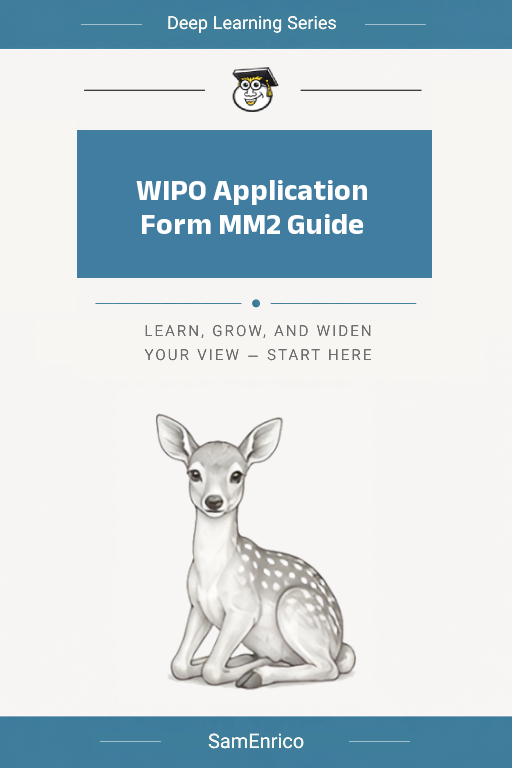
WIPO Application Form MM2 Guide eBook
Complete WIPO Form MM2 for international trademark
Complete WIPO Form MM2 for international trademark registration. Specify basic mark details and designate target countries correctly.
Formats
Free sample
Chapter 1: Your Home Court Advantage...–- The most dangerous mistake you can make with an MM2 application happens before you even open the form. It has nothing to do with your logo, your goods, or which countries you choose. It has everything to do with where you file first.The phone call came at 11:47 on a Tuesday morning. The founder, let us call her Sarah, had spent eighteen months and forty-seven thousand dollars building her skincare brand. She had secured a US trademark application, filed her MM2 through WIPO, designated sixteen countries across Europe and Asia, and paid all the fees.
Six months later, her international registration was published. She celebrated.Then the letter arrived from the European Union Intellectual Property Office. Her mark was refused. Not because of a conflict with another brand. Not because her logo was confusing.
Because her basic mark – the US application she had filed eighteen months earlier – had been refused by the USPTO on a technicality. Someone had filed a competing application three days before hers. The USPTO issued a suspension. Then a refusal. And because that basic mark failed, her entire international registration collapsed.
Every country. Every euro she had spent on translations, on designations, on fees. Gone.Sarah had never heard of the dependency period. Nobody told her that for five years, her international registration was legally chained to her home country application. If the home application failed, everything failed.
She thought she was being efficient by filing internationally while her US application was pending. Instead, she built a ten-story building on a foundation of sand.This chapter exists to ensure you never make Sarah's mistake. Before you write a single word on the MM2 form, before you calculate fees or designate a single country, you must understand the legal ground on which you are standing. Your home country application or registration is not merely a ticket to the Madrid System. It is the anchor.
If that anchor drags, your entire ship sinks.The Three Prongs of Entitlement: Who Can Actually File an MM2?The Madrid Protocol is not a universal right. You cannot simply wake up one morning, decide you want trademark protection in 130 countries, and file an MM2 from your kitchen table. The system has strict rules about who is entitled to use it. These rules are known as the three prongs of entitlement: nationality, domicile, and real and effective industrial or commercial establishment.Let us start with nationality. If you are a citizen of a Madrid Protocol member country, you qualify.
A French citizen living in Bali qualifies. A Japanese citizen studying in Canada qualifies. A German citizen retired in Costa Rica qualifies. Nationality follows you regardless of where you live. The key is that your country of citizenship must be a member of the Madrid Protocol.
As of this writing, 114 countries are members, including the United States, all European Union member states, China, Japan, South Korea, Australia, the United Kingdom, Switzerland, and Russia. Notable non-members include Canada (which joined in 2019 but has unique transitional rules), Brazil (which joined in 2019), and several Middle Eastern countries.Next, domicile. Even if you are not a citizen of a member country, you can file if you have your domicile there. Domicile is a legal term that means more than just a mailing address. It means your fixed, permanent home where you intend to return.
A Mexican citizen who has lived in Spain for seven years, owns a home there, pays Spanish taxes, and intends to remain indefinitely likely has domicile in Spain. A temporary worker on a one-year visa does not. The distinction matters because some applicants attempt to establish domicile through virtual offices or mail forwarding services. Those strategies rarely succeed. If your Office of Origin suspects you have established domicile solely for the purpose of filing an MM2, it can reject your application.Finally, real and effective industrial or commercial establishment.
This is the broadest prong and the one most frequently used by corporations. You do not need to be a citizen or have domicile. You simply need to have a genuine, operational business presence in a member country. A warehouse staffed with employees counts. A factory counts.
A sales office with actual staff counts. A post office box does not count. The World Intellectual Property Organization has consistently held that a letter-drop address, a mail forwarding service, or a registered agent without actual business operations does not constitute a real and effective establishment. If you are a Chinese company with a US subsidiary that has an office, employees, and bank accounts, that subsidiary can file through the USPTO. If you simply register a shell company in Delaware with no operations, expect rejection.Many applicants fail to realize that they can qualify under multiple prongs.
A German citizen living in Germany with a German factory qualifies under all three. A British citizen living in France with a British company qualifies under nationality but not necessarily domicile. The safest approach is to file through the country where you have the strongest connection. Do not shop for the easiest Office of Origin. The office that certifies your MM2 will examine your entitlement.
If they doubt your connection, they can refuse to forward your application to WIPO. And unlike a refusal from a designated country, which only affects that one country, a refusal from your Office of Origin kills the entire application.The Basic Mark: Your International Registration's Lifeline The term "basic mark" appears throughout the Madrid Protocol and its implementing regulations. It sounds innocuous. It is not. The basic mark is the home country application or registration upon which your entire international registration depends.
Think of it as the trunk of a tree. The branches – your designations in Japan, Germany, Australia, and everywhere else – cannot survive if the trunk is severed.The basic mark must meet three requirements. First, it must be filed with your Office of Origin. You cannot base an international application on a mark registered in a country different from your Office of Origin. If you are filing through the USPTO, your basic mark must be a US application or registration.
Second, the basic mark must be for the same mark. Sounds obvious, but the standard of "same" is strict. Minor variations in the mark – a different font, a different arrangement of elements, an additional word – can break the chain of identity. Third, the basic mark must list the same applicant. The name on your MM2 must match the name on your basic mark exactly.
"Sarah K. Johnson" versus "Sarah Johnson" is a discrepancy. "Johnson Industries LLC" versus "Johnson Industries, LLC" is a discrepancy. Offices of Origin and WIPO are not forgiving. They will issue irregularities for missing commas, abbreviated words, and punctuation differences.The basic mark also determines the scope of your international protection.
Every good and service you list on your MM2 must be covered by, or narrower than, the goods and services in your basic mark. You cannot expand your protection internationally beyond what you have at home. If your basic mark covers only "clothing," you cannot list "clothing and footwear" on the MM2. If your basic mark covers "restaurant services," you cannot list "restaurant and…
This is the end of the free sample. Get the eBook to keep going. Buy now
About this book
Details
- Author
- Fortier Nenita
- Publisher
- SamEnrico
- Language
- English
- Genre
- Non-Fiction, Business Brief
- Released
- 2026-05-30
- Pages (approx.)
- 142
- Available as
- eBook, Audiobook

Read better in the ZLOADR app
Your eBooks on your phone or tablet. Sign in with your SamEnrico account and start reading.
More by Fortier Nenita
 Assertiveness on Phone CallsFortier Nenita$11.99
 Managing Interruption Fallout WorkbookFortier Nenita$11.99
 Living Abroad for BookkeepersFortier Nenita$11.99
 IBS Massage Therapy GuideFortier Nenita$11.99
 Scheduling for Neurotypical SpousesFortier Nenita$11.99
 The Freelance Reference DilemmaFortier Nenita$11.99
 Teen Self Esteem and AppearanceFortier Nenita$11.99
 Fog Driving Patience GuideFortier Nenita$11.99
 Adhesive Capsulitis Recovery ManualFortier Nenita$11.99
 Crowns and Calculators: The Financial Lessons of a Future KingFortier Nenita$11.99
 The Scholastic Flame: How Oxford Ignited the RenaissanceFortier Nenita$11.99
 The Frozen Odyssey: Shackleton’s Lost PhotographsFortier Nenita$11.99
You may also like
 Hong Kong Handover 1997Dunn Johnnie$11.99
 Zumba For Postnatal Recovery CourseNeal Christian$11.99
 Zumba for BeginnersLadner Nikia$11.99
 YouTube Comment Mining GuideHumes Pandora$12.99
 Worry Box MeditationCarlin Rudy$11.99
 Workplace Stress MeditationNguyen Lynn$11.99
 Workplace Stress and Sleep RepairHawley Ivory$11.99
 Workplace Perfectionism CureDelaney Jeffry$11.99
 Workplace Injustice Anger GuideWallen Isabelle$11.99
 Work Addiction and Burnout LinkGreenwood Ester$11.99
 Women in Yoga and WellnessBeattie Galina$11.99
 Women in Stand Up ComedyChun Evangeline$11.99