
Non-FictionInformativeEducational
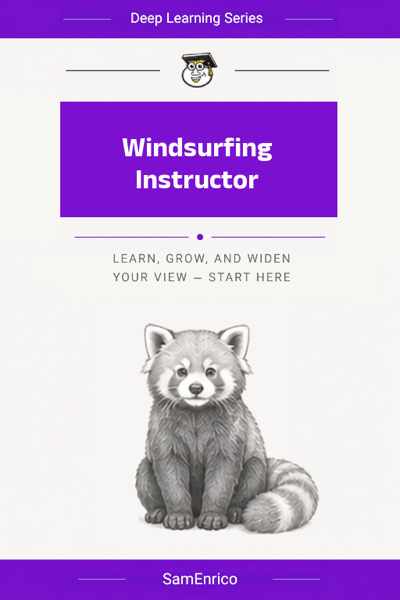
Windsurfing Instructor eBook
A Coursebook on Windsurfing Instructor
A Coursebook on Windsurfing Instructor
Formats
Free sample
Chapter 1: Beyond the Rig...--The difference between a person who knows how to windsurf and a person who knows how to teach windsurfing is not a matter of skill. It is a matter of translation. You can be a former professional wave sailor with thirty years of water time, capable of loop jumps and forward spins that make spectators gasp, and still be a completely ineffective instructor. Conversely, you can be an intermediate sailor who only recently mastered the carve gybe and yet become the most sought-after coach at your local center. The secret has nothing to do with your personal top speed or your freestyle repertoire.
The secret is understanding that your job is not to sail. Your job is to make other people sail.This single distinction separates the hobbyist from the professional, the person who happens to give occasional pointers from the certified instructor who transforms terrified beginners into confident, independent windsurfers. The entire sport of windsurfing, for all its athletic demands and technical complexity, ultimately rises or falls on the quality of its instruction. A student's first experience with a rig and a board will determine whether they return for a second lesson, whether they buy their own equipment, whether they bring their children to the sport, or whether they walk away forever convinced that windsurfing is impossibly hard, painfully cold, and reserved only for the athletic elite. You, as the instructor, hold that decision in your hands.This book exists to ensure that you make the right decision every time.
But before we dive into the mechanics of rig setup, the psychology of feedback, the physics of apparent wind, or the business of running a profitable school, we must first establish the foundation upon which every subsequent chapter rests. That foundation is not a technique. It is not a certification. It is a mindset. Specifically, it is the recognition that you are not teaching a sport.
You are teaching a person. And that person brings to the water a unique constellation of fears, expectations, prior athletic experience, learning preferences, and tolerance for cold water, embarrassment, and physical failure.Understanding the Modern Windsurfing Ecosystem Let us begin with a sobering fact. Windsurfing participation in most Western countries peaked in the late 1980s and early 1990s, then declined sharply with the rise of kiteboarding, stand-up paddleboarding, and most recently wingfoiling. Many windsurfing schools closed. Equipment manufacturers consolidated or went bankrupt.
A generation of potential sailors grew up believing that windsurfing was outdated—something their uncle did in the era of fluorescent wetsuits and boom boxes on the beach.Yet something unexpected happened in the last five years. Windsurfing has begun to return, not as the dominant watersport it once was, but as a refined, technologically advanced, and deeply satisfying discipline that offers something no other board sport can match: direct, mechanical connection to the wind through a rigid mast and a boom. Unlike kiteboarding, where power comes from a fabric canopy tethered by lines, or wingfoiling, where the wing is held separately from the board, windsurfing offers immediate tactile feedback. The sailor feels every gust, every lull, every shift in pressure through their hands, arms, and torso. This feedback loop creates a meditative focus that experienced sailors describe as being "in the groove"—a state of flow where the boundary between sailor, rig, board, and water dissolves into pure motion.The instructor's challenge, therefore, is twofold.
First, you must help students overcome the initial difficulty curve, which is genuinely steeper than almost any other board sport. A beginner on a stand-up paddleboard can be paddling around happily within fifteen minutes. A beginner on a windsurf board will spend the first hour simply trying to stand up, lift the sail, and figure out which way the wind is blowing. Second, you must frame this difficulty not as a barrier but as a feature. The very steepness of the learning curve means that the rewards—the first planing reach, the first harness ride, the first carve gybe—are correspondingly profound.The Three Major Certification Schemes No book on windsurfing instruction would be complete without an understanding of the three major certification bodies that govern instructor training worldwide.
While many local schools develop their own internal systems, the vast majority of recognized certifications fall under one of these umbrellas. Understanding their differences, strengths, and weaknesses will help you choose the right pathway for your career and adapt your teaching style to whatever scheme your employer uses.The Royal Yachting Association (RYA), based in the United Kingdom, operates the most globally recognized and pedagogically rigorous system. The RYA does not simply teach instructors how to sail; it teaches them how to teach. Their instructor training programs emphasize structured lesson planning, the "Tell, Show, Do, Review" model, and detailed progression ladders that break every skill into tiny, achievable steps. An RYA instructor can walk onto any beach in the world, pick up any brand of equipment, and deliver a consistent, safe, and effective lesson.
The downside is that the RYA system can feel prescriptive to experienced sailors who prefer a more intuitive, "feel it out" approach. The RYA also requires significant time and financial investment, including multiple assessment days and logbook sign-offs.The United States Sailing Association (US Sailing) offers a different philosophy. Their "Start Windsurfing Right!" program prioritizes getting students on the water as quickly as possible, with less emphasis on dry-land simulation and more on trial-and-error learning in controlled conditions. US Sailing certifications are widely recognized across North America and increasingly in international resort settings. The strength of this approach is that students feel immediate progress and are less likely to become bored with extended land drills.
The weakness is that students may develop bad habits—incorrect stance, inefficient sail handling, poor harness technique—that become difficult to correct later. US Sailing has recently updated its instructor materials to incorporate more structured pedagogy, but the cultural emphasis remains on "on-the-water quickly."The VDWS (Verband Deutscher Windsurfing und Wassersportschulen), based in Germany, takes a third approach. The VDWS system is heavily focused on the business and operational aspects of running a windsurf school. Their instructor certifications include substantial modules on equipment fleet management, repair, customer service, and legal liability. VDWS instructors are common in European resort destinations, particularly in Greece, Turkey, Egypt, and the Canary Islands.
The VDWS strength is practical: a VDWS instructor can not only teach but also maintain the rental fleet, manage bookings, handle customer complaints, and keep the school profitable. The weakness is that the teaching methodology itself can be less standardized than the RYA, relying more on individual instructor experience.As you read this book, you will notice that I draw primarily from RYA methodology, not because it is inherently superior, but because it provides the most explicit, replicable, and evidence-based framework for teaching. However, I have also incorporated the "on-water quickly" insights from US Sailing and the operational wisdom of VDWS. A truly excellent instructor borrows from all three traditions, using the RYA structure to ensure no student falls through the cracks, the US Sailing energy to keep lessons fun and engaging, and the VDWS business sense to keep the school solvent.The Instructor Pathway: From Assistant…
This is the end of the free sample. Get the eBook to keep going. Buy now
About this book
Details
- Author
- Sykes Bronwyn
- Publisher
- SamEnrico
- Language
- English
- Genre
- Non-Fiction, Informative, Educational
- Released
- 2026-06-02
- Pages (approx.)
- 133
- Available as
- eBook, Audiobook

Read better in the ZLOADR app
Your eBooks on your phone or tablet. Sign in with your SamEnrico account and start reading.
More by Sykes Bronwyn
 Indian Green Incentives HandbookSykes Bronwyn$11.99
 TM Documentary Watch GuideSykes Bronwyn$11.99
 Men's Ventricular Assist Device GuideSykes Bronwyn$11.99
 The 4 Month Sleep Regression GuideSykes Bronwyn$11.99
 Workplace Stress First Aid TechniquesSykes Bronwyn$11.99
 Ragnarok’s Last Light: The Doomed Prophecy of the Sun’s EclipseSykes Bronwyn$11.99
 Shadows Over the Silk Road: The KGB's Lost AgentSykes Bronwyn$11.99
 How to Become a Camp TenderSykes Bronwyn$11.99
 Technical Skills Development GuideSykes Bronwyn$12.99
 Medical Exam for Express EntrySykes Bronwyn$12.99
 Understanding Chromosome 16, Uniparental DisomySykes Bronwyn$17.99
You may also like
 Hong Kong Handover 1997Dunn Johnnie$11.99
 Zumba For Postnatal Recovery CourseNeal Christian$11.99
 Zumba for BeginnersLadner Nikia$11.99
 YouTube Comment Mining GuideHumes Pandora$12.99
 Worry Box MeditationCarlin Rudy$11.99
 Workplace Stress MeditationNguyen Lynn$11.99
 Workplace Stress and Sleep RepairHawley Ivory$11.99
 Workplace Perfectionism CureDelaney Jeffry$11.99
 Workplace Injustice Anger GuideWallen Isabelle$11.99
 Work Addiction and Burnout LinkGreenwood Ester$11.99
 Women in Yoga and WellnessBeattie Galina$11.99
 Women in Stand Up ComedyChun Evangeline$11.99