
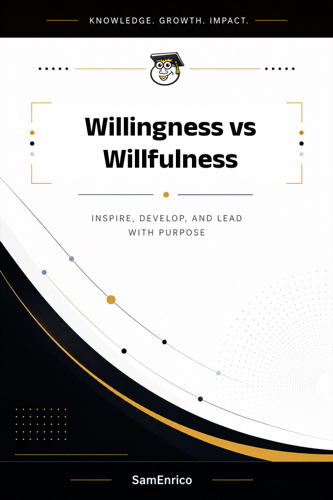
Non-FictionSelf-HelpAcceptance
Willingness vs Willfulness eBook
Accept reality vs fighting what cannot change.
by Boykin Buddy
Accept reality vs fighting what cannot change.
Formats
Free sample
Chapter 1: The Two Doors--You are fighting something right now. Maybe it is a boss who will not change. Maybe it is a body that has betrayed you. Maybe it is a past mistake you replay every night like a film you cannot turn off. Or maybe it is something smaller but no less exhausting: a spouse who leaves dishes in the sink, a flight delayed for the third time, a political outcome you cannot accept.
Whatever it is, you are expending energy on it. And that fight—not the thing you are fighting—is likely the source of most of your daily exhaustion, your background irritation, and your sense of being perpetually stuck.This book makes a startling claim: most human suffering is not caused by pain itself. Pain is inevitable. You will experience loss, rejection, physical discomfort, and disappointment. That is not the problem.
The problem is the second layer—the layer of resistance, refusal, and relentless fighting against what has already happened. That second layer is willfulness. And it is optional.Welcome to the foundational dichotomy of this book: willingness versus willfulness. Willingness is the capacity to see reality clearly and respond to it with openness, flexibility, and effective action. It is not passive resignation.
It is not giving up. It is the active, courageous choice to stop fighting the unchangeable so that you can direct your energy toward what actually works. Willfulness, by contrast, is the stubborn, often unconscious attempt to force reality to conform to your desires, preferences, or demands. It is the clenched fist pounding against a wall that will not break. It is the internal scream that says, "This should not be happening," long after it is already happening.If you have ever lain awake at night replaying an argument, hoping that somehow your rumination will rewrite the past, you have experienced willfulness.
If you have ever tried to control another person's behavior through nagging, manipulation, or silent treatment, you have experienced willfulness. If you have ever raged against a diagnosis, a layoff, or a death as if your anger could reverse time, you have experienced willfulness. And if you have ever felt exhausted despite doing nothing physical all day, you have likely experienced the hidden cost of willfulness: the enormous metabolic price of fighting reality itself.The good news is that willingness is a skill. It is not a personality trait you either have or lack. It is a muscle you can build, a practice you can learn, and a mindset you can cultivate.
This book exists to teach you exactly how to do that—how to move from the locked room of willfulness into the open field of willingness, one small choice at a time.But before we go any further, a crucial clarification. For the next ten chapters, we will focus on willfulness as a source of suffering. We will explore how fighting the unchangeable drains your energy, damages your relationships, and keeps you stuck. There is, however, one important exception to this framing—a place where willfulness is not only useful but essential. That exception involves fighting for change when change is genuinely possible: social justice, personal ambition, and the pursuit of a better future.
We will explore that exception fully in Chapter Eleven. For now, assume that when we speak of willfulness as problematic, we mean willfulness applied to the unchangeable. The wisdom of knowing the difference between what can and cannot be changed is the very heart of this book.The Serenity Prayer as a Compass You have likely encountered the Serenity Prayer before, though perhaps not as a practical tool for daily life. Written by theologian Reinhold Niebuhr in the 1930s and later adopted by Twelve-Step programs worldwide, the prayer offers a deceptively simple framework: "God, grant me the serenity to accept the things I cannot change, courage to change the things I can, and wisdom to know the difference."Most people hear this prayer and focus on the first two requests: serenity and courage. They want to feel peaceful about what they cannot change, and they want to feel brave about what they can.
These are worthy goals. But the prayer's true genius lies in the third line: the wisdom to know the difference. Because without that wisdom, serenity becomes passivity and courage becomes willfulness. You cannot accept what you mistakenly believe you can still change—that would be premature resignation. And you cannot effectively change what is actually unchangeable—that would be exhausting futility.This book is essentially a manual for developing that wisdom.
The first half teaches you how to recognize the unchangeable and practice acceptance. The second half teaches you how to mobilize effective action without falling into the trap of willful control. And throughout, you will learn a series of practical skills—breath work, somatic release, cognitive reframing, and behavioral practices—that build your capacity to discern and respond wisely.But let us begin with a story. It is a story about two people facing the exact same reality. Only one of them finds peace.The Parable of the Two Doors Imagine two people standing in a long, narrow corridor.
At the far end of the corridor are two doors. Door A is made of solid steel, bolted from the outside, with no handle on the inside. Door B is made of old wood, slightly ajar, with warm light spilling through the crack.The first person—let us call her Willful Wendy—approaches Door A. She tries the handle. It does not move.
She pushes. The door does not budge. She throws her shoulder against it. Nothing. She begins to scream, "This door should open!
It is unfair that it is locked! Someone did this to me!" She kicks the door until her foot bruises. She searches for a tool to pry it open. She enlists others to help her break it down. Days pass.
Weeks. She grows exhausted, bitter, and isolated. She blames the door. She blames the person who locked it. She blames herself for not trying harder.
All the while, Door B remains open just a few feet away, unnoticed or ignored because it is not the door she wanted.The second person—let us call him Willing Will—approaches Door A. He tries the handle. It does not move. He pushes. Nothing.
He takes a breath and says quietly, "This door is locked. That is simply what is true right now." He does not like it. He wishes it were different. But he does not argue with the lock. He turns around, walks to Door B, and steps through into the open field beyond.
The field is not perfect. There are rocks and uneven ground. But there is also sky, and air, and a path forward. He is not happy about Door A. He is simply no longer trapped by it.This parable will recur throughout this book.
Door A represents everything you cannot change: the past, other people, your age, your biology, the laws of physics, the fact of loss. Door B represents willingness—the choice to turn toward what is possible rather than exhausting yourself against what is not. Willful Wendy is not stupid or weak. She…
This is the end of the free sample. Get the eBook to keep going. Buy now
About this book
Details
- Author
- Boykin Buddy
- Publisher
- SamEnrico
- Language
- English
- Genre
- Non-Fiction, Self-Help, Acceptance
- Released
- 2026-06-07
- Pages (approx.)
- 127
- Available as
- eBook, Audiobook

Read better in the ZLOADR app
Your eBooks on your phone or tablet. Sign in with your SamEnrico account and start reading.
More by Boykin Buddy
 Remote Work for Social WorkersBoykin Buddy$11.99
 Design Thinking for Vision SettingBoykin Buddy$11.99
 Veteran Sleep MeditationBoykin Buddy$11.99
 Empathy and AttachmentBoykin Buddy$11.99
 The Twelve Step Beginner PrimerBoykin Buddy$11.99
 NVC in Schools GuideBoykin Buddy$11.99
 Catherine Territorial ExpansionBoykin Buddy$11.99
 The Resurrectionists: Canada's Victorian Grave Robbery ScandalBoykin Buddy$11.99
 The Armored Train of the Red Army: Tsaritsyn's Iron GambitBoykin Buddy$11.99
 A Collector's Handbook to the Hillman Minx (1940-44)Boykin Buddy$11.99
 10 Ways to Use Hyssop (Recipe Book)Boykin Buddy$11.99
 Service Providers Guide to Cosmetic DentistryBoykin Buddy$11.99
You may also like
 Hong Kong Handover 1997Dunn Johnnie$11.99
 Zumba For Postnatal Recovery CourseNeal Christian$11.99
 Zumba for BeginnersLadner Nikia$11.99
 YouTube Comment Mining GuideHumes Pandora$12.99
 Worry Box MeditationCarlin Rudy$11.99
 Workplace Stress MeditationNguyen Lynn$11.99
 Workplace Stress and Sleep RepairHawley Ivory$11.99
 Workplace Perfectionism CureDelaney Jeffry$11.99
 Workplace Injustice Anger GuideWallen Isabelle$11.99
 Work Addiction and Burnout LinkGreenwood Ester$11.99
 Women in Yoga and WellnessBeattie Galina$11.99
 Women in Stand Up ComedyChun Evangeline$11.99