
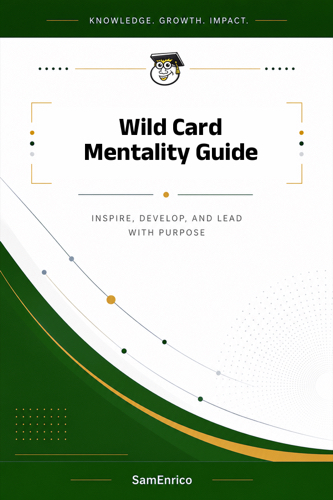
Non-FictionBiographyUnderdog Strategy
Wild Card Mentality Guide eBook
Embrace the chaos and opportunity of do-or-die sit
Embrace the chaos and opportunity of do-or-die situations like playoff underdogs.
Formats
Free sample
Chapter 1: The Liability Paradox--–- The call came at 3:47 AM. My phone buzzed against the wooden nightstand like a trapped insect, and I knew before I answered that everything had changed. Not because I was psychic, but because people don't call at 3:47 AM to share good news. They call at 3:47 AM when the thing they've been pretending isn't happening has finally happened.On the other end of the line, my business partner's voice sounded small and distant, as if he were speaking from the bottom of a well. "It's over," he said.
"The investors pulled out. All of them. We have nothing."I sat up in the darkness, my feet finding the cold floor, and I waited for the feeling I expected to arrive: panic. Despair. The hot rush of cortisol that tells you your world is ending.
But instead, something strange happened. I felt calm. Not the calm of resignation or the numbness of shock. A different kind of calm. The calm of someone who had been here before.
The calm of someone who had learned, through years of being counted out, that the moment everyone else calls a crisis is actually the moment when everything becomes clear.Three years earlier, I had been sitting in a different room, in a different city, holding a different kind of bad news. A termination letter. "We're letting you go," my manager had said, not meeting my eyes. "You're just not a good fit for our culture." Translation: I asked too many questions. I moved too fast.
I didn't know how to play the game of nodding along while the company slowly veered off a cliff. I was, in every sense that mattered to them, a liability.What I didn't know then—what I would spend the next decade learning—was that their liability was my superpower. And that is the paradox at the heart of this book.The Lie You've Been Told About Advantage Let me start with a provocation: most of what you believe about advantage is wrong. Not slightly off, not in need of minor adjustment, but categorically, dangerously wrong.We live in a culture obsessed with assets. Get more funding.
Hire more people. Acquire more customers. Build a bigger office. Buy better technology. The logic seems unassailable: more is better.
Bigger is stronger. The favorite wins because the favorite has more.Except the data doesn't support this. Not even close.Malcolm Gladwell, in his brilliant dissection of power dynamics in David and Goliath, documented something that should have shattered our assumptions forever: favorites lose far more often than they should, and they lose not despite their advantages but because of them. Large budgets create bureaucracy—layers of approval that slow decision-making to a crawl. Elite reputations breed complacency—the quiet assumption that victory is inevitable, which kills the desperate innovation that actually wins games.
Superior size leads to predictable strategies—when you're used to winning by brute force, you stop developing agility.Consider the data from professional sports, where the concept of "favorite" is most measurable. In the NBA, teams with a 3-1 lead in the playoffs have lost the series only eleven times in history. That sounds like evidence that favorites win. But look closer: those eleven losses are not random. They share a pattern.
The team that blew the 3-1 lead was almost always the team with superior talent, deeper resources, and a culture of expecting to win. And the team that came back? Almost always the hungrier team, the more creative team, the team that had nothing to lose and everything to prove.The 2016 Cleveland Cavaliers, down 3-1 to the 73-win Golden State Warriors—the greatest regular season team in NBA history. The 2004 Boston Red Sox, down 3-0 to the New York Yankees—a deficit no team in baseball history had ever overcome. The 2017 Philadelphia Eagles, underdogs in every single playoff game, facing Tom Brady and the greatest dynasty in football.
In each case, the favorite had every imaginable advantage. In each case, the favorite lost.This is not an accident. This is a pattern. And it reveals the first law of the Wild Card mentality: the things you think are helping you are often hurting you, and the things you think are holding you back are often your deadliest weapons.The Poison Trait Test: When a Weakness Is Just a Weakness Before we go any further, I need to make something clear. I am not going to tell you that every weakness is secretly a strength.
That is the kind of motivational nonsense that sounds good on a poster but falls apart the moment you try to apply it to real life.Some weaknesses are just weaknesses. Chronic lateness is not a hidden superpower. Dishonesty is not a strategic weapon. An inability to follow through on commitments is not a sign of creative thinking. These are poisons, and pretending otherwise is how well-intentioned advice becomes dangerous delusion.So let me give you a tool to distinguish between the traits you can weaponize and the traits you need to manage or eliminate.
I call it the Poison Trait Test, and it consists of three questions:Question 1: Does this trait cause predictable harm across all contexts?If your trait leads to negative outcomes regardless of the situation—if it's not situational but universal—you're dealing with a poison. The person who lies in every context, who is late to every meeting, who fails to deliver on every promise—that's not an underappreciated genius. That's someone with a problem that needs solving, not reframing.Question 2: Can you deploy this trait intentionally, or does it control you?A weaponizable trait is one you can turn on and off depending on the situation. Impatience, for example, can be deployed intentionally when speed matters more than consensus, then suppressed when careful listening is required. A poison trait is one that controls you—you're late whether you want to be or not, you lie before you've decided to, you fail to follow through even when you're trying your hardest.Question 3: Have you ever seen anyone succeed because of this exact trait?This is the empirical test.
Can you point to a single example—in sports, business, art, or any field—where someone's supposed weakness was the direct cause of their success? If you can't find a single example, you're looking at a poison. If you can find many examples, you're looking at a weapon waiting to be deployed.Let me give you an example. I once worked with a founder who was told his entire career that he was "too impatient." He couldn't sit through long strategy meetings. He wanted decisions made in hours, not weeks.
His board saw this as a flaw to be corrected. But when I ran him through the Poison Trait Test, something interesting emerged. His impatience did not cause harm across all contexts—it caused harm in bureaucratic environments but created massive value in fast-moving markets. He could deploy it intentionally, speeding up when speed was the advantage and slowing down when deliberation was required. And I could point to dozens of successful founders—from Steve Jobs to Reed Hastings—whose impatience was legendary and directly tied to their…
This is the end of the free sample. Get the eBook to keep going. Buy now
About this book
Details
- Author
- Spellman Ruthanne
- Publisher
- SamEnrico
- Language
- English
- Genre
- Non-Fiction, Biography, Underdog Strategy
- Released
- 2026-06-06
- Pages (approx.)
- 132
- Available as
- eBook, Audiobook

Read better in the ZLOADR app
Your eBooks on your phone or tablet. Sign in with your SamEnrico account and start reading.
More by Spellman Ruthanne
 The Performing Teen GuideSpellman Ruthanne$11.99
 Snapchat Streak Comparison TrapSpellman Ruthanne$11.99
 Carson Presidential MedalSpellman Ruthanne$11.99
 TikTok Highlight Reel RecoverySpellman Ruthanne$11.99
 The Childhood Worth Wound WorkbookSpellman Ruthanne$11.99
 Gratitude Habit GuideSpellman Ruthanne$11.99
 Self Doubt Destroyer GuideSpellman Ruthanne$11.99
 Commute Burnout ReductionSpellman Ruthanne$11.99
 The Last Broadcast: When the Radio DiedSpellman Ruthanne$11.99
 The Silent Storm: How a Forgotten Admiral Won the Cold War at SeaSpellman Ruthanne$11.99
 Growing SeriphidiumSpellman Ruthanne$11.99
 UK Employee Stock Options Tax GuideSpellman Ruthanne$12.99
You may also like
 Hong Kong Handover 1997Dunn Johnnie$11.99
 Zumba For Postnatal Recovery CourseNeal Christian$11.99
 Zumba for BeginnersLadner Nikia$11.99
 YouTube Comment Mining GuideHumes Pandora$12.99
 Worry Box MeditationCarlin Rudy$11.99
 Workplace Stress MeditationNguyen Lynn$11.99
 Workplace Stress and Sleep RepairHawley Ivory$11.99
 Workplace Perfectionism CureDelaney Jeffry$11.99
 Workplace Injustice Anger GuideWallen Isabelle$11.99
 Work Addiction and Burnout LinkGreenwood Ester$11.99
 Women in Yoga and WellnessBeattie Galina$11.99
 Women in Stand Up ComedyChun Evangeline$11.99