
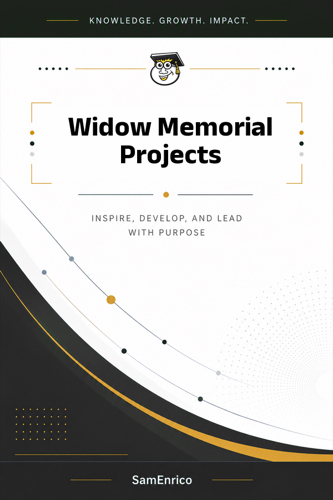
Non-FictionSelf-HelpMemorializing
Widow Memorial Projects eBook
Create lasting tribute to honor spouse's life and
Create lasting tribute to honor spouse's life and legacy.
Formats
Free sample
Chapter 1: The Half-Finished Grocery List...–- On the night before he died, my husband wrote the first three words of a grocery list and then got up to answer the phone. “Milk, eggs, bread”—that was it. For six months, that half-finished scrap of paper sat under a magnet on my refrigerator, a silent accusation. Every time I reached for the butter, I saw those three words and thought: He didn’t get to finish. We didn’t get to finish.
I couldn’t throw it away. I couldn’t frame it. I couldn’t even look at it without my throat closing. That scrap of paper was everything wrong with grief: the sudden stop, the incomplete sentence, the life that ended mid-thought.This book exists because of that grocery list. And because of what happened next.One afternoon, deep in the fog of the first year, a friend came over.
She didn’t say “Let me know if you need anything.” She didn’t bring a casserole. She walked straight to the refrigerator, took down the list, and said, “Let’s finish it.” I stared at her. She grabbed a pen and wrote the next item: “Coffee. The good kind.” Then she handed me the pen. I stared at the paper for a long time.
Then I wrote: “Something that doesn’t hurt.” She wrote: “Impossible. Try ‘something that hurts less.’” And somehow, in that ridiculous, impossible moment, I laughed. Not because it was funny. Because she understood something that most people don’t: grief isn’t about erasing the unfinished sentence. It’s about learning to add to it.That is what this book is about.
Not letting go. Not moving on. Not “closure”—a word I have come to hate because it suggests that love has an off switch. This book is about something far more radical: the idea that you can keep loving your spouse, keep talking to them, keep building a life that includes them, even after they are gone. And one of the most powerful ways to do that is through a memorial project—a tangible, intentional act of creation that transforms your grief into something you can see, touch, share, or experience.The Lie We’ve Been Told About Grief Before we talk about projects—quilts, gardens, scholarships, voice recordings, annual rituals—we have to talk about the story you have been told your entire life.
The story goes like this: grief has stages. You move through denial, anger, bargaining, depression, and finally—if you do the work, if you’re strong enough—acceptance. And acceptance looks like letting go. It looks like putting away the photos. It looks like not crying at the grocery store when you see their brand of coffee.
It looks like moving on.That story is wrong.It was invented in 1969 by a psychiatrist named Elisabeth Kübler-Ross, who was actually describing the emotional states of terminally ill patients facing their own deaths—not the experience of bereaved spouses. Somewhere along the way, our culture applied her framework to everyone who has ever lost someone. And it has been causing harm ever since.Why? Because when you don’t experience grief as five tidy stages—when you feel anger years later, or you accept the death and then wake up one morning unable to breathe—you conclude that you’re doing it wrong. You’re broken.
Everyone else seems to have moved on; why can’t you?You’re not broken. You’re human.The Science of Continuing Bonds Over the past three decades, researchers in thanatology (the study of death and dying) have developed a different model, one that actually matches what bereaved people report feeling. It’s called Continuing Bonds Theory, and it was first articulated by Dennis Klass, Phyllis Silverman, and Steven Nickman in their 1996 book of the same name.Here is what they discovered through decades of clinical research: the healthiest grievers are not the ones who “let go.” They are the ones who find a way to maintain a bond with the deceased—a bond that changes over time but never disappears. They talk to their spouse. They keep their photo on the nightstand.
They laugh at inside jokes. They make decisions by asking, “What would they want me to do?”The key word is continuing. Not frozen. Not static. A living bond that evolves as you evolve.I remember the first time I read about continuing bonds.
I was sitting in a coffee shop, still in that first year, convinced that my nightly conversations with my husband’s photograph were a sign of pathology. I thought I was stuck. The book said something else: You are not stuck. You are connected. And that connection is not a symptom of complicated grief—it is a source of resilience.That moment changed everything.
It gave me permission to keep loving him. Permission to keep including him. Permission to stop trying to “move on” and instead start trying to move forward with him still beside me.The Problem with the Funeral Let me be clear about something: funerals are important. The gathering, the eulogies, the ritual—these help the community acknowledge a death. But funerals are not for the widow.
Not really. They happen in a blur. You shake hands. You say thank you. You wear clothes that feel like costumes.
And then, usually within a week or two, the flowers die, the casseroles run out, the calls taper off, and you are left alone.The funeral is a single event. Grief is a lifelong process.This is the gap that memorial projects fill. A memorial project is not a one-time ritual. It is an ongoing practice. It is something you can return to when the anniversary rolls around, when you find an old voicemail, when you need to feel close to them.
It bends. It changes. It grows with you.And unlike a headstone—which someone else designed, which cost thousands of dollars, which sits in a cemetery you may only visit twice a year—a memorial project is yours. It reflects your spouse, yes. But it also reflects you.
Your hands. Your creativity. Your love.What This Book Is—And What It Is Not Let me set expectations clearly.This book is not a grief therapy manual. I am not a therapist. If you are in the early weeks or months of loss—if you cannot eat, cannot sleep, cannot function—please put this book down and seek professional support.
There is no shame in that. Grief can be a medical event, and it deserves medical attention.This book is not prescriptive. You will not be told that you must make a quilt or plant a garden or start a scholarship. Instead, you will be offered a menu of possibilities, ranging from five-minute projects (Chapter 2) to lifelong commitments (Chapter 10). You will choose what fits.
You will ignore what doesn’t.This book is not linear. You do not have to read it in order. If you want to skip straight to Chapter 7 (digitizing voice and handwriting), do it. If Chapter 6 (the garden) makes you want to throw the book across the room, skip…
This is the end of the free sample. Get the eBook to keep going. Buy now
About this book
Details
- Author
- Mccue Josphine
- Publisher
- SamEnrico
- Language
- English
- Genre
- Non-Fiction, Self-Help, Memorializing
- Released
- 2026-06-07
- Pages (approx.)
- 139
- Available as
- eBook, Audiobook

Read better in the ZLOADR app
Your eBooks on your phone or tablet. Sign in with your SamEnrico account and start reading.
More by Mccue Josphine
 Imposter After LayoffMccue Josphine$11.99
 Survivor Benefit Planning GuideMccue Josphine$11.99
 Reconstruction of Domestic HomicidesMccue Josphine$11.99
 Pomodoro for Real EstateMccue Josphine$11.99
 Memory Palace For Sports PlaysMccue Josphine$11.99
 Intonation for HypnosisMccue Josphine$11.99
 Christina Ricci Wednesday AddamsMccue Josphine$11.99
 The Ides of Shadow: Caesar and Pompey's Doomed RepublicMccue Josphine$11.99
 Hannibal's Gambit: The Genius of the Second Punic WarMccue Josphine$11.99
 Mastering The HamstringsMccue Josphine$11.99
 How to Start a Commodities Dealing for Investment Purposes Business (Beginners Guide)Mccue Josphine$11.99
 College Essay Title Crafting GuideMccue Josphine$12.99
You may also like
 Hong Kong Handover 1997Dunn Johnnie$11.99
 Zumba For Postnatal Recovery CourseNeal Christian$11.99
 Zumba for BeginnersLadner Nikia$11.99
 YouTube Comment Mining GuideHumes Pandora$12.99
 Worry Box MeditationCarlin Rudy$11.99
 Workplace Stress MeditationNguyen Lynn$11.99
 Workplace Stress and Sleep RepairHawley Ivory$11.99
 Workplace Perfectionism CureDelaney Jeffry$11.99
 Workplace Injustice Anger GuideWallen Isabelle$11.99
 Work Addiction and Burnout LinkGreenwood Ester$11.99
 Women in Yoga and WellnessBeattie Galina$11.99
 Women in Stand Up ComedyChun Evangeline$11.99