
Non-FictionSelf-HelpSurvivor Guilt
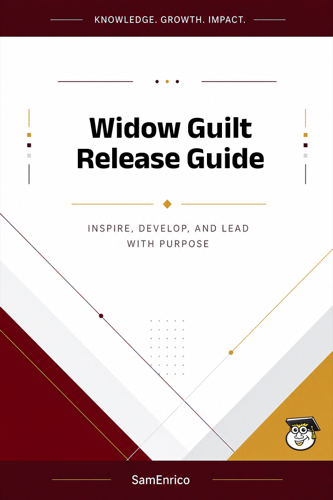
Widow Guilt Release Guide eBook
Let go of 'if only' thoughts and self blame after
by Leyva Karin
Let go of 'if only' thoughts and self blame after spouse dies.
Formats
Free sample
Chapter 1: The Uninvited Guest--Guilt arrives without knocking. Unlike grief, which you expect—the sadness, the anger, the hollow ache of an empty bed—guilt slips in through a crack you didn't know existed. One moment you are simply missing your partner. The next, you are replaying a Tuesday afternoon from three years ago, wondering if that one tired sigh meant you didn't love them enough. You did not invite this feeling.
You do not want it. And yet, here it is, sitting on your chest, whispering that you could have done something different. That you should have. That you failed.If you are reading this chapter, you have likely already met this uninvited guest. Perhaps you have been telling yourself that your guilt is irrational, that you know logically you did nothing wrong, but the feeling persists.
Perhaps you have been secretly relieved that your partner's long illness is over, then immediately hated yourself for that relief. Perhaps you have laughed at something—a movie, a friend's joke, a memory—and felt the joy curdle into shame because how dare you laugh when they cannot. Or perhaps you carry the specific, grinding guilt of the caregiver: the belief that if only you had noticed the symptom sooner, pushed harder for a second opinion, been more patient, less exhausted, more loving, less human—then they would still be here.This chapter exists to tell you something that no other voice in your head is currently saying: your guilt is not evidence that you were a bad partner. It is evidence that you loved someone. That love, when confronted with the chaos of loss, has nowhere to go.
So it transforms. It wraps itself in regret and calls itself proof of your failure. But that is a lie—a lie your brain tells you because the truth is far more terrifying. The truth is that you were not in control. And the human mind, which craves cause and effect more than it craves food or water, would rather invent a false cause than accept randomness.
Guilt, paradoxically, feels better than helplessness. Because if you could have prevented the death, then the world is predictable. If you could have done something, then you are not powerless. Guilt is the illusion of control wearing a mask of self-blame.This chapter will not ask you to stop feeling guilty. That would be like asking a river to stop flowing.
Instead, it will help you understand why guilt is the cruelest symptom of grief, how it differs from sadness and anger, and why feeling guilty does not mean you are guilty. By the end of this chapter, you will have taken the first step toward release: not elimination, but transformation. You will learn to observe your guilty thoughts without believing them. And you will begin to separate the love that remains from the blame that was never yours to carry.The Cruelest Symptom When we imagine grief, we imagine tears. We imagine photographs held to chests, hands reaching for empty spaces, the silence of a phone that will never ring again.
Sadness is the expected visitor. It arrives in waves, and we know its name. We say, "I am grieving," and the world nods. We say, "I am angry," and the world understands—anger at the doctors, at the universe, at the unfairness of it all. These are the acceptable faces of loss.But guilt is different.
Guilt is the symptom that isolates you. When you tell someone you are sad, they may hug you. When you tell someone you feel guilty—that you believe you caused your partner's death, or failed them in their final days, or secretly wished for relief—they often fall silent. They do not know what to say. And in that silence, your guilt grows.
You think, See? Even they know I am monstrous. You pull away. You stop speaking. And the guilt, now unchallenged, moves into the empty spaces where conversation used to live.This is why guilt is the cruelest symptom.
Not because it hurts the most—though it often does—but because it isolates you at the exact moment when connection is most vital. Sadness invites comfort. Guilt repels it.Consider the difference in the stories we tell ourselves. Sadness says, "I am hurt. I miss them.
The world is emptier without them." Anger says, "This is unfair. I did not deserve this. They did not deserve this." But guilt whispers something far more insidious: "I am bad. I failed. I am responsible for this loss." Sadness and anger are emotions about the event.
Guilt is an emotion about the self. And when the self is condemned, there is no safe place to land.Yet here is the paradox that will save you: guilt is also a sign of love. You cannot feel guilty about someone you did not care for. The very presence of guilt proves that your partner mattered to you. The "if only" thoughts—if only I had noticed, if only I had been kinder, if only I had made them go to the doctor—are not the words of someone who didn't care.
They are the words of someone who cared deeply and is now searching for a way to reverse time. Guilt is love turned backward. It is love looking for a place to land after the person you love is gone.The goal of this book is not to eliminate that love. It is to redirect it—to turn it from self-blame toward self-compassion, from regret toward remembrance, from "if only" toward "even so." But before we can redirect anything, we must understand where the guilt came from in the first place.The Illusion of Control Your brain is a pattern-finding machine. It evolved to see cause and effect because seeing cause and effect kept your ancestors alive.
The rustle in the bushes is either the wind or a predator. If you assume it is a predator and run, you survive. If you assume it is the wind and stay, you might die. Your brain is biased toward assuming threat, and it is biased toward assuming that everything happens for a reason—because a world with reasons is a world you can navigate.This is called the illusion of control. It is not a flaw in your brain; it is a feature.
It kept you alive on the savanna. But it also creates suffering in the modern world, especially in the face of death. When your partner dies—from illness, accident, suicide, or any other cause—your brain faces a problem it cannot solve. The event is random, or at least unpredictable. There is no clear cause that you could have prevented.
But your brain refuses to accept randomness. So it searches for a cause anyway. And because you are the nearest variable, the cause it finds is often you.This is the origin of "if only." If only I had made them see a doctor. If only I had pushed harder. If only I had been more patient, more attentive, more loving.
Your brain is not trying to punish you. It is trying to restore order to a universe that has just…
This is the end of the free sample. Get the eBook to keep going. Buy now
About this book
Details
- Author
- Leyva Karin
- Publisher
- SamEnrico
- Language
- English
- Genre
- Non-Fiction, Self-Help, Survivor Guilt
- Released
- 2026-06-10
- Pages (approx.)
- 131
- Available as
- eBook, Audiobook

Read better in the ZLOADR app
Your eBooks on your phone or tablet. Sign in with your SamEnrico account and start reading.
More by Leyva Karin
 Imposter Remote Work FixLeyva Karin$11.99
 Bloodstain Pattern Reconstruction CasesLeyva Karin$11.99
 Mindfulness Master GuideLeyva Karin$11.99
 Pomodoro for TeachersLeyva Karin$11.99
 Natalie Portman Child ProfessionalLeyva Karin$11.99
 Disaster Preparedness Disability AdvocateLeyva Karin$11.99
 Peg System For PresidentsLeyva Karin$11.99
 The Last Broadcast: Orson Welles and the War of the Worlds PanicLeyva Karin$11.99
 The Bloodhound of Sydney Cove: A K9’s War on the Sicilian UnderworldLeyva Karin$11.99
 Research Proposal Resubmission Strategy GuideLeyva Karin$12.99
 College Application Essay EthicsLeyva Karin$12.99
 Mastering The Posterior DeltoidLeyva Karin$11.99
You may also like
 Hong Kong Handover 1997Dunn Johnnie$11.99
 Zumba For Postnatal Recovery CourseNeal Christian$11.99
 Zumba for BeginnersLadner Nikia$11.99
 YouTube Comment Mining GuideHumes Pandora$12.99
 Worry Box MeditationCarlin Rudy$11.99
 Workplace Stress MeditationNguyen Lynn$11.99
 Workplace Stress and Sleep RepairHawley Ivory$11.99
 Workplace Perfectionism CureDelaney Jeffry$11.99
 Workplace Injustice Anger GuideWallen Isabelle$11.99
 Work Addiction and Burnout LinkGreenwood Ester$11.99
 Women in Yoga and WellnessBeattie Galina$11.99
 Women in Stand Up ComedyChun Evangeline$11.99