
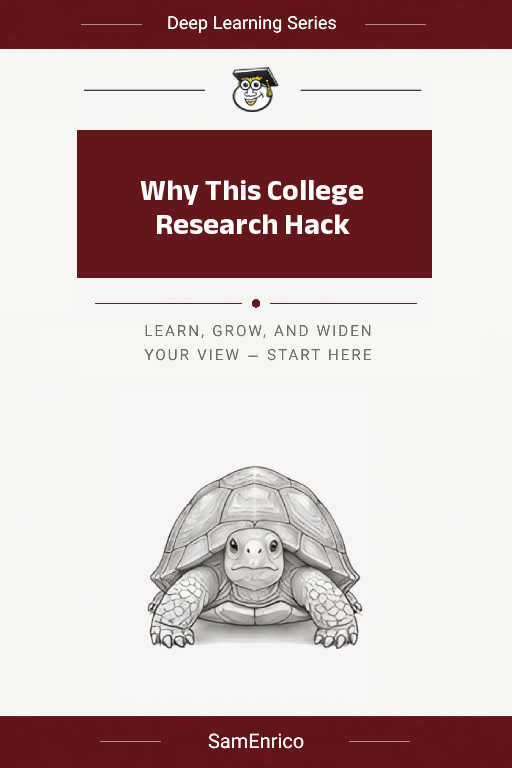
researchStudent's ShortcutDemonstrated InterestSupplemental Essays
Why This College Research Hack eBook
Find specific professors, courses, and traditions
by Lively Cammy
Find specific professors, courses, and traditions that prove genuine interest, then weave them naturally into your supplement.
Formats
Free sample
Chapter 1: The Tourist Trap...--Every year, nearly one million students write a "Why Us" college essay. And nearly one million of them get it wrong.Not because they aren't smart. Not because they lack ambition. But because they have been trained, by every guidance counselor, every parent, and every college marketing brochure, to write like tourists rather than detectives. They visit campuses.
They take official tours. They read the "About Us" page. And then they sit down to write an essay that sounds exactly like every other essay the admissions officer has read that morning.The result is a graveyard of generic phrases, buried under the weight of their own meaninglessness. "I love your small class sizes." "Your professors are world-renowned." "The campus is beautiful." "I can see myself here." These sentences are not technically false. Many selective colleges do have small classes.
Many do have prestigious faculty. But these statements describe every selective college, which means they describe no college uniquely. They are the academic equivalent of telling someone you like "food" and "air." Technically true. Completely useless.Here is the truth that no one tells you: Admissions officers do not read "Why Us" essays to learn about their own school. They already know their school.
They work there. They have memorized the brochure. They have walked the quad a thousand times. When they read your essay, they are not looking for confirmation that their institution has small classes. They are looking for evidence that you have done the work to understand what makes their institution different from every other institution on your list.And most of you haven't.This chapter is about understanding why generic essays fail, what admissions officers are actually looking for, and how to fundamentally shift your mindset from tourist to detective.
By the end of this chapter, you will never write another sentence like "I love your small class sizes" again. You will understand the difference between institutional features and individual artifacts. And you will have a new set of rules—including the most important rule about mentioning professors—that will guide every essay you write from this moment forward.The One-Paragraph Test Before we go any further, I want you to try something.Read the following paragraph. It is a real "Why Us" essay submitted to a top-twenty university. The names have been changed, but the words are exactly as they appeared."I have always dreamed of attending a university with a strong academic reputation.
Your small class sizes will allow me to build meaningful relationships with my professors. The campus is beautiful and I can already imagine myself studying on the quad. Your research opportunities are unparalleled, and I know that studying here will prepare me for a successful career. I am excited about the possibility of joining your community of scholars."Now, without looking back at the paragraph, answer these three questions:Which university was this written for?What specific course did the applicant want to take?What did the applicant actually do in high school?You cannot answer any of these questions. No one can.
Because this paragraph contains zero specific information. It could have been written for Harvard, Stanford, the University of Michigan, or a liberal arts college in Ohio. It describes no course, no professor, no program, no tradition, and no actual human being. The applicant has told the admissions officer nothing about themselves and nothing about why they chose this particular institution.This is what I call a Layer 1 essay—and we will spend significant time in later chapters upgrading Layer 1 and Layer 2 essays into what I call Layer 3. But for now, understand this: The admissions officer who read this paragraph spent approximately fifteen seconds on it, then moved to the next file.
The applicant was waitlisted. Not rejected—but waitlisted, which at top schools is a polite form of rejection.Now read this paragraph, written by a student with a similar academic profile for the same university:*"At my high school in rural New Mexico, I noticed that our community health clinic had a single EEG machine shared across three counties. For my AP Biology independent project, I built a seizure-detection algorithm using less than two hundred dollars of open-source hardware. When I read about Dr. Vasquez's recent zebrafish study on vitexin at the University of Richmond, I realized that her methodology—using low-cost models to test neurological treatments—could be replicated with my algorithm.
I want to spend my first semester in BIO 203 mastering neurobiology, then bring my coding background to Dr. Vasquez's pilot study as a sophomore research assistant. After graduation, I hope to deploy this system in the clinics that inspired it."*Which applicant do you think was accepted?The second applicant was accepted early decision. Not because their grades were better (they were comparable) and not because their test scores were higher (they were slightly lower). They were accepted because they wrote an essay that no one else could have written.
It mentioned a specific high school project (the EEG algorithm), a specific professor (Dr. Vasquez), a specific piece of research (the zebrafish/vitexin study), a specific course (BIO 203), and a specific real-world problem (rural New Mexico clinics). Every sentence contained information that was unique to this applicant and this university.The first applicant wrote about small class sizes. The second applicant wrote about zebrafish. The zebrafish won.Why Generic Phrases Are Silent Killers Let me be blunt: Certain phrases should never appear in a "Why Us" essay.
They are not merely clichés. They are signals that you did not do your research. Admissions officers have internalized these phrases as red flags. When they see them, they stop reading carefully and start skimming.Here is the list of phrases that will kill your essay:"Small class sizes" or "intimate learning environment""World-renowned professors" or "distinguished faculty""Beautiful campus" or "stunning architecture""Research opportunities" (without naming a specific project)"Vibrant community" or "diverse student body""I can see myself here""Your prestigious reputation""The perfect balance of rigorous academics and supportive community""I have always dreamed of attending"Why are these phrases so dangerous? Not because they are false.
Many of them are true. They are dangerous because they are transferable. You could copy and paste any of these phrases into an essay about any selective university, and the sentence would still be accurate. Transferability is the enemy of specificity. And specificity is the only thing that proves genuine interest.Think about it from the admissions officer's perspective.
They have a stack of five hundred applications for two hundred spots. They are reading at a rate of five to ten minutes per file. They have already read fifty "Why Us" essays that day. When they encounter your essay, they are not looking for reasons to accept you. They are looking for reasons to put your file in the "maybe" pile or the "no" pile.
Generic phrases are reasons to put you in the "maybe" pile, which at most selective schools is functionally a "no."The second applicant in our example used exactly zero of these generic phrases. Every sentence in their essay was specific to their experience and specific to the university. They…
This is the end of the free sample. Get the eBook to keep going. Buy now
About this book
Details
- Author
- Lively Cammy
- Publisher
- SamEnrico
- Language
- English
- Genre
- research, Student's Shortcut, Demonstrated Interest, Supplemental Essays
- Released
- 2026-06-01
- Pages (approx.)
- 142
- Available as
- eBook, Audiobook

Read better in the ZLOADR app
Your eBooks on your phone or tablet. Sign in with your SamEnrico account and start reading.
More by Lively Cammy
 Pomodoro Distraction Control CourseLively Cammy$11.99
 Zumba International StylesLively Cammy$11.99
 The Cleaning Crew SurvivorLively Cammy$11.99
 Conversation Starters for Multiracial FamiliesLively Cammy$11.99
 Graduate Exam PrepLively Cammy$11.99
 Child Death And SexualityLively Cammy$11.99
 Garmin Smartwatch RemindersLively Cammy$11.99
 Bipolar Personality IntegrationLively Cammy$11.99
 Workplace EQ Assessment GuideLively Cammy$11.99
 The Medici Dynasty: Banking, Art, and the Birth of the RenaissanceLively Cammy$11.99
 The Last Broadcast: The Mysterious Vanishing of Flight MH370Lively Cammy$11.99
 Shadows of the Reconquista: The Last Moorish Stand at GranadaLively Cammy$11.99
You may also like
 Scientific Research On TM GuideMartens Nathanial$11.99
 Research Proposal Methodology Section MasteryPauley Debroah$11.99
 Research Proposal Appendix CompilationRaines Tyisha$11.99
 Academic Researcher Distraction GuideFord Virgil$11.99
 TM Research and ScienceCovert Nicki$11.99
 Social Anxiety Research ReviewRoberge Cole$11.99
 Research Proposal Significance Section GuideBock Tory$12.99
 Research Proposal Reviewer PsychologyLugo Tawanda$11.99
 Research Proposal Research Questions DesignLara Robbi$11.99
 Research Proposal References and CitationsPatten Shanice$11.99
 Research Proposal Mixed Methods DesignCameron Omega$11.99
 Research Proposal Data Management PlanAnderson Roberto$12.99