
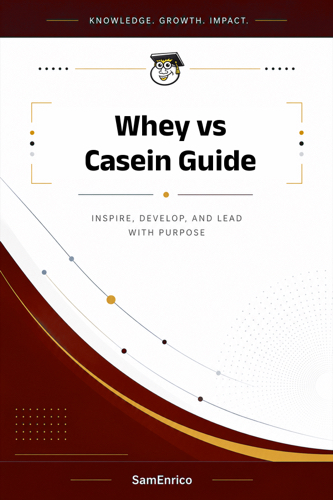
Whey vs Casein Guide eBook
Compares fast vs slow digesting dairy proteins for
by Dow Marleen
Compares fast vs slow digesting dairy proteins for timing purposes.
Formats
Free sample
Chapter 1: The $10 Billion Lie--–- Let me tell you something the supplement industry hopes you never figure out. Every year, you—along with millions of other health-conscious people—spend over ten billion dollars on protein powder. That number is not an exaggeration. According to market research, the global sports nutrition market surpassed forty billion dollars recently, with protein powders claiming the largest slice of that pie. And yet, despite all that money changing hands, despite all the billboards, Instagram ads, and gym bro lectures, most people are using protein completely wrong.
They buy the wrong type. They take it at the wrong time. And they are literally flushing their hard-earned money down the toilet while wondering why their muscles aren't growing the way they expected.I know this because I was one of those people for nearly a decade.For ten years, I did everything the "experts" told me. I chugged a whey protein shake within thirty minutes of finishing every workout, convinced that I was maximizing my "anabolic window." I bought the most expensive isolates because I thought they were superior. I never touched casein because someone on the internet said it was "slow and useless." And you know what happened?
I plateaued. Hard. My lifts stopped progressing. My recovery between workouts felt sluggish. And no matter how much whey I drank, I could not seem to add lean mass the way my training volume suggested I should.The turning point came when I stumbled upon a research paper that changed everything I thought I knew about protein.
The study was simple. Two groups of trained athletes consumed the same total amount of protein per day. The only difference was the timing and type. One group took all their protein as whey, mostly around their workouts. The other group split their protein between whey post-workout and casein before bed.
The results were not subtle. The group using both proteins, strategically timed, gained significantly more lean mass over eight weeks despite eating the same total protein and following the same training program.That was the moment I realized I had been lied to. Not maliciously, necessarily, but lied to nonetheless. The supplement industry has a vested interest in keeping things simple. Whey sells.
Whey is cheap to manufacture. Whey tastes decent and mixes easily. So they hammer the message that whey is all you need. They created the "anabolic window" myth to make you feel anxious if you do not drink your shake within thirty minutes. They buried the research on casein because casein is more expensive to produce and harder to flavor.
And millions of people have been stuck in mediocrity ever since.This book exists to fix that.The Two Proteins You Have Been Ignoring Before we can talk about timing, strategy, or protocols, you need to understand what whey and casein actually are. They come from the same source: cow's milk. But they are not the same. In fact, they could not be more different.Milk contains two families of protein. About twenty percent of the protein in milk is whey.
The other eighty percent is casein. That ratio is important because it tells you something about nature's design. Mammalian milk evolved over millions of years to nourish growing offspring. It contains both a fast protein and a slow protein for a reason. The fast protein provides an immediate surge of amino acids to stimulate growth.
The slow protein provides a sustained release to prevent breakdown between feedings. Your body works the same way, but most people only use half of that evolutionary gift.Whey is the protein that remains liquid when milk coagulates. If you have ever made cheese at home or watched a video of cheesemaking, you have seen whey. It is the thin, watery liquid that separates from the curds. Those curds are primarily casein.
The cheesemaking process physically separates these two proteins, which is why we can buy them in powdered form today.Here is where things get interesting. Despite coming from the same source, whey and casein behave completely differently inside your body. Whey is fast. Very fast. When you consume whey protein, it hits your stomach, gets broken down rapidly, and floods your bloodstream with amino acids within thirty to sixty minutes.
This spike in blood amino levels sends a powerful signal to your muscles. That signal says, "Build tissue now."Casein is the opposite. It is slow. When casein hits your stomach, it does not dissolve like whey. Instead, it forms a gel-like clot.
This clot slows down gastric emptying dramatically. Instead of a spike, casein produces a slow, steady trickle of amino acids that lasts for six to eight hours. It does not trigger the same explosive building signal that whey does. But it does something whey cannot do. It suppresses muscle breakdown.Think of it this way.
Whey is like throwing gasoline on a fire. You get a massive, immediate blaze. Casein is like adding a slow-burning log. The fire does not flare up, but it stays lit for hours.Most people only use the gasoline. They never add the log.
And their fire goes out while they sleep.Why "Total Grams Per Day" Is Obsolete For years, the conventional wisdom in fitness circles has been simple. Eat one gram of protein per pound of body weight per day. Hit that number, and you are good. Everything else is just details.That advice is not wrong. It is incomplete.Think about your body as a construction site.
Protein provides the bricks. Your total daily protein intake is like the total number of bricks delivered to the site. If you do not deliver enough bricks, the building cannot go up. That part is true. But here is what the "total grams" crowd misses.
Bricks delivered all at once, stacked in a pile, are not the same as bricks delivered continuously throughout the day as the workers need them.Your body has a limited ability to use protein at any given moment. Research suggests that the muscle protein synthesis response to a protein meal maxes out somewhere between twenty and forty grams, depending on your size, age, and training status. Eat more than that in a single sitting, and the excess amino acids are either oxidized for energy or converted to urea and excreted. In other words, you pee out the extra bricks.But here is the more important point. Even if you spread your protein across three or four meals, you still have a problem.
You have an eight-hour period every single day where you are not eating. It is called sleep. During those eight hours, your body continues to break down muscle protein for fuel and repair. Without a steady supply of amino acids, you enter a catabolic state. Your body starts consuming its own muscle tissue.That is not speculation.
That is human physiology.A 2012 study published in the journal Medicine and Science in Sports and Exercise measured overnight muscle protein balance in healthy young men. The researchers found that after an evening meal, subjects consistently shifted into a negative nitrogen balance during sleep. Negative nitrogen balance means you are breaking down more protein than you are…
This is the end of the free sample. Get the eBook to keep going. Buy now
About this book
Details
- Author
- Dow Marleen
- Publisher
- SamEnrico
- Language
- English
- Genre
- Non-Fiction, Health & Wellness, Dairy Proteins
- Released
- 2026-06-11
- Pages (approx.)
- 148
- Available as
- eBook, Audiobook

Read better in the ZLOADR app
Your eBooks on your phone or tablet. Sign in with your SamEnrico account and start reading.
More by Dow Marleen
 Loving Kindness for Community OrganizersDow Marleen$11.99
 Opioid Dependency Evening Wind Down Routine GuideDow Marleen$11.99
 Nobel Laureates in NeuroscienceDow Marleen$11.99
 Pushing Shopping CartDow Marleen$11.99
 Stress and Skin Picking DisorderDow Marleen$11.99
 Holiday Grief Without SpouseDow Marleen$11.99
 DoorDash Delivery Strategy GuideDow Marleen$11.99
 The Maori Athletes Who Fought for Equality: The 1867 New Zealand Native Football Team's Silent RevolutionDow Marleen$11.99
 The Billionaire's Obsession: How One Man Collected the World's Rarest BooksDow Marleen$11.99
 A Collector's Handbook to the Morris Cowley (1927-30)Dow Marleen$11.99
 How to Produce Wet Towel DispensersDow Marleen$11.99
 How to Produce a Manure SpreaderDow Marleen$11.99