
Non-FictionInformativeEducational
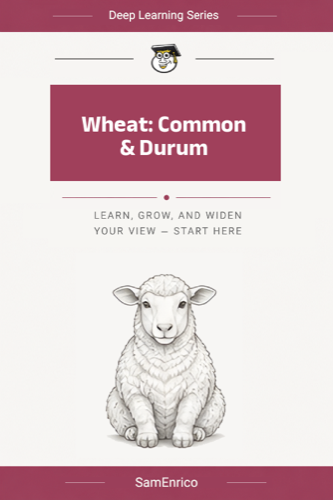
Wheat: Common & Durum eBook
This harvesting publication, published by SamEnric
This harvesting publication, published by SamEnrico, covers Wheat: Common & Durum
Formats
Free sample
Chapter 1: The Ancestral Fork...--–- The combine’s headlights cut through the predawn Kansas darkness as seventy-year-old Harold Miller climbed into the cab for what he suspected might be his final harvest. Forty thousand acres of hard red winter wheat stretched beneath a sky still peppered with stars. His grandson, twenty-two-year-old Eli, rode shotgun with a tablet glowing blue against the dashboard—a device that tracked yield data, moisture content, and satellite imagery in real time. Harold’s father had done this same work with a team of horses and a binder. Harold had done it with a cabless open-station combine.
Now Eli would do it with artificial intelligence and autosteer. Three generations, one family, two wheat species, and a hundred years of agricultural revolution compressed into a single hour before sunrise.The wheat beneath their tires was Triticum aestivum—common bread wheat. But ten miles to the north, on a smaller farm carved from the same glacial till, another farmer was preparing to harvest Triticum turgidum subsp. durum—the hard, amber grain destined not for bread but for pasta. To the untrained eye, both fields looked identical: golden, undulating seas of grain ready for the combine.
To the trained eye, the differences were everything. One wheat was elastic, forgiving, and adaptable. The other was rigid, demanding, and aristocratic. One would become a crusty boule baked in a Brooklyn brick oven. The other would become spaghetti rolled flat in a Parma factory.
One had fed empires through temperate winters. The other had sustained civilizations through Mediterranean summers.This book is about those two wheats—Common and Durum—and every decision that separates a profitable harvest from a heartbreaking loss. But before we talk about planting dates, nitrogen rates, and combine settings, we must understand where these two grains came from, why their genetics pull them in different directions, and how the fork in their evolutionary path dictates everything else that follows.The Deep History: Domestication’s First Choice Ten thousand years ago, in the fertile arc of land curling from the Mediterranean Sea to the Persian Gulf, human beings made a decision that would alter the course of civilization. They stopped chasing food and started growing it. Among the first plants they domesticated were wild grasses with edible seeds—the ancestors of modern wheat.
But here is the critical detail that most history books miss: they did not domesticate one wheat. They domesticated several. And the differences between those ancient grains echo down to every field trial, every grain bin, and every loaf of bread baked today.The story begins with wild emmer (Triticum dicoccoides), a tetraploid grass containing fourteen pairs of chromosomes arranged in four sets. Tetraploid means “four-fold”—two sets inherited from each of two different wild grasses that hybridized naturally in the ancient Middle East. Wild emmer grew abundantly across the Levant, and early farmers selected seeds from plants that held their grain longer (reduced shattering), grew larger kernels, and ripened uniformly.
Over centuries of selection, wild emmer became domesticated emmer (Triticum dicoccum), the staple grain of pharaonic Egypt and the earliest Roman armies.But evolution was not finished. Sometime in the last ten thousand years—likely within the last eight thousand—domesticated emmer hybridized with another wild grass, Aegilops tauschii, a weedy relative native to the Caspian Sea region. This second hybridization event added an additional fourteen chromosomes, transforming tetraploid emmer into hexaploid wheat: six sets, forty-two chromosomes total. That hexaploid wheat, Triticum aestivum, is what we call common wheat today. It is the workhorse of world agriculture, representing approximately ninety-five percent of all wheat grown globally.
Its extra chromosomes gave it greater genetic flexibility, allowing it to adapt to a wider range of climates, soils, and growing seasons than its tetraploid ancestor.Meanwhile, the original domesticated emmer did not disappear. It continued to evolve under human selection, eventually giving rise to Triticum turgidum subsp. durum—durum wheat. Unlike its hexaploid descendant, durum remained tetraploid. It kept its fourteen pairs of chromosomes, and with them, a more specialized, less flexible genetic toolkit.
That specialization became an advantage in the hot, dry summers of the Mediterranean basin, where durum’s tolerance for heat and solar radiation allowed it to outperform common wheat. But that same specialization made it less adaptable to the cold winters, humid summers, and variable rainfall of northern Europe and the American Midwest.The takeaway for the grower: When you choose between common and durum, you are not just picking a variety. You are picking a ploidy level—a fundamental genetic architecture that will constrain your management options and reward your attention to detail. Common wheat will forgive you. Durum will not.The Chromosomal Reality: What Forty-Two vs.
Twenty-Eight Actually Means Let us step out of the narrative and into the science for a moment, because understanding ploidy is not an academic exercise. It is the single most important concept in this entire book, and it will appear in every subsequent chapter when we discuss disease resistance, milling quality, and nitrogen management.A chromosome is a threadlike structure of nucleic acids and protein found in the nucleus of every plant cell, carrying genetic information in the form of genes. Humans have twenty-three pairs, or forty-six chromosomes total. Common wheat has forty-two chromosomes: six sets of seven. Durum wheat has twenty-eight chromosomes: four sets of seven.
That extra fourteen chromosomes—two complete sets—in common wheat provide what geneticists call “genetic buffering.”Here is what genetic buffering means in practice. Common wheat carries three copies of every gene (one copy on each of its three ancestral genomes, designated A, B, and D). If a mutation damages one copy, two functional copies remain. If a disease evolves to target a specific genetic sequence, the other genomes may carry resistance genes the pathogen cannot overcome. This redundancy makes common wheat remarkably resilient.
It can survive drought, heat, cold, and disease pressure that would devastate a less buffered crop.Durum wheat, with only two copies of every gene (one on the A genome and one on the B genome), lacks that third layer of protection. Every gene matters more. Every weakness is more exposed. Disease resistance that is “good enough” in common wheat may be completely inadequate in durum. A two-degree temperature increase during flowering that causes a ten percent yield reduction in common wheat might cause a forty percent reduction in durum.
This is not speculation. It is basic genetics, confirmed by decades of field trials across the world’s wheat-growing regions.But here is the paradox. The same genetic vulnerability that makes durum less resilient also makes it more valuable. Because durum has only two copies of the genes controlling gluten protein synthesis, those proteins are expressed in higher proportion and with greater consistency. The result is a gluten network that is stronger, more tenacious, and less elastic than common wheat’s gluten.
For bread, elasticity is everything—it allows dough to stretch without tearing, trapping carbon dioxide from yeast to create an open crumb structure. For pasta, tenacity is everything—it allows extruded dough to hold its shape during drying and cooking, producing firm, al dente noodles that do not turn to mush.The takeaway for the…
This is the end of the free sample. Get the eBook to keep going. Buy now
About this book
Details
- Author
- Rosser Verdie
- Publisher
- SamEnrico
- Language
- English
- Genre
- Non-Fiction, Informative, Educational
- Released
- 2026-06-02
- Pages (approx.)
- 154
- Available as
- eBook, Audiobook

Read better in the ZLOADR app
Your eBooks on your phone or tablet. Sign in with your SamEnrico account and start reading.
More by Rosser Verdie
 Self Esteem for Career ChangersRosser Verdie$11.99
 Anki For Project ManagementRosser Verdie$11.99
 Spin Cadence Drills GuideRosser Verdie$11.99
 Google Keep for Daily ListsRosser Verdie$11.99
 Philippine Jungle GuerrillaRosser Verdie$11.99
 Morning Review RitualsRosser Verdie$11.99
 Morning Affirmation RitualsRosser Verdie$11.99
 Meditation for FibromyalgiaRosser Verdie$11.99
 The Golden Quill: Amina Saïd and the Poetry of RevolutionRosser Verdie$11.99
 Silicon Samurai: The Untold Story of Japan's Forgotten Tech PioneerRosser Verdie$11.99
 How to Produce Ethnic ClothingRosser Verdie$11.99
 How to Start a Made-to-order Software Business (Beginners Guide)Rosser Verdie$11.99
You may also like
 Hong Kong Handover 1997Dunn Johnnie$11.99
 Zumba For Postnatal Recovery CourseNeal Christian$11.99
 Zumba for BeginnersLadner Nikia$11.99
 YouTube Comment Mining GuideHumes Pandora$12.99
 Worry Box MeditationCarlin Rudy$11.99
 Workplace Stress MeditationNguyen Lynn$11.99
 Workplace Stress and Sleep RepairHawley Ivory$11.99
 Workplace Perfectionism CureDelaney Jeffry$11.99
 Workplace Injustice Anger GuideWallen Isabelle$11.99
 Work Addiction and Burnout LinkGreenwood Ester$11.99
 Women in Yoga and WellnessBeattie Galina$11.99
 Women in Stand Up ComedyChun Evangeline$11.99