
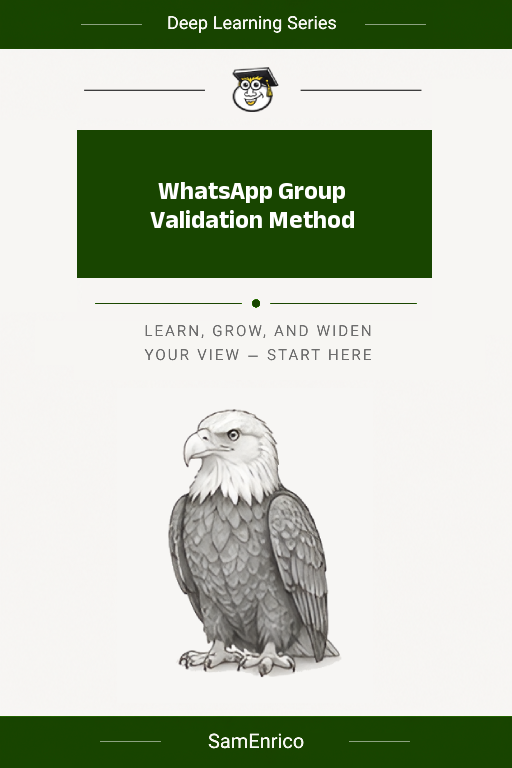
WhatsApp Group Validation Method eBook
Create free WhatsApp group with potential customer
Create free WhatsApp group with potential customers to discuss their problems and test your idea quickly.
Formats
Free sample
Chapter 1: The Architecture of Trust--–- In the summer of 2017, a first-time founder named Mara had an idea for a subscription box for exotic spices. She did everything right by conventional wisdom: she built a landing page, ran Facebook ads, surveyed 500 people, and even got 47 email signups. Six months and $12,000 later, she launched to exactly three paying customers. Two of them were her parents. The surveys had all said “Yes, I would buy that.” The landing page clicks were enthusiastic.
But when money had to leave a wallet, the enthusiasm evaporated. Mara’s story is not an exception. It is the rule.According to CB Insights, 42 percent of startups fail because there is no market need for their product. Not because the technology was flawed. Not because the team was incompetent.
Not because funding ran out. Because they built something that nobody actually wanted. And the most tragic part is that most of these founders could have discovered this before writing a single line of code, before renting office space, before incorporating an LLC. They simply didn’t know how to ask the right questions in the right environment.This book exists because the way most entrepreneurs validate ideas is fundamentally broken. Surveys lie.
Friends lie. Even potential customers lie—not because they are malicious, but because they are human. They want to be nice. They want to appear smart. They want to avoid conflict.
And when you ask someone, “Would you buy this?” you are asking them to predict their future behavior, which even professional economists cannot do with any accuracy. What you need instead is a way to observe real behavior in a natural context. You need a container where people feel safe enough to complain, honest enough to say “that’s worthless,” and engaged enough to reveal their deepest frustrations.That container is a Whats App group.Not a survey. Not a landing page. Not a focus group in a sterile conference room with free sandwiches.
A Whats App group that lives in your participants’ pockets, buzzing with notifications, where conversations unfold asynchronously over days. Whats App has a 98 percent open rate, compared to 20 percent for email. People check it seven times per hour on average. And when you put twenty to fifty target customers in a single chat and ask them about their problems—not your solution—something remarkable happens. They start talking to each other.
They disagree. They reveal workarounds you never imagined. They confess how much money they have already wasted on bad solutions. They tell each other the truth in ways they would never tell a founder holding a clipboard.This chapter introduces the foundational architecture of what we call a Validation Group. It is not a sales channel.
It is not a support group. It is not a beta testing program. It is a temporary, structured, rules-based community designed to answer one question and one question only: Should I build this?By the end of this chapter, you will understand the three pillars of validation, why Whats App is uniquely suited for this job, the ethical boundaries that protect both you and your participants, and how to know if you are ready to proceed to the recruitment phase. This is the bedrock upon which the entire five-day sprint rests. If you skip or rush this chapter, the rest of the book will not save you.The Three Pillars of a Validation Group Every successful Validation Group rests on three sequential pillars.
They are not optional. They are not interchangeable. They must be executed in order because each pillar depends on the information gathered in the previous one. Attempting to skip a pillar is like trying to build a roof before the foundation has cured.Pillar One: Problem Discovery The first and most important pillar answers a deceptively simple question: Does the problem you believe exists actually exist, and does it exist with sufficient intensity that someone would change their behavior to solve it?Most founders fall in love with their solution before they have verified the problem. They wake up at 3 a.m.
with a brilliant idea for an app that organizes grocery lists, and they immediately start sketching wireframes. They never stop to ask whether grocery list organization is actually a hair-on-fire problem or merely a minor annoyance that people have already solved with the notes app on their phone. The difference between these two categories is the difference between a business and a hobby.Problem discovery means listening for frequency, intensity, and current workarounds. Frequency answers “How often does this happen?” Intensity answers “How much does it hurt?” Workarounds answer “What are they already doing to cope?” If someone tells you they have tried three different solutions in the past year and all of them failed, you have discovered something valuable. If someone tells you they have never bothered to look for a solution because the problem isn’t that annoying, you have also discovered something valuable—just not the thing you wanted to hear.Pillar Two: Solution Feedback Only after you have confirmed that the problem is real and painful do you introduce your proposed solution.
Notice the word “proposed.” At this stage, you have built nothing. You have written no code. You have signed no manufacturing contracts. You have a hypothesis, expressed as a manual MVP—screenshots, wireframes, text descriptions, or video mockups. Nothing more.Solution feedback answers: Does my proposed fix actually address the problem in a way that feels better than their current workaround?
You are not asking whether they like the solution. You are asking whether they would switch from what they currently do to what you are offering, assuming equal cost and effort. This is a much higher bar than most founders realize. Your solution does not need to be perfect. It needs to be better than whatever they are already doing, including doing nothing.The most common failure at this pillar is presenting the solution too early or too defensively.
If you show your manual MVP and immediately say “We’re building this amazing thing,” you will receive compliments, not criticism. If you instead say “Here is a rough idea. Please tell me everything that is wrong with it,” you will receive the raw material you need to iterate or pivot.Pillar Three: Purchase Intent The final pillar is the one that separates genuine validation from polite applause. Purchase intent does not ask “Would you pay for this?” It observes whether participants actually commit something of value—time, attention, or money—to acquire the solution.There are three escalating levels of commitment we will cover in depth in Chapter 8. Level one is joining a waitlist, which costs nothing but a few seconds.
Level two is booking a paid discovery call, which costs time and social discomfort. Level three is prepaying with a credit card, which costs real money and triggers legal considerations. Each level is a more reliable signal than the last. And each level should produce a smaller number of positive responses. If the drop-off between levels is too steep—for example, 80 percent join the waitlist but only 2 percent prepay—you have a red light.
The problem may be real, but your solution or pricing is not yet compelling enough to open a wallet.These three…
This is the end of the free sample. Get the eBook to keep going. Buy now
About this book
Details
- Author
- Ferry Clarissa
- Publisher
- SamEnrico
- Language
- English
- Genre
- Non-Fiction, Startup Guide, WhatsApp, Group Chat
- Released
- 2026-05-28
- Pages (approx.)
- 124
- Available as
- eBook, Audiobook

Read better in the ZLOADR app
Your eBooks on your phone or tablet. Sign in with your SamEnrico account and start reading.
More by Ferry Clarissa
 Nepali Worker Migration TrendsFerry Clarissa$11.99
 Remote Team Creative Warm Ups CourseFerry Clarissa$11.99
 Variable Reward PsychologyFerry Clarissa$11.99
 Calisthenics Travel WorkoutFerry Clarissa$11.99
 Stress Management for Massage TherapistsFerry Clarissa$11.99
 The Bones Beneath the Ash: How a Japanese Surgeon Unlocked the Secrets of the Human BodyFerry Clarissa$11.99
 Personal ChefFerry Clarissa$11.99
 Understanding Chromosome 5, Trisomy 5pter P13 3Ferry Clarissa$17.99
 Business Launch Announcement GuideFerry Clarissa$12.99
 How to Become a CaddieFerry Clarissa$11.99