
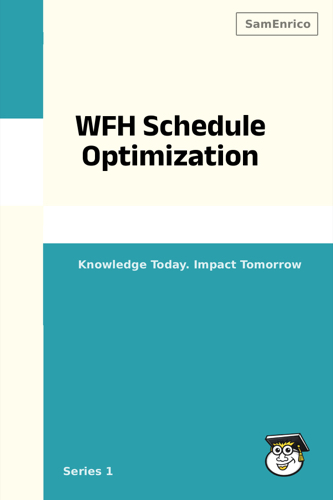
WFH Schedule Optimization eBook
Design a daily remote schedule that balances deep
Design a daily remote schedule that balances deep work, meetings, and breaks.
Formats
Free sample
Chapter 1: The Energy Lie--–- On a Tuesday afternoon in March, Sarah stared at her laptop screen for forty-five minutes without typing a single word. Her calendar showed eight "busy" hours. Her Slack status was green. She had responded to fourteen messages, attended three video calls, and moved her mouse periodically to keep her status active. And yet, at 4:47 PM, she could not name a single thing she had actually finished.
The report she promised her manager was still blank. The strategy document was one sentence long. Her back ached. Her eyes burned. And somewhere in the kitchen, the coffee she had poured at 9 AM sat cold and untouched.
Sarah was not lazy. Sarah was not unproductive. Sarah was working in the wrong century.She was practicing what this book calls performative productivity—the exhausting, soul-crushing habit of appearing busy while accomplishing little. And she is not alone. Millions of remote workers have traded the office cubicle for the home desk, only to discover that the old rules of work have followed them like ghosts.
The "butt-in-seat" mentality—the implicit belief that hours present equal value produced—did not die when we left the office. It merely mutated. Now it manifests as the 10 PM email response, the performative Slack message, the endless scrolling through shared drives, the guilt of stepping away for lunch, and the quiet dread that if you are not visibly working, you must not be working at all.This chapter dismantles that lie. It exposes the fundamental flaw in how we measure remote work and replaces it with a radically different framework: energy management over time management. You will learn why an hour of focused work is worth three hours of distracted work.
You will discover the 100-80-100 Rule, a formula that has saved high-performers from burnout while actually increasing their output. And you will complete the Energy Audit—a one-week self-diagnostic that will become the foundation for everything else in this book.But first, we must understand how we got here.The Myth of the Nine-to-Five Corpse The traditional office schedule was never designed for productivity. It was designed for industrial efficiency. In the factory era, workers needed to be physically present at the same time because machines required human operation. The assembly line did not care about your chronotype, your creative cycles, or your family obligations.
It cared only that you were there when the conveyor belt started moving.That logic persisted into the knowledge economy for one reason: visibility equals control. Managers could not measure the quality of your thinking, so they measured the quantity of your presence. Nine to five became a proxy for value. Show up. Sit down.
Look busy. Go home. Repeat.Remote work shattered that illusion but left the psychology intact. Without a manager physically present, workers internalized the surveillance. They began monitoring themselves.
The result is a strange hybrid: employees who work longer hours than ever before—often ten, eleven, or twelve hours—while feeling less productive than when they commuted to an office.Consider the data. A 2023 study of over ten thousand remote workers found that the average respondent worked 1.4 more hours per day from home than from the office. Yet the same respondents rated their sense of accomplishment 23 percent lower. More time, less done. This is not a paradox.
It is a predictable outcome of a broken measurement system.When you measure productivity by hours, you incentivize hours. When you measure by output, you incentivize output. Remote work forces us to choose between these two metrics. Most organizations have not chosen. They have defaulted to the old system, creating what one researcher calls productivity theater: the performance of work rather than the production of results.The Two Traps of Remote Work Remote workers fall into one of two traps.
The first is overwork. This is the Sarah who responds to emails at 10 PM, who never truly logs off, who measures her worth by her Slack activity. Overworkers burn out slowly, then suddenly. They mistake exhaustion for dedication. They believe that if they are not tired, they must not have worked hard enough.The second trap is performative work.
This is the employee who schedules three hours of meetings to avoid two hours of difficult thinking. Who reorganizes their file structure for the fourth time this month. Who writes long, detailed status updates instead of finishing the project those updates describe. Performative workers are not lazy. They are anxious.
They have learned that visible activity feels safer than invisible deep work—even when that deep work is the only thing that matters.Here is what both traps share: they are responses to the same underlying problem. Remote work removes the external structure of the office but provides no internal framework to replace it. You are left alone with your to-do list, your calendar, and your guilt. The result is not freedom. It is chaos wrapped in pajamas.The Paradigm Shift: Energy Management The solution is not better time management.
Time management assumes that all hours are equal. They are not. An hour at 9 AM after eight hours of sleep is not the same as an hour at 3 PM after four hours of Zoom calls. A hour before lunch is not the same as an hour after lunch. A hour when you are excited about a project is not the same as an hour when you are dreading a task.Energy management recognizes that your cognitive resources fluctuate throughout the day.
It treats your focus as a renewable but limited resource, like water in a reservoir. You can drain it quickly with shallow tasks, or you can invest it carefully in deep work. But you cannot ignore the reservoir's limits without consequences.The science behind this is robust. Research on circadian rhythms—your body's internal 24-hour clock—shows that alertness, memory, and problem-solving ability vary systematically throughout the day. Research on ultradian rhythms—the 90-minute cycles we will explore in depth in Chapter 2—demonstrates that the human brain naturally moves from high focus to low focus and back again, like breathing.
Fighting these rhythms is not discipline. It is biology denial.Think of it this way. You would not try to run a marathon at the same pace as a sprint. You would not expect your car to perform the same on empty roads as in bumper-to-bumper traffic. Yet we expect our brains to produce the same output at 7 AM, 11 AM, and 4 PM.
This is not ambitious. It is absurd.Energy management replaces the question "How many hours did I work?" with "What did I accomplish during my peak hours?" It replaces the guilt of a slow afternoon with the strategy of matching tasks to energy levels. It replaces burnout with sustainability.The 100-80-100 Rule Here is the promise that makes energy management possible: you can work 80 percent of your current hours and produce 100 percent of your current output—or more. This is not a fantasy. It is the observed reality of high-performers who have abandoned time-based productivity for output-based productivity.The 100-80-100 Rule has three components:100 percent pay.
Your compensation should not change. You are delivering the same or better results. You are not working less because you…
This is the end of the free sample. Get the eBook to keep going. Buy now
About this book
Details
- Author
- Almeida Dario
- Publisher
- SamEnrico
- Language
- English
- Genre
- Non-Fiction, Self-Help, Work Life Balance
- Released
- 2026-06-10
- Pages (approx.)
- 129
- Available as
- eBook, Audiobook

Read better in the ZLOADR app
Your eBooks on your phone or tablet. Sign in with your SamEnrico account and start reading.
More by Almeida Dario
 Worry Postponement TechniqueAlmeida Dario$11.99
 Nobel Laureates In Gravity WavesAlmeida Dario$11.99
 Weekly Prioritization System WorkbookAlmeida Dario$11.99
 Pricing Tier Positioning MapAlmeida Dario$11.99
 The Bone Collector: How the Adze Devoured the Gold CoastAlmeida Dario$11.99
 Spice and the Sea: Vasco da Gama's Epic Voyage to IndiaAlmeida Dario$11.99
 Style AdvisorAlmeida Dario$11.99
 Understanding Growth Retardation Alopecia Pseudoanodontia OpticAlmeida Dario$17.99
 ITIN Application for LLC Owners GuideAlmeida Dario$12.99
 BPO CSAT Improvement GuideAlmeida Dario$12.99
 How to Become a Clay RoasterAlmeida Dario$11.99
You may also like
 Workaholism Recovery WorkbookBrowne Lucrecia$11.99
 Work Stress Home Peace ManualFrazier Elena$11.99
 The Remote Work Shutdown RitualCalvin Danyel$11.99
 Requesting Time Off WorkBurchfield Khadijah$11.99
 Parental Anger After Work HoursPritchett Almeta$11.99
 Anger After Work Hours GuideHerring Jonelle$11.99
 Work Life Integration PlanBarclay Milda$11.99
 The Work Life Balance for WorkaholicsRosenberg Inger$11.99
 Work Stress Home SpilloverGordon Debbie$11.99
 Work Stress Home Relationship GuideVilla Verline$11.99
 End Of Workday RitualWooten Wen$11.99
 Work Commute Rage SolutionsStubblefield Christin$11.99