
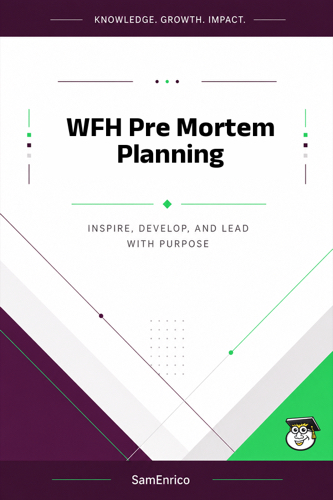
Non-FictionSelf-HelpPre MortemRisk
WFH Pre Mortem Planning eBook
Imagine what could derail your day and prevent tho
Imagine what could derail your day and prevent those obstacles in advance.
Formats
Free sample
Chapter 1: The Cognitive Budget--–- You lost four hours today and you didn’t even notice.Not to a nap. Not to Netflix. Not to a two-hour lunch. You lost four hours to something invisible: the gap between what you intended to do and what you actually did. You sat down at your desk at 9:00 AM with a clear plan.
By 5:00 PM, you felt exhausted, scattered, and vaguely ashamed—yet when you look back at your calendar, you can’t point to a single “waste” of time. You answered emails. You joined calls. You switched between Slack, a spreadsheet, and a half-read document. You did nothing “wrong.” And still, you got nothing important done.This is the great deception of work-from-home.
In an office, distractions are visible: the coworker who talks too loud, the meeting that runs long, the commute that steals an hour. At home, distractions are silent. They live inside the tabs on your browser, the notifications on your phone, the gentle pull of laundry in the next room. And the most dangerous distraction of all—the one that costs you more time than anything else—is invisible even to you.It is called the switching penalty.Every time you flip from one task to another, your brain does not simply “move on.” It leaves a ghost behind. Psychologists call this attentional residue: a portion of your cognitive processing power remains stuck on the previous task, even after you have physically switched to something new.
That residue accumulates. Each switch costs you not just the second it takes to click a different tab, but minutes of reorientation, recall, and mental reengagement. By the end of a typical WFH day, the average knowledge worker has switched tasks more than three hundred times. The cumulative cost is measured in hours of lost cognitive capacity.This chapter introduces the single most important framework in this book: the Cognitive Budget. You will learn why your brain is not a computer (computers multitask effortlessly; brains do not).
You will measure your personal switching penalty through a simple one-day audit. And you will discover that your feeling of “busy but unproductive” is not a character flaw—it is a mathematical consequence of an environment designed to steal your attention. By the end of this chapter, you will know exactly how much of your day you are losing, and you will have the first tool to take it back.The Myth of the Multitasking Superpower Let us begin with a funeral. We need to bury the word “multitasking” once and for all.In popular culture, multitasking is framed as a superpower. The best employees are the ones who can juggle five things at once—Slack in one window, email in another, a report in a third, all while nodding along to a conference call.
We admire this person. We aspire to be this person. Job descriptions explicitly ask for “strong multitasking skills.” Parents boast that their teenager can “watch Netflix, do homework, and text friends all at the same time.”Every single part of that picture is a lie.The human brain cannot multitask. What we call multitasking is actually rapid task-switching: doing one thing, then another, then back to the first, in very fast sequence. And every switch carries a cost.The most famous study on this topic comes from the University of Michigan, where researchers asked students to solve math problems while simultaneously remembering a sequence of letters.
The students who switched between the two tasks were significantly slower and less accurate than those who focused on one task at a time. But here is the part that should terrify you: even after the students switched back to the original task, their reaction times remained elevated. Their brains were still processing residue from the previous task.That residue is the switching penalty.The best estimate from cognitive psychology research is that a typical task switch costs you 40% of your productive time on that task. In practical terms, if you spend two hours on a project but switch to email four times during that period, your effective working time is closer to one hour and twelve minutes. The other forty-eight minutes are lost to reorientation, error recovery, and the slow decay of focus.A 2014 study published in the Journal of Experimental Psychology found that even momentary interruptions—glancing at a notification without responding—produced a measurable drop in performance on complex tasks.
Participants who were interrupted took twice as long to complete the task and made three times as many errors as those who worked uninterrupted.Let me translate that into WFH reality. You are writing a quarterly report. A Slack message pops up. You glance at it. You do not even respond.
You just look. That glance alone has just cost you approximately ninety seconds of reorientation time. If that happens twenty times in a day, you have lost thirty minutes. Not to responding. Not to engaging.
Just to looking.Now add in the actual responses. The quick email you fire off. The calendar invite you accept. The question from your partner about dinner. The text from a friend.
The dog scratching at the door. Each interruption costs you a minimum of ninety seconds. Most cost significantly more. By the end of the day, you have lost between two and four hours to the switching penalty alone.You felt exhausted at 5:00 PM not because you worked too hard. You felt exhausted because your brain spent the day slamming the clutch between gears, over and over, with no time to rest.The Cognitive Budget: Your Daily Mental Currency The switching penalty is not the only drain on your cognitive resources.
It is simply the most invisible. To understand why you feel depleted, we need a framework that accounts for everything that costs you mental energy.I call this the Cognitive Budget.Here is the premise: every day, you wake up with a finite amount of focused attention. For most adults, that budget is between four and six hours of high-quality cognitive work. This is not a guess. Research on deliberate practice (Anders Ericsson), flow states (Mihaly Csikszentmihalyi), and attention restoration theory (Rachel and Stephen Kaplan) all converge on the same number: the human brain can sustain intense focus for approximately four to six hours per day before diminishing returns set in.The remaining hours of your workday—the other two to four hours, assuming an eight-hour day—are filled with lower-cognitive tasks: email, scheduling, administrative work, meetings that could have been emails, and the thousand small decisions that keep an organization running.
There is nothing wrong with these tasks. But they do not require your full attention. The mistake is treating them as if they do.The problem with WFH is not that you have too little cognitive budget. The problem is that you are spending your budget on the wrong things.Every distraction, interruption, and context switch makes a withdrawal from your Cognitive Budget. Some withdrawals are small (glancing at a notification costs ninety seconds).
Some are massive (an unexpected crisis costs an hour of rumination after the crisis is resolved). And here is the cruelest part of the Cognitive Budget: the withdrawals…
This is the end of the free sample. Get the eBook to keep going. Buy now
About this book
Details
- Author
- Kincaid Altha
- Publisher
- SamEnrico
- Language
- English
- Genre
- Non-Fiction, Self-Help, Pre Mortem, Risk
- Released
- 2026-06-08
- Pages (approx.)
- 124
- Available as
- eBook, Audiobook

Read better in the ZLOADR app
Your eBooks on your phone or tablet. Sign in with your SamEnrico account and start reading.
More by Kincaid Altha
 Risk Taking for Flow InductionKincaid Altha$11.99
 Income Elasticity AnalysisKincaid Altha$11.99
 Gambling Addiction and SleepKincaid Altha$11.99
 The Battle of the Delta: Ramses II and the Sea Peoples' Onslaught (1175 BC)Kincaid Altha$11.99
 How to Start a Bitumen and Flax Felts for Roofing and Damp-proof Courses Business (Beginners Guide)Kincaid Altha$11.99
 Data Protection Officer GuideKincaid Altha$12.99
 Nanosecond Laser TechnicianKincaid Altha$11.99
 Learn to Play the PsalteryKincaid Altha$11.99
You may also like
 Hong Kong Handover 1997Dunn Johnnie$11.99
 Zumba For Postnatal Recovery CourseNeal Christian$11.99
 Zumba for BeginnersLadner Nikia$11.99
 YouTube Comment Mining GuideHumes Pandora$12.99
 Worry Box MeditationCarlin Rudy$11.99
 Workplace Stress MeditationNguyen Lynn$11.99
 Workplace Stress and Sleep RepairHawley Ivory$11.99
 Workplace Perfectionism CureDelaney Jeffry$11.99
 Workplace Injustice Anger GuideWallen Isabelle$11.99
 Work Addiction and Burnout LinkGreenwood Ester$11.99
 Women in Yoga and WellnessBeattie Galina$11.99
 Women in Stand Up ComedyChun Evangeline$11.99