
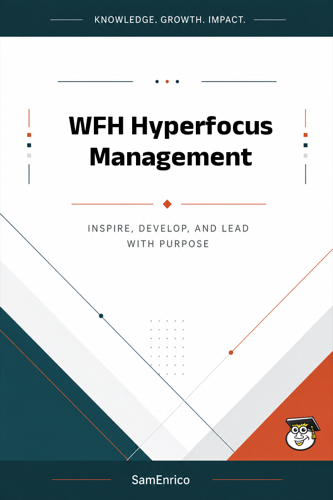
Non-FictionSelf-HelpHyperfocusBalance
WFH Hyperfocus Management eBook
Schedule forced breaks to avoid losing entire days
Schedule forced breaks to avoid losing entire days to unplanned hyperfocus.
Formats
Free sample
Chapter 1: The Attention Debt--–- You sit down at 9:00 AM to answer one email. Just one. When you next look up, it is 1:17 PM. Your coffee is cold. Your back aches.
Your bladder is screaming. And that single email? You wrote it, then rewrote it, then fell into a spiral of reorganizing your entire folder structure, reading five linked articles, and “quickly” checking three other projects.This is not a failure of will. This is not laziness. This is the hidden architecture of hyperfocus in a work-from-home environment—and it is quietly stealing your life in fifteen-minute increments that compound into entire lost years.Welcome to Chapter 1.
Before we can fix the problem, you must understand what hyperfocus actually is, why it becomes dangerous at home, and how the absence of office “interruption noise” turns your greatest cognitive asset into a liability that degrades your health, relationships, and long-term performance.The Finite Well of Attention Let us begin with a fundamental truth that most productivity books obscure: attention is a finite biological resource. You do not have unlimited focus. You have approximately four to five hours of genuine deep attention per day, distributed unevenly across your waking hours. This is not opinion. This is cognitive neuroscience.Drawing on the research synthesized in Chris Bailey’s Hyperfocus and Celeste Headlee’s Do Nothing, we must accept that the brain consumes energy at a remarkable rate during intense concentration.
Glucose metabolism spikes. Neural firing increases. The prefrontal cortex—the seat of executive function, working memory, and self-control—works overtime. After extended periods of hyperfocus, these systems fatigue just as surely as a sprinter’s legs fatigue after repeated dashes.Here is what happens during hyperfocus: you become deeply absorbed in a task to the exclusion of everything else. Time distorts.
Peripheral awareness vanishes. The phone could ring, your partner could speak, your back could scream in pain—and you would not register any of it. This state is responsible for nearly every great work of art, scientific breakthrough, and complex problem solved. It is not the enemy.The enemy is unplanned, unbounded, breakless hyperfocus that continues until you crash.In an office environment, hyperfocus is naturally interrupted. A colleague stops by your desk.
The lights dim at 5:00 PM. Someone heats fish in the microwave. A meeting reminder pops up. Your train schedule dictates departure time. These ambient interruptions—annoying as they sometimes feel—serve a critical function: they force you to disengage, reset, and redistribute cognitive load.Work from home removes all of these anchors.Your home has no meeting rooms that clear out at the top of the hour.
Your commute does not exist, so there is no hard stop at 5:30 PM. Your spouse may be afraid to interrupt you because you snapped at them last time. The result is not more productivity. The result is tunneling—a psychological state where you lock onto a single task while ignoring bodily signals, time, and priorities.Tunneling feels productive. It is not.
It is attrition dressed in the costume of dedication.The True Cost of Unbroken Hyperfocus Let me be specific about what hyperfocus costs you. These are not theoretical harms. These are the documented consequences reported by thousands of remote workers who believed they were “just being productive.”First, physical costs. When you hyperfocus without breaks, you stop listening to your body. You do not drink water because you do not want to break concentration.
You do not use the bathroom because you are “almost done.” You sit in the same position for hours, compressing your spine, straining your neck forward, and drying out your eyes. The result is a predictable cascade: headaches, back pain, carpal tunnel symptoms, dry eye syndrome, and digestive issues from irregular eating. One study of remote workers found that those who reported frequent hyperfocus episodes (defined as losing track of three or more hours) had 47 percent higher rates of musculoskeletal complaints than those who took regular breaks.Second, cognitive costs. Hyperfocus depletes executive function. After three hours of unbroken concentration, your ability to switch tasks efficiently drops by approximately 30 percent.
Your working memory—the cognitive scratchpad where you hold and manipulate information—becomes cluttered and slow. This is why you feel “brain fog” after a long hyperfocus session. You are not imagining it. You have exhausted the neural circuits that allow you to think clearly.Third, emotional costs. The evening crash is real and brutal.
After a day of unbroken hyperfocus, you have nothing left for your family. Your partner asks a simple question, and you snap. Your child wants to play, and you feel irritated. You collapse on the couch and scroll your phone for two hours because you cannot muster the energy for a conversation, a hobby, or even deciding what to watch on television. This is not a character flaw.
This is cognitive depletion expressed as emotional unavailability.Fourth, relational costs. Here is the quiet tragedy of WFH hyperfocus: your loved ones learn that when you are “working,” you are unreachable. They stop trying to interrupt you. They stop asking for help. They stop sharing small moments because they have learned that your face behind the screen means “do not disturb.” Over months and years, this erodes intimacy.
I have interviewed remote workers who missed their child’s first steps because they were “just finishing a ticket.” I have spoken to spouses who felt like single parents because their partner was physically present but mentally gone for ten hours a day.Fifth, strategic costs. This is the one that should terrify every knowledge worker. Hyperfocus on the wrong task is worse than no focus at all. When you lose four hours to reformatting slides that no one will notice, you have not been productive. You have been busy.
Busy fatigue is the state of exhausting yourself on low-impact work while your most important projects remain untouched. Chapter 3 will address this in depth, but for now, understand that hyperfocus is a high-cost cognitive state. Wasting it on trivial work is like using a scalpel to open a cardboard box.The Heroic Hyperfocuser vs. The Sustainable Performer Throughout my research for this book, I have encountered two distinct archetypes of WFH workers. I want you to identify which one you currently resemble.The first is the Heroic Hyperfocuser.
This person wears their hyperfocus as a badge of honor. They say things like, “I forgot to eat lunch again,” with pride. They boast about working through back pain. They believe that more hours of concentration equal more output. They are exhausted, irritable, and secretly resentful that their spouse “does not understand how hard I work.” Their productivity, measured properly, is actually lower than it could be because they spend half their hyperfocus hours on low-value tasks and the other half recovering from burnout.The second is the Sustainable Performer.
This person produces the same or greater output in significantly fewer hours because they hyperfocus only on high-impact tasks and take scheduled breaks that preserve cognitive energy. They finish work by 4:00 PM. They have energy for their family. They do not brag about forgetting to eat because they never forget to eat. Their secret is not more willpower.
Their secret is environmental design and break discipline—the entire subject of this book.Here is the hard truth: if you identify…
This is the end of the free sample. Get the eBook to keep going. Buy now
About this book
Details
- Author
- Eagle Dennise
- Publisher
- SamEnrico
- Language
- English
- Genre
- Non-Fiction, Self-Help, Hyperfocus, Balance
- Released
- 2026-06-09
- Pages (approx.)
- 139
- Available as
- eBook, Audiobook

Read better in the ZLOADR app
Your eBooks on your phone or tablet. Sign in with your SamEnrico account and start reading.
More by Eagle Dennise
 The Comparison and AnxietyEagle Dennise$11.99
 Demand Side Subsidies BriefEagle Dennise$11.99
 The Telomerase Activation GuideEagle Dennise$11.99
 The Golden Ledgers of Timbuktu: Africa's Forgotten Financial GeniusesEagle Dennise$11.99
 Palliative Care Nurse PractitionerEagle Dennise$11.99
 Learn to Play the Baritone UkuleleEagle Dennise$11.99
 10 Ways to Use Grating Cheese (Recipe Book)Eagle Dennise$11.99
 Measuring Event ROI on a BudgetEagle Dennise$12.99
You may also like
 Hong Kong Handover 1997Dunn Johnnie$11.99
 Zumba For Postnatal Recovery CourseNeal Christian$11.99
 Zumba for BeginnersLadner Nikia$11.99
 YouTube Comment Mining GuideHumes Pandora$12.99
 Worry Box MeditationCarlin Rudy$11.99
 Workplace Stress MeditationNguyen Lynn$11.99
 Workplace Stress and Sleep RepairHawley Ivory$11.99
 Workplace Perfectionism CureDelaney Jeffry$11.99
 Workplace Injustice Anger GuideWallen Isabelle$11.99
 Work Addiction and Burnout LinkGreenwood Ester$11.99
 Women in Yoga and WellnessBeattie Galina$11.99
 Women in Stand Up ComedyChun Evangeline$11.99