
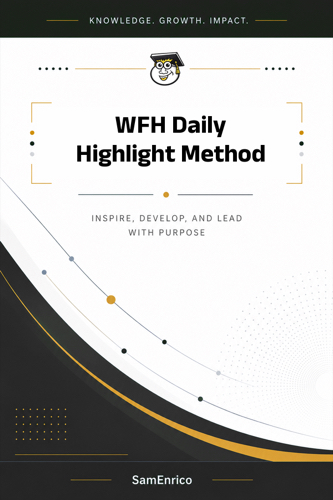
Non-FictionSelf-HelpHighlightPrioritization
WFH Daily Highlight Method eBook
Choose one most important task to complete before
Choose one most important task to complete before checking email or messages.
Formats
Free sample
Chapter 1: The Stolen Hour--–- Every morning, millions of remote workers commit the same quiet act of self-sabotage. They wake up, pour coffee, open their laptops, and within sixty seconds, they have surrendered the best hour of their day to people who are not even in the room. They check email. They glance at Slack. They scroll through messages from colleagues, clients, and automated notifications.
And by the time they have finished this ritual, they are already behind. Not because the messages were urgent, but because they allowed their attention to be fractured before they had done a single thing that mattered.This chapter is called The Stolen Hour because that is precisely what happens every morning when you check email first. You do not just lose time. You lose your best cognitive state, your ability to focus deeply, and your sense of agency over your own day. The hour is stolen not by a thief in the night, but by your own reflexive habit.
And the first step toward reclaiming it is understanding exactly how the theft happens.The Seduction of the Inbox Let us begin with a simple experiment that you can conduct tomorrow morning. Wake up at your usual time. Make your coffee. Sit down at your workspace. Then, instead of opening your email, simply sit for sixty seconds and notice the impulse.
What do you feel? For most people, there is a low-grade hum of curiosity. Someone might have replied to that thread. There might be news about the project. There might be a problem that needs solving.
This curiosity is not malicious. It is not laziness. It is a perfectly normal human response to uncertainty. And that is exactly why email and messaging apps were designed to exploit it.Email, as it turns out, is not a neutral tool. It is a psychological device engineered to capture and hold your attention using the same mechanisms as slot machines.
Behavioral psychologists have known for decades that variable rewards are more addictive than fixed rewards. A slot machine that paid out every tenth pull would be boring. But a slot machine that pays out randomly, sometimes after two pulls, sometimes after fifty, keeps people pulling the lever for hours. Your inbox operates on the exact same principle. Most emails are irrelevant.
Some are mildly interesting. A rare few contain urgent or exciting news. You never know which one will appear next. So you keep checking.This is not a moral failing. It is a design feature.
The engineers who built your email client and your messaging apps did not accidentally make them addictive. They measured engagement metrics. They tested notification timing. They optimized for the behavior that keeps you coming back. And that behavior is checking first thing in the morning, because the first check of the day has the highest uncertainty and therefore the highest potential reward.
The system is working exactly as intended. The only problem is that the system is not working for you.The Mental Cost of Open Loops Before we go further, we need to understand a concept from cognitive psychology that explains why checking email first is so damaging. The concept is called open loops, and it comes from the work of David Allen, who wrote the book Getting Things Done. An open loop is any unfinished task, unresolved question, or unprocessed commitment that your brain is holding in the background. Your mind is not a storage device.
It is a processing unit. When you leave tasks unfinished, your brain continues to chew on them subconsciously, consuming mental energy even when you are not actively thinking about them.Here is where this becomes dangerous. When you check email first thing in the morning, you are not just reading messages. You are opening loops. Every unread email is a potential commitment.
Every Slack message is a potential demand. Within five minutes of opening your laptop, you have created dozens of open loops. Did you see that request from accounting? Should you reply to the client question now or later? What about that meeting invite?
Your brain, trying to be helpful, starts holding onto all of these threads. And now, when you try to do your actual work, you are doing it with a significantly reduced cognitive capacity.Researchers have quantified this effect. The term is attention residue, and it was first studied by Sophie Leroy, a professor at the University of Washington. Her research found that when you switch from one task to another, a portion of your attention remains stuck on the first task. That residue reduces your performance on the second task.
And the more frequently you switch, the more residue accumulates. Checking email first thing creates a cascade of residue before you have even begun your most important work. You are not multitasking. You are doing something worse. You are task-switching so rapidly that your brain never achieves a state of deep focus at all.Peak Performance Happens Once Per Day There is another reason why checking email first is a tragic waste, and it has to do with the biology of attention.
Your cognitive performance is not constant throughout the day. It follows a rhythm called the ultradian rhythm, named for the biologist Nathaniel Kleitman who discovered it in the 1950s. Simply put, your brain operates in cycles of approximately ninety minutes. During the first sixty to ninety minutes after waking, most people experience their peak cognitive performance. This is when your working memory is freshest, your inhibition is strongest, and your ability to sustain focus on a single task is at its highest.This window is gold.
It is the only time of day when you can reliably do your deepest, most demanding work without fighting against fatigue, decision fatigue, or the accumulated stress of the day. And what do most remote workers do with this golden window? They spend it reading email. They scroll through messages that could wait until the afternoon. They reply to low-stakes questions that require minimal cognitive effort.
They use their best brain on their least important work.Think about the absurdity of this for a moment. If you had one hour of superhuman focus available per day, would you spend it on other people's agendas? Would you spend it on messages that arrived while you were sleeping? Or would you spend it on the one thing that moves your own most important project forward? The answer seems obvious when stated directly, and yet millions of people make the opposite choice every morning.
They are not lazy. They are not stupid. They are simply trapped in a habit that feels productive because it generates a sense of motion. But motion is not progress. Activity is not achievement.Meet Sarah: A Case Study in Transformation Let me tell you about Sarah.
She is a marketing manager at a mid-sized software company, and before she discovered the Daily Highlight Method, her mornings looked like most people's mornings. She would wake up at 7:00 AM, get her children ready for school, pour a large cup of coffee, and sit down at her home office desk by 8:30 AM. Then she would open her laptop and…
This is the end of the free sample. Get the eBook to keep going. Buy now
About this book
Details
- Author
- Eutsey Anjelica
- Publisher
- SamEnrico
- Language
- English
- Genre
- Non-Fiction, Self-Help, Highlight, Prioritization
- Released
- 2026-06-08
- Pages (approx.)
- 126
- Available as
- eBook, Audiobook

Read better in the ZLOADR app
Your eBooks on your phone or tablet. Sign in with your SamEnrico account and start reading.
More by Eutsey Anjelica
 Flow State for StudentsEutsey Anjelica$11.99
 Cross Price Elasticity GuideEutsey Anjelica$11.99
 Gambling Addiction Relapse After YearsEutsey Anjelica$11.99
 The Golden Quill of the Sudan: Al-Jahiz and the Birth of African Literary BrillianceEutsey Anjelica$11.99
 Data Subject Rights GuideEutsey Anjelica$12.99
 Learn to Play the PiwanchaEutsey Anjelica$11.99
 Ultimate Handbook Guide to Dandong : (China) Travel GuideEutsey Anjelica$11.99
You may also like
 Hong Kong Handover 1997Dunn Johnnie$11.99
 Zumba For Postnatal Recovery CourseNeal Christian$11.99
 Zumba for BeginnersLadner Nikia$11.99
 YouTube Comment Mining GuideHumes Pandora$12.99
 Worry Box MeditationCarlin Rudy$11.99
 Workplace Stress MeditationNguyen Lynn$11.99
 Workplace Stress and Sleep RepairHawley Ivory$11.99
 Workplace Perfectionism CureDelaney Jeffry$11.99
 Workplace Injustice Anger GuideWallen Isabelle$11.99
 Work Addiction and Burnout LinkGreenwood Ester$11.99
 Women in Yoga and WellnessBeattie Galina$11.99
 Women in Stand Up ComedyChun Evangeline$11.99