
Non-FictionInformativeEducational
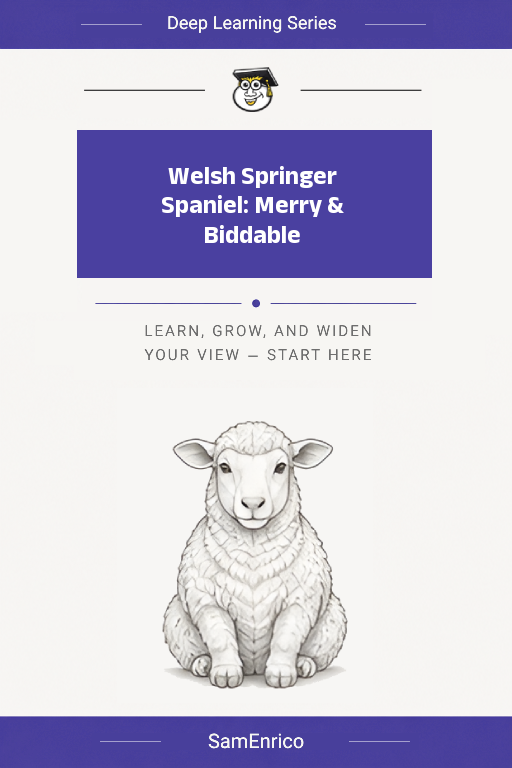
Welsh Springer Spaniel: Merry & Biddable
This publication, published by SamEnrico, covers W
by Fay Ileana
This publication, published by SamEnrico, covers Welsh Springer Spaniel: Merry & Biddable
Formats
About this book
Free sample
Chapter 1: The Land Spaniel’s Shadow...-- In the misty valleys of medieval Wales, long before the Kennel Club stamped its approval on any breed standard, a singular type of dog worked the edges of hawthorn hedges and splashed through peat-stained streams. This was the Land Spaniel—not yet divided into English, Welsh, cocker, or springer—and its shadow falls directly across every red-and-white dog that shares our homes today. To understand the Welsh Springer Spaniel, you must first understand that this breed is not a recent invention, nor a Victorian parlor decoration, nor a mere color variation of its more famous English cousin. The Welsh Springer is an ancient working dog, shaped by geography, necessity, and the stubborn devotion of a few determined breeders who refused to let it disappear. This chapter traces that remarkable journey: from the hunting grounds of 16th-century noblemen to the near-extinction of two world wars, and finally to the loving homes where the "merry and biddable" spirit thrives today.The Land Spaniel: A Common Ancestor Before there were distinct breeds of spaniels, there was simply the Land Spaniel—a term used throughout Britain from at least the 1500s to describe dogs that worked on solid ground (as opposed to water spaniels, which were specialized for retrieving from lakes and rivers).
Historical records from the reign of King Henry VIII (1509-1547) mention "spaniells" used for falconry, where the dog's job was to flush game from dense cover so that trained hawks could be released to strike. This partnership between dog, hawk, and human was among the most sophisticated hunting methods of the medieval era, and it demanded a dog with specific traits: stamina to work all day, intelligence to quarter the ground methodically, a soft mouth to avoid damaging flushed game, and a temperament that could tolerate the close presence of both humans and birds of prey.The earliest written description that almost certainly refers to what we now call the Welsh Springer appears in a 1560 manuscript by John Caius, a physician to Queen Elizabeth I. In his work "De Canibus Britannicis" (On British Dogs)…
This is the end of the free sample. Get the eBook to keep going. Buy now
Contents
- Chapter 1
- Chapter 2
- Chapter 3
- Chapter 4
- Chapter 5
- Chapter 6
- Chapter 7
- Chapter 8
- Chapter 9
- Chapter 10
- Chapter 11
- Chapter 12
Details
- Author
- Fay Ileana
- Publisher
- SamEnrico
- Language
- English
- Genre
- Non-Fiction, Informative, Educational
- Released
- 2026-06-02
- Pages (approx.)
- 146
- Available as
- eBook, Audiobook

Read better in the ZLOADR app
Your eBooks on your phone or tablet. Sign in with your SamEnrico account and start reading.
More by Fay Ileana
 John Adams PresidencyFay Ileana$11.99
 Burke Ramsey InterviewFay Ileana$11.99
 Self Hypnosis for Fear of CatsFay Ileana$11.99
 Transcendental Meditation for MenFay Ileana$11.99
 Hep A Vaccination GuideFay Ileana$11.99
 The Exercise and Emotion LinkFay Ileana$11.99
 Hunger Scale Emotional EatingFay Ileana$11.99
 Cochlear Implant CandidacyFay Ileana$11.99
 The Lion of Carthage: Hannibal's Last Stand at ZamaFay Ileana$11.99
 Stefan Batory: The Lion of the CommonwealthFay Ileana$11.99
 How to Start a Aerodrome Business (Beginners Guide)Fay Ileana$11.99
 How to Produce Semi-permanentFay Ileana$11.99
You may also like
 Hong Kong Handover 1997Dunn Johnnie$11.99
 Zumba For Postnatal Recovery CourseNeal Christian$11.99
 Zumba for BeginnersLadner Nikia$11.99
 YouTube Comment Mining GuideHumes Pandora$12.99
 Worry Box MeditationCarlin Rudy$11.99
 Workplace Stress MeditationNguyen Lynn$11.99
 Workplace Stress and Sleep RepairHawley Ivory$11.99
 Workplace Perfectionism CureDelaney Jeffry$11.99
 Workplace Injustice Anger GuideWallen Isabelle$11.99
 Work Addiction and Burnout LinkGreenwood Ester$11.99
 Women in Yoga and WellnessBeattie Galina$11.99
 Women in Stand Up ComedyChun Evangeline$11.99