
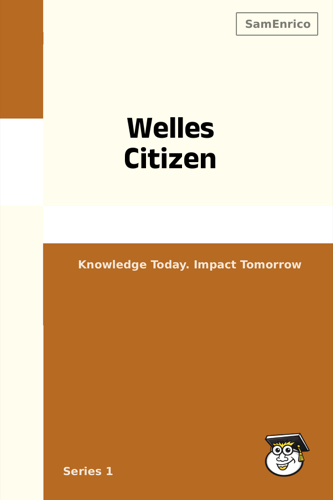
Welles Citizen
Chronicles the boy genius's rise and fall in Holly
Chronicles the boy genius's rise and fall in Hollywood.
Formats
About this book
Free sample
Chapter 1: The Boy Who Buried His Mother Twice--–- The first time Orson Welles buried his mother, he was nine years old, standing in a cemetery in Kenosha, Wisconsin, wearing a suit that itched and shoes that pinched, watching a mahogany casket descend into frozen earth. The second time he buried her was twenty-six years later, on a soundstage in Hollywood, when he wrote a scene about a dying newspaper tyrant whispering a word that meant nothing to anyone but him. Beatrice Ives Welles died of jaundice on May 10, 1924, and her son never stopped rewriting that ending. Every film he ever made, every performance he ever gave, every grand gesture and theatrical flourish was a variation on the same theme: the child who loses a parent and spends the rest of his life trying to get her back, frame by frame, line by line, illusion by illusion.The myth of Orson Welles—the myth he carefully cultivated and the public eagerly consumed—was that he sprang fully formed from the forehead of American culture, a boy genius who simply appeared on Broadway, conquered radio, and then reinvented Hollywood before his twenty-sixth birthday. The truth, as always, is more interesting and more painful.
The origins of the Wellesian temperament—the imperiousness, the insecurity, the desperate need to control every frame of every film, the simultaneous craving for and rejection of paternal authority—can be traced directly to the bedrooms and funeral parlors of his childhood. To understand the man who made Citizen Kane, you must first understand the boy who learned to perform before he learned to trust, who substituted applause for love, and who built an empire of illusion on the foundation of a childhood that crumbled too early.The House on Washington Street Kenosha, Wisconsin, in the first decades of the twentieth century was a manufacturing town on the shores of Lake Michigan, a place of factories and frame houses, immigrant labor and midwestern propriety. The Welles family did not quite fit. Richard Hodgdon Welles, Orson's father, had inherited a successful lamp manufacturing business and then promptly lost interest in it, preferring…
This is the end of the free sample. Get the eBook to keep going. Buy now
Contents
- Chapter 1
- Chapter 2
- Chapter 3
- Chapter 4
- Chapter 5
- Chapter 6
- Chapter 7
- Chapter 8
- Chapter 9
- Chapter 10
- Chapter 11
- Chapter 12
Details
- Author
- Barfield Carmina
- Publisher
- SamEnrico
- Language
- English
- Genre
- Non-Fiction, Biography, Golden Age
- Released
- 2026-06-05
- Pages (approx.)
- 122
- Available as
- eBook, Audiobook

Read better in the ZLOADR app
Your eBooks on your phone or tablet. Sign in with your SamEnrico account and start reading.
More by Barfield Carmina
 Empathy In Difficult ConversationsBarfield Carmina$11.99
 TM for Caffeine DependenceBarfield Carmina$11.99
 Pomodoro For ExecutivesBarfield Carmina$11.99
 City Hall After DarkBarfield Carmina$11.99
 Asthma Nighttime MeditationBarfield Carmina$11.99
 Clubhouse Room Status GuideBarfield Carmina$11.99
 Colombia Remote Tax GuideBarfield Carmina$11.99
 Sleep Lab Study GuideBarfield Carmina$11.99
 The Golden Slippers: How Black Ballerinas Conquered the WorldBarfield Carmina$11.99
 The Gates of Babylon: Darius and the Birth of the Persian EmpireBarfield Carmina$11.99
 Silent Witness: The Trial That Shook the Art WorldBarfield Carmina$11.99
 How to Become a Bucket ChuckerBarfield Carmina$11.99
You may also like
 Welles Rising Citizen KaneMichael Romaine$11.99
 Mankiewicz Witty DialogueRockwell Lettie$11.99
 Wilder Hollywood WitCraig Derek$11.99
 Ethel Merman Broadway QueenBader Gregorio$11.99
 Cukor Women DirectorKunkel Xavier$11.99
 Capra Americana SpiritBachman Margurite$11.99
 Carol Channing Hello DollyRoush Taisha$11.99