
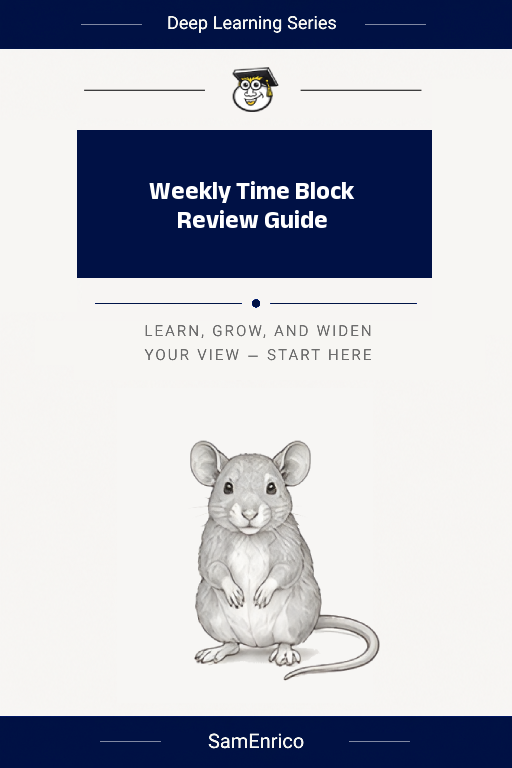
Non-FictionProfessional's Cheat Sheet
Weekly Time Block Review Guide eBook
Spend 30 minutes each Friday auditing your time bl
Spend 30 minutes each Friday auditing your time blocks for the week ahead.
Formats
Free sample
Chapter 1: The Monday Trap--–- The alarm screams at 6:30 AM. You silence it, scroll notifications, and feel the weight of the week before your feet touch the floor. By 8:00 AM, you have already replied to fourteen emails, put out two fires, and agreed to a meeting you knew you should have declined. It is Monday. And you are already losing.This is not a failure of character.
It is a failure of design.Most professionals begin their week the same way: they open their calendar on Monday morning, stare at the empty slots, and immediately start reacting. An email arrives—respond. A colleague pings—answer. A manager requests a "quick sync"—accept. By 10:00 AM, the calendar that looked empty at 8:00 AM is now a mosaic of other people’s priorities, and your own work has been pushed to "sometime this week, if there is time."This book exists because that pattern is optional.You do not have to start your week in reactive mode.
You do not have to let Monday morning dictate your focus. And you certainly do not have to spend five days scrambling, only to reach Friday exhausted, wondering where the time went.There is another way. It takes thirty minutes. It happens on Friday afternoon, not Monday morning. And it will change not just how you work, but how you live.Welcome to the Weekly Time Block Review.The Anatomy of a Lost Week Before we build a better system, we must understand why the default system fails.
Most people do not lack ambition, intelligence, or work ethic. They lack a structured moment to think before they act. And nowhere is this absence more damaging than on Monday morning.Let us walk through a typical Monday. Not an exaggerated caricature of chaos, but the ordinary, respectable Monday of a competent professional.You arrive at your desk—physical or virtual—at 8:30 AM. Your plan, vaguely formed over the weekend, is to "make progress on the Johnson proposal" or "catch up on reporting" or "finally clean out the task list." But before you can even open the relevant document, your email inbox catches your eye.
Forty-seven unread messages from the weekend. Some are newsletters you never subscribed to. Some are automated alerts. But several are from colleagues, clients, or managers who expect responses.You tell yourself you will just "scan quickly." Twenty minutes later, you have replied to twelve messages, deleted twenty-three, and flagged the rest for "later." You have not touched the Johnson proposal. You have not caught up on reporting.
You have not cleaned out your task list. You have, however, successfully cleared your inbox—temporarily—and feel a small dopamine hit of productivity that is entirely unrelated to your actual goals.Then Slack pings. Then a teammate stops by with a "quick question" that turns into a thirty-minute discussion about something completely off your radar. Then a meeting starts—one you accepted last week without looking closely at the agenda—and you spend forty-five minutes listening to updates that could have been an email.By noon, you are behind. By 3:00 PM, you are exhausted.
By 5:00 PM, you have moved the Johnson proposal to tomorrow’s to-do list, and you tell yourself that tomorrow will be different.It will not be. Because tomorrow will also start with email, Slack, and reactive firefighting. And the day after that. And the day after that.This is not a personal failing. This is a structural problem with how we are trained to begin our weeks.The Science of Decision Fatigue The Monday morning collapse is not just anecdotal.
It has a name in cognitive psychology: decision fatigue.Decision fatigue is the deteriorating quality of decisions made by an individual after a long session of decision making. Every choice you make—what to respond to first, whether to attend a meeting, how to phrase an email—draws from a finite reservoir of mental energy. By the time you have made fifty small decisions, your ability to make the fiftieth well is significantly impaired.Here is what most people miss: decision fatigue begins accumulating the moment you wake up. What to wear. What to eat for breakfast.
Whether to hit snooze. Which news headline to read. Which email to open first. By the time you sit down to plan your week, you have already exhausted a substantial portion of your decision-making capacity.This is why Monday morning is the worst possible time to plan your week. Your mental reservoir is already partially depleted before you even open your calendar.
And the moment you see those forty-seven unread emails, your brain shifts from strategic mode to survival mode. You stop asking "What matters most?" and start asking "What is loudest?"The result is a week designed by urgency, not importance. You will spend your time on whatever screams the loudest, not whatever moves you closer to your goals. And because you never had a moment to define those goals clearly, you will not even notice the misalignment until Friday afternoon—when it is too late to fix.The Myth of the Monday Fresh Start The cultural story we tell ourselves is seductive: Monday is a fresh start. A clean slate.
A new beginning.This story persists because it feels good. After a weekend of rest (or, more realistically, a weekend of errands, social obligations, and scrolling), Monday offers the promise of redemption. This week, you tell yourself, will be different. This week, you will finally get organized. This week, you will stop reacting and start leading.But a fresh start is not a strategy.
It is an emotion. And emotions, however pleasant, do not protect you from the structural reality of Monday morning. You can feel as fresh and motivated as you like—the moment you open your email, the reactive machine will swallow you whole.The problem is not your motivation. The problem is your timing.Think of your week as a river. Monday morning is the headwaters: fast, chaotic, full of debris from the weekend.
Trying to plan your week on Monday is like trying to build a boat while already being swept downstream. You are not designing a route; you are just trying not to drown.Friday afternoon, by contrast, is the calm eddy. The week is over. The fires have been extinguished (or at least contained). The urgent demands have subsided.
Your mind, while tired, is not yet overwhelmed by the next wave of inputs. This is the moment when you can step back, look at the river, and decide where you want to go next week.The Friday Reset is not about being productive on Friday. It is about being strategic on Friday so that Monday becomes executable.From Reactor to Architect Every professional operates in one of two modes: reactor or architect.The reactor wakes up and asks, "What needs my attention right now?" They open their inbox, their Slack, their calendar, and they respond. Their day is shaped by the loudest voice, the most recent notification, the closest deadline. Reactors are not lazy or undisciplined.
They are often the hardest-working people in their organizations. But they work hard on whatever arrives, not on whatever matters…
This is the end of the free sample. Get the eBook to keep going. Buy now
About this book
Details
- Author
- Calderon Scarlett
- Publisher
- SamEnrico
- Language
- English
- Genre
- Non-Fiction, Professional's Cheat Sheet
- Released
- 2026-05-30
- Pages (approx.)
- 157
- Available as
- eBook, Audiobook

Read better in the ZLOADR app
Your eBooks on your phone or tablet. Sign in with your SamEnrico account and start reading.
More by Calderon Scarlett
 The Monk with One RobeCalderon Scarlett$11.99
 HIPAA Data Leak Patient ScriptsCalderon Scarlett$11.99
 Acupuncture For UTI PreventionCalderon Scarlett$11.99
 Nightmare MythsCalderon Scarlett$11.99
 Feeling Trapped AngerCalderon Scarlett$11.99
 The Eyes Closed TM PostureCalderon Scarlett$11.99
 Strength Training Periodization GuideCalderon Scarlett$11.99
 DevOps On Call BurnoutCalderon Scarlett$11.99
 Elliot AbramsCalderon Scarlett$11.99
 The Maori Voyagers: Charting the Pacific with Western ScienceCalderon Scarlett$11.99
 Fenrir’s Bride: The Wolf and the ValkyrieCalderon Scarlett$11.99
 The Phantom Ledger: How a Small Town Accountant Outsmarted Wall StreetCalderon Scarlett$11.99
You may also like
 Hong Kong Handover 1997Dunn Johnnie$11.99
 Zumba For Postnatal Recovery CourseNeal Christian$11.99
 Zumba for BeginnersLadner Nikia$11.99
 YouTube Comment Mining GuideHumes Pandora$12.99
 Worry Box MeditationCarlin Rudy$11.99
 Workplace Stress MeditationNguyen Lynn$11.99
 Workplace Stress and Sleep RepairHawley Ivory$11.99
 Workplace Perfectionism CureDelaney Jeffry$11.99
 Workplace Injustice Anger GuideWallen Isabelle$11.99
 Work Addiction and Burnout LinkGreenwood Ester$11.99
 Women in Yoga and WellnessBeattie Galina$11.99
 Women in Stand Up ComedyChun Evangeline$11.99