

Non-FictionSelf-HelpDigital Wellness
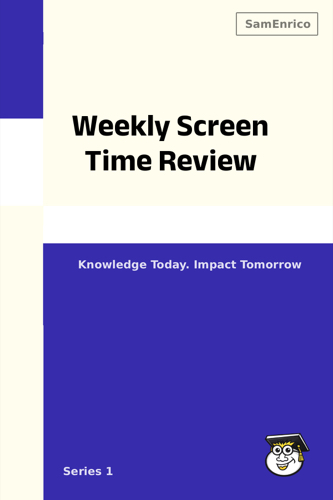
Weekly Screen Time Review eBook
Audit your digital consumption with this practical
by Haynes Sheri
Audit your digital consumption with this practical technology ritual.
Formats
Free sample
Chapter 1: The 106-Day Heist--On a Tuesday morning in early spring, a 34-year-old marketing director named Sarah did something she had done ten thousand times before: she picked up her phone to check the weather. Three hours later, she looked up from her couch, realized she had missed two work deadlines, ignored three texts from her son’s school, and could not remember a single thing she had watched on Instagram Reels. She had not checked the weather.Sarah is not lazy. She is not weak-willed. She is not addicted in the clinical sense of the word.
Sarah is a highly competent professional, a devoted parent, and a person who genuinely wants to use her time well. And yet, on that Tuesday morning, three hours of her life vanished into a glowing rectangle without her consent. She did not choose to lose those hours. They were taken from her.This book is the story of how that happens, why it is not your fault, and what you can do about it that actually works.Let us begin with a number that will either shock you or make you defensive: seven. According to the most recent data from Rescue Time, Screen Time, and Digital Wellbeing aggregators, the average adult spends over seven hours per day looking at a screen.
Not working on a screen—although work is included—but looking at a screen. Scrolling, tapping, watching, liking, sharing, swiping. Seven hours. Every day. That is 49 hours per week, 2,548 hours per year, or roughly 106 full days per year.
Let that land. One hundred and six days. Nearly one third of your waking life.If you are like most people, your first reaction to that number is denial. “Not me,” you think. “I work on a computer, sure, but that’s different.” Or: “I only check my phone when I’m waiting in line.” Or the classic: “I’m not addicted like those people.”Here is what Sarah thought when she first heard the seven-hour statistic: “That’s ridiculous.
I’m maybe at three hours.” Then she checked her Screen Time report. She was at six hours and fifty-two minutes. She had been off by nearly four hours. She was those people.So before you read another sentence, I want you to do something uncomfortable. Guess your average daily screen time.
Write it down. Be specific. Then open your Screen Time (i OS) or Digital Wellbeing (Android) settings and look at the last seven days. Do not change anything yet. Do not judge yourself.
Just look. The gap between your guess and the truth is the first honest confrontation of this book.The Great Unlearning Most books about screen time begin with a premise that feels good but does not work. That premise is: “You have a willpower problem. You just need to try harder.” These books tell you to put down your phone, to be more disciplined, to resist temptation. They make you feel like a failure when you inevitably pick the phone back up.
They sell shame disguised as self-help.This book begins with a different premise. Actually, it begins with a confession: I have tried the willpower approach. I have deleted apps, only to reinstall them three days later. I have set screen time limits, only to click “ignore limit” fifteen times in a row. I have sworn I would never scroll again, only to find myself scrolling an hour later, mid-sentence in my own promise.
I am not weak. I am human. And so are you.The problem with the willpower approach is that it misunderstands who you are fighting. You are not fighting your own laziness or lack of discipline. You are fighting a thousand of the world’s smartest engineers, psychologists, and data scientists who have spent billions of dollars learning exactly how to keep you looking at a screen.
Your phone is not a neutral tool. It is a slot machine designed to exploit your brain’s most ancient vulnerabilities.This is not a conspiracy theory. This is public record. In 2017, a former Google product manager named Tristan Harris testified before Congress that the attention economy is deliberately engineered to be addictive. In 2020, Netflix released The Social Dilemma, featuring dozens of Silicon Valley insiders admitting that they designed their products to exploit dopamine loops.
In 2022, the Wall Street Journal published a series of internal Facebook documents showing that the company knew its algorithm pushed angry, divisive content because that content kept people scrolling longer.You are not losing a battle against your phone. You are losing a battle against a multi-trillion-dollar industry that employs the best minds in the world to capture your attention and sell it to advertisers. Willpower is useless against that. You need a system.The Attention Economy Explained Let us step back and understand the machine you are up against. The Attention Economy is a term coined by economist Herbert Simon in 1971, long before the i Phone existed.
Simon wrote: “What information consumes is rather obvious: it consumes the attention of its recipients. Hence a wealth of information creates a poverty of attention.”In other words, there is only so much attention to go around. Every second you spend looking at one thing is a second you are not spending looking at another thing. In the pre-internet world, attention was abundant and information was scarce. You had to work to find things worth paying attention to.
In the post-internet world, the opposite is true. Information is infinite and attention is scarce. Whoever captures your attention captures value.The business model of almost every free app you use is built on this scarcity. Facebook, Instagram, Tik Tok, You Tube, Twitter, Reddit, Snapchat—none of them charge you money. You are not the customer.
You are the product. Advertisers are the customers. Your attention is what is being sold. Every time you scroll past an ad, the platform gets paid. Every time you watch a video, the platform gets paid.
Every time you like a post, the platform learns more about how to keep you scrolling, and then it gets paid more.This is not a bug. This is the feature. The platforms are not trying to help you connect with friends. They are trying to maximize the time you spend on their app. Those are opposing goals.
Genuine connection is efficient—you call your mother, you say what you need to say, you hang up. That is not profitable. What is profitable is infinite, frictionless, slightly novel content that never ends. An infinite scroll. An autoplaying video.
A notification that pulls you back in. All of it designed by people who have read the same neuroscience research you have not.The Dopamine Loop To understand why your phone feels so hard to put down, you need to understand a molecule called dopamine. You have probably heard of dopamine as the “pleasure chemical,” but that is not quite right. Dopamine is not released when you experience pleasure. It is released when you anticipate pleasure.
It is the molecule of wanting, not liking.Here is how it works. Your brain is constantly trying to predict what will make you feel good. When something good happens unexpectedly, your…
This is the end of the free sample. Get the eBook to keep going. Buy now
About this book
Details
- Author
- Haynes Sheri
- Publisher
- SamEnrico
- Language
- English
- Genre
- Non-Fiction, Self-Help, Digital Wellness
- Released
- 2026-06-06
- Pages (approx.)
- 135
- Available as
- eBook, Audiobook

Read better in the ZLOADR app
Your eBooks on your phone or tablet. Sign in with your SamEnrico account and start reading.
More by Haynes Sheri
 Immigrants Who Started Over After FiftyHaynes Sheri$11.99
 Facebook Envy Recovery WorkbookHaynes Sheri$11.99
 Menopause Sexuality GuideHaynes Sheri$11.99
 Personal Branding on Social MediaHaynes Sheri$11.99
 Risk Taking Confidence HypnosisHaynes Sheri$11.99
 Inbox Triage Decision MatrixHaynes Sheri$11.99
 Time Blocking for BeginnersHaynes Sheri$11.99
 The Outback Pioneers: Building Australia’s FrontierHaynes Sheri$11.99
 The Last Empress: A Forgotten Dynasty in the ShadowsHaynes Sheri$11.99
 How to Produce Play VehiclesHaynes Sheri$11.99
 How to Produce Disposable CupsHaynes Sheri$11.99
 Exploring Computer Art: Digital Drawing & DesignHaynes Sheri$11.99
You may also like
 Hong Kong Handover 1997Dunn Johnnie$11.99
 Zumba For Postnatal Recovery CourseNeal Christian$11.99
 Zumba for BeginnersLadner Nikia$11.99
 YouTube Comment Mining GuideHumes Pandora$12.99
 Worry Box MeditationCarlin Rudy$11.99
 Workplace Stress MeditationNguyen Lynn$11.99
 Workplace Stress and Sleep RepairHawley Ivory$11.99
 Workplace Perfectionism CureDelaney Jeffry$11.99
 Workplace Injustice Anger GuideWallen Isabelle$11.99
 Work Addiction and Burnout LinkGreenwood Ester$11.99
 Women in Yoga and WellnessBeattie Galina$11.99
 Women in Stand Up ComedyChun Evangeline$11.99