
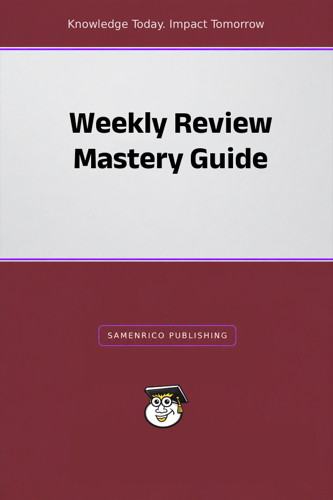
Non-FictionSelf-HelpProductivity
Weekly Review Mastery Guide eBook
Set aside one hour each Friday to clear clutter an
Set aside one hour each Friday to clear clutter and plan next week.
Formats
Free sample
Chapter 1: The Open Loops--I want you to try a simple experiment. Right now, without moving from wherever you are sitting, take a slow look around your immediate environment. Notice what you see. Perhaps there is a stack of mail on the corner of your desk, unopened from three days ago. Maybe there is a sticky note attached to your computer monitor with a phone number you meant to call back.
There might be a notification badge on your email icon—twenty-seven, forty-three, or heaven forbid, over a thousand unread messages. There could be a text message from a friend that you opened, read, and then told yourself you would reply to later. There is almost certainly a bill sitting somewhere, paid or unpaid, that you have been meaning to file or address. There is a project at work that you have not made progress on in two weeks. There is a conversation you have been meaning to have with your partner, your parent, or your child.
There is a doctor's appointment you need to schedule. There is a car registration that expires next month. There is a book you started and never finished. There is a skill you have been telling yourself you will learn. There is a dream you have been carrying around like a suitcase you never unpack.All of those items—every single one of them—is what psychologists and productivity researchers call an open loop.An open loop is any task, commitment, idea, or obligation that your brain considers incomplete.
It does not matter whether the task is trivial or monumental. It does not matter whether you have explicitly written it down or whether it exists only as a vague worry floating at the edge of your consciousness. Your brain, magnificent and relentless as it is, treats every open loop exactly the same way: as a threat to be monitored.This chapter is about understanding that mechanism. It is about naming the enemy of your attention, which is not laziness or lack of discipline, but rather the silent accumulation of unresolved commitments that slowly drain your cognitive energy until you feel exhausted at the end of a day in which you did not actually accomplish anything physically demanding. By the time you finish this chapter, you will understand why you feel tired even when you have not done much.
You will understand why Monday mornings feel like walking into a fog. And you will understand why the Weekly Review Mastery Guide begins not with calendars or to-do lists, but with the psychology of closure.The Hidden Cost of Unfinished Business In the late 1920s, a young Russian psychologist named Bluma Zeigarik was sitting in a café in Vienna when she noticed something peculiar about the waiters. They seemed to have an astonishing memory for orders that were still in progress—who had ordered which coffee, which pastry, which sandwich—but as soon as the bill was paid and the customer left, the waiters could not remember a single detail of that order. Zeigarik, who was a student of the renowned psychologist Kurt Lewin, returned to her laboratory and designed a series of experiments to test this phenomenon.What she discovered became known as the Zeigarnik effect: the human mind has a superior memory for tasks that are interrupted or incomplete compared to tasks that have been completed. In her experiments, participants were given a series of simple puzzles and mental tasks.
Some were allowed to finish; others were interrupted mid-stream. When asked later to recall the tasks, the participants remembered the interrupted tasks approximately twice as well as the completed ones.This is not a bug. It is a feature. Your brain is designed to hold open loops in active memory because, from an evolutionary perspective, incomplete threats required attention. If you were a hunter-gatherer and you saw a predator in the distance, your brain would keep that loop open until the predator was gone or until you were safe.
If you were building shelter for the winter and you had not yet sealed the roof, your brain would keep that loop open until the roof was finished. The mechanism is ancient, powerful, and utterly indifferent to the nature of the modern world.Today, that same mechanism is applied to email, text messages, unpaid bills, unwritten reports, unresolved arguments, unfulfilled promises, and unopened mail. Your brain does not know the difference between a lion approaching the village and an unanswered email from your boss. It treats both as open loops demanding cognitive resources.This is why you feel tired. Not because you have run a marathon or dug a ditch, but because your brain is constantly, silently, relentlessly tracking dozens—sometimes hundreds—of open loops at the same time.
Each loop consumes a tiny amount of what cognitive scientists call "attentional resources." A few loops are negligible. But when you have fifty or a hundred open loops, your brain is effectively operating with a significant portion of its processing power reserved for background monitoring.Think of it like the random-access memory in your computer. When you first turn on your computer and have only your operating system running, the RAM usage is low and everything runs quickly. But as you open browser tabs, email clients, word processors, and chat applications, the RAM fills up. The computer slows down.
It takes longer to switch between tasks. Eventually, the computer freezes or crashes. Your brain works exactly the same way. Every open loop occupies psychic RAM. When your psychic RAM is full, you suffer from what psychologists call decision fatigue—the progressive deterioration of your ability to make good choices after a long period of decision-making.Decision Fatigue and the Paradox of Choice There is a famous study involving judges in Israeli parole hearings.
Researchers followed eight judges over the course of ten months, analyzing more than one thousand parole decisions. The judges would hear cases in sequence, take breaks for food, and then hear more cases. What the researchers found was startling: the probability of a prisoner being granted parole was highest at the very beginning of the day, at roughly sixty-five percent. As the morning wore on, the parole rate dropped steadily, falling to nearly zero just before the morning break. After the break, the rate spiked again to about sixty-five percent, then dropped steadily toward zero before the lunch break.
After lunch, the same pattern repeated.The judges were not being malicious or discriminatory. They were suffering from decision fatigue. Each parole decision required cognitive effort. As they made more decisions, their ability to make careful, thoughtful judgments diminished. Eventually, they defaulted to the easiest decision, which was to deny parole and maintain the status quo.
The breaks—the morning snack, the lunch—restored their cognitive resources temporarily.This is what happens to you every single day. You wake up with a certain amount of decision-making energy. Every choice you make—what to eat for breakfast, which email to answer first, whether to call that client now or later, which route to take to work—consumes a small amount of that energy. By the end of the day, you are running on fumes. This is why you eat junk food…
This is the end of the free sample. Get the eBook to keep going. Buy now
About this book
Details
- Author
- Prentice Dotty
- Publisher
- SamEnrico
- Language
- English
- Genre
- Non-Fiction, Self-Help, Productivity
- Released
- 2026-06-09
- Pages (approx.)
- 153
- Available as
- eBook, Audiobook

Read better in the ZLOADR app
Your eBooks on your phone or tablet. Sign in with your SamEnrico account and start reading.
More by Prentice Dotty
 IBS And Mold Exposure GuidePrentice Dotty$11.99
 Habit Tracking JournalPrentice Dotty$11.99
 Career Disappointment RecoveryPrentice Dotty$11.99
 DEXA Scan Body CompositionPrentice Dotty$11.99
 The Twelve Step Home Group GuidePrentice Dotty$11.99
 Cut Off Response GuidePrentice Dotty$11.99
 David Unaipon Australian VoicePrentice Dotty$11.99
 The Bronze Masters of Ife: Sculpting the Divine in Yoruba ArtPrentice Dotty$11.99
 The Pen and the Pitch: How Latin America's Sports Writers Shaped a ContinentPrentice Dotty$11.99
 How to Produce Train PartsPrentice Dotty$11.99
 A Collector's Handbook to the Hupmobile Aerodynamic 6Prentice Dotty$11.99
 German Raise for ImmigrantsPrentice Dotty$12.99
You may also like
 Hong Kong Handover 1997Dunn Johnnie$11.99
 Zumba For Postnatal Recovery CourseNeal Christian$11.99
 Zumba for BeginnersLadner Nikia$11.99
 YouTube Comment Mining GuideHumes Pandora$12.99
 Worry Box MeditationCarlin Rudy$11.99
 Workplace Stress MeditationNguyen Lynn$11.99
 Workplace Stress and Sleep RepairHawley Ivory$11.99
 Workplace Perfectionism CureDelaney Jeffry$11.99
 Workplace Injustice Anger GuideWallen Isabelle$11.99
 Work Addiction and Burnout LinkGreenwood Ester$11.99
 Women in Yoga and WellnessBeattie Galina$11.99
 Women in Stand Up ComedyChun Evangeline$11.99