
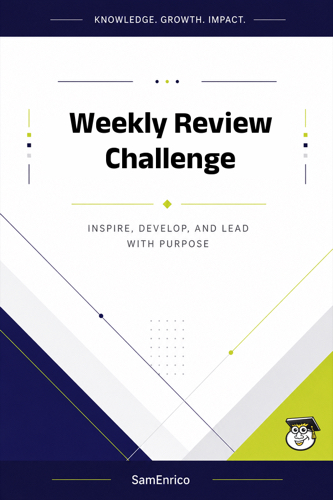
Weekly Review Challenge eBook
Twelve weeks to build lasting review habit.
Twelve weeks to build lasting review habit.
Formats
Free sample
Chapter 1: The 84-Day Reset--–- The email arrived at 11:47 PM on a Tuesday. I had been staring at my calendar for forty-five minutes, moving the same three tasks from one day to the next, pretending I was planning when I was actually hiding. My daughter's soccer game had been that afternoon. I had watched it through my phone screen while answering "urgent" Slack messages about a project that no one would remember in six months. When she scored her first goal of the season, I missed it.
Not because I wasn't there. Because I was looking down.That night, I printed my calendar for the previous twelve months. I spread the pages across my kitchen table – fifty-two weeks of meetings, deadlines, travel, and "busy work." Then I asked myself a question that would change everything: How many of these weeks actually moved me toward something I genuinely cared about?The answer was seven. Seven weeks out of fifty-two.Seven weeks where I could point to concrete progress on a meaningful goal. The other forty-five weeks were not failures exactly.
They were just... drift. Responding to other people's emergencies. Attending meetings that could have been emails. Working late to clear an inbox that would fill up again before breakfast.
I had been busy. Very busy. But busy is not the same as productive, and productive is not the same as meaningful.This book exists because of that night at the kitchen table. And because I have since discovered that my experience is not unusual – it is nearly universal.The Statistic That Changed How I Think About Goals You have probably heard some version of the following claim: "92% of people fail to achieve their annual goals." This statistic appears in countless productivity books, keynote presentations, and Linked In posts. It is repeated so often that most people accept it as settled fact.Here is what I learned when I actually traced it to its source: the number comes from a 1980s study on New Year's resolutions, not annual goals.
The original research found that about 12% of people felt they had "succeeded" with their resolutions after one year – but the study did not define success consistently, and follow-up research has produced wildly different numbers depending on how "goal achievement" is measured.I tell you this not to dismiss the statistic, but to make an important distinction: the exact percentage does not matter. What matters is the pattern that every serious study of goal achievement confirms. Whether the number is 92% or 80% or even 70%, the overwhelming majority of people do not achieve their annual goals. And they fail not because they lack ambition, intelligence, or work ethic. They fail because of the container they put their goals into.The annual timeline is broken.The Dangerous Illusion of "Someday"There is a specific psychological mechanism that makes annual goals fail.
I call it the Someday Illusion.Here is how it works. When you set a goal with a deadline that is twelve months away, your brain instinctively categorizes that goal as "distant future." The distant future feels abundant. It feels like there is plenty of time. And when time feels abundant, urgency evaporates. You tell yourself: I will start next month.
I will work harder after the holidays. I will catch up in the summer.Months pass. The goal remains untouched. But because the deadline is still months away, you do not feel the appropriate level of alarm. The anxiety only arrives when the calendar flips to November or December – and by then, it is too late to do anything but scramble.This is the Someday Illusion: the belief that because a deadline is far away, you have plenty of time to complete the work.The antidote is the Deadline Mindset: compressing your timeline until urgency becomes unavoidable.
When a deadline is twelve weeks away instead of twelve months, your brain treats it differently. Twelve weeks feels real. Twelve weeks feels finite. Twelve weeks creates the productive anxiety that annual timelines cannot produce.But here is the nuance that most productivity books get wrong – and that I got wrong in my first attempts at fixing this problem. The solution is not to abandon annual thinking entirely.
The solution is to nest short cycles inside a longer vision.The Nested Model: Yearly Compass + 12-Week Cycles Let me introduce you to the framework that runs through every page of this book. It resolves the contradiction that plagues so many productivity systems.Most approaches fall into one of two camps. Camp One says: "Set annual goals and work toward them consistently." This fails because the timeline is too long to generate urgency. Camp Two says: "Abandon annual planning entirely and just focus on 12-week sprints." This fails because you can sprint in the wrong direction for a very long time without realizing it.The solution is a nested model with two layers:Layer One: The Yearly Compass Once per year – ideally in December or January, but any month works – you set a broad directional vision. This is not a goal with a deadline.
It is not measurable. It is a compass heading. Examples: "This year, I want to prioritize my health so I have energy for my family." or "This year, I want to build the foundation for a career transition." The Yearly Compass answers the question: Which direction is forward?Layer Two: The 12-Week Cycle Every twelve weeks – four times per year – you set specific, measurable, time-bound goals that move you in the direction of your compass. These are your Wildly Important Goals (WIGs), a concept we will explore in depth in Chapter 3. The 12-week cycle answers the question: What specific progress can I make in the next 84 days?Here is why this nested model works when pure 12-week planning fails.
Without a Yearly Compass, you might complete four excellent 12-week cycles that take you in four different directions – lots of activity, zero progress toward anything that matters. With a Yearly Compass, every 12-week cycle reinforces the others. Your sprints accumulate into a meaningful journey.And here is why this nested model works when pure annual planning fails. With a 12-week cycle, you cannot hide. The deadline is close enough that procrastination has real consequences.
You feel the pressure early enough to act.The rest of this book is the operating manual for the 12-week cycle. The Yearly Compass is simple enough to set in one hour. The 12-week cycle requires twelve weeks of disciplined execution. That is what we are building together.Why Weekly Reviews Are the Engine – Not the Destination Before we go further, I need to clarify something important. This book is called The Weekly Review Challenge.
The weekly review is the central practice. But the weekly review is not the goal.The goal is whatever you want to achieve in your life, your work, your relationships, your health. The weekly review is simply the engine that gets you there. It is the difference between hoping for progress and ensuring it.Think of it this way. If you wanted to build a house, you would not spend all your time learning to use a hammer.
You would learn to use a hammer because you needed to build a house. The hammer is not the point.…
This is the end of the free sample. Get the eBook to keep going. Buy now
About this book
Details
- Author
- Dunham Kristel
- Publisher
- SamEnrico
- Language
- English
- Genre
- Non-Fiction, Self-Help, 12 Week
- Released
- 2026-06-08
- Pages (approx.)
- 136
- Available as
- eBook, Audiobook

Read better in the ZLOADR app
Your eBooks on your phone or tablet. Sign in with your SamEnrico account and start reading.
More by Dunham Kristel
 Great Mother Symbol Dream CourseDunham Kristel$11.99
 Values And Mission Alignment Board ReportingDunham Kristel$11.99
 Dumbbell Only Strength ProgramDunham Kristel$11.99
 Midnight in Marrakech: The Lost Jazz Sessions of 1954Dunham Kristel$11.99
 The Last Love Letter: A Nurse’s Secret War in the PacificDunham Kristel$11.99
 Understanding Hypo-alphalipoproteinemia PrimaryDunham Kristel$17.99
 Family Office Career GuideDunham Kristel$12.99
 Automated Medication DispensingDunham Kristel$12.99
 How to Start a Multi-function office Equipment Business (Beginners Guide)Dunham Kristel$11.99
 Patient Benefits AdvocateDunham Kristel$11.99
You may also like
 Hong Kong Handover 1997Dunn Johnnie$11.99
 Zumba For Postnatal Recovery CourseNeal Christian$11.99
 Zumba for BeginnersLadner Nikia$11.99
 YouTube Comment Mining GuideHumes Pandora$12.99
 Worry Box MeditationCarlin Rudy$11.99
 Workplace Stress MeditationNguyen Lynn$11.99
 Workplace Stress and Sleep RepairHawley Ivory$11.99
 Workplace Perfectionism CureDelaney Jeffry$11.99
 Workplace Injustice Anger GuideWallen Isabelle$11.99
 Work Addiction and Burnout LinkGreenwood Ester$11.99
 Women in Yoga and WellnessBeattie Galina$11.99
 Women in Stand Up ComedyChun Evangeline$11.99