
Non-FictionSelf-HelpWeekend PlanningRest
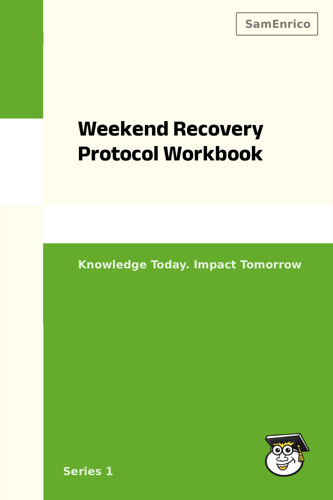
Weekend Recovery Protocol Workbook eBook
Use two days off to actually recharge instead of c
by Root Rico
Use two days off to actually recharge instead of catching up on chores.
Formats
Free sample
Chapter 1: The Chores Trap--If you are reading this book on a Sunday evening, I want you to pause for a moment. Set the book down—just for ten seconds—and place your hand on your chest. Feel your heartbeat. Notice whether your shoulders are raised toward your ears. Observe if your jaw is clenched or your breathing is shallow.
Now, ask yourself one question: What did I actually do this weekend?Not what you planned to do. Not what you wished you had done. What did you actually do?If you are like the thousands of people I have interviewed, researched, and worked with over the past several years, your answer probably falls into one of three categories. First, you did chores: laundry, grocery shopping, cleaning, meal prep, email catch-up, bill paying, home repair, or the endless administrative labor of keeping a life running. Second, you collapsed: hours of scrolling social media, binge-watching a show you cannot remember, staring at your phone while a movie played in the background, or lying on the couch feeling vaguely guilty about the first category.
Third—and this is the smallest category by far—you did something that actually made you feel better when Monday morning arrived.Here is the brutal truth that most weekend advice books are too polite to say: you are treating your two days off as a forty-eight-hour extension of your work week, just without pay. You have convinced yourself that if you just push hard enough on Saturday—if you sprint through the laundry, the dishes, the errands, the emails—then Sunday will finally be yours. But Sunday never comes. Sunday becomes another chore day, another collapse day, another day of trading exhaustion for the vague hope that next weekend will be different. And then Sunday night arrives, and with it comes the familiar dread: the tight chest, the racing thoughts, the feeling that you wasted the only time you had to yourself.This chapter is called The Chores Trap not because chores are evil or because you can somehow eliminate them from your life.
That would be a fantasy, and this book deals only in realities. The trap is something far more insidious: the belief that catching up is the same as recharging. It is not. They are opposites. Catching up depletes.
Recharging restores. And right now, you are likely using the same exhausted energy systems to catch up on your weekends that got you behind in the first place.The Weekend Autopsy: What Actually Happens Let us perform a quick autopsy of a typical weekend. I want you to be honest with yourself—not judgmental, but honest. There is a difference. Judgment says, "I am lazy and undisciplined." Honesty says, "I am tired and I have not yet learned a better system."On Friday evening, you finish work.
Maybe you close your laptop at 5:00 PM, or maybe you send one last email at 7:30 PM. Either way, you collapse onto the couch with your phone. You tell yourself you are "decompressing," but what you are actually doing is marinating in the same cognitive soup that you swam in all week: notifications, decisions, comparisons, inputs. You order takeout because you are too tired to cook. You watch two episodes of a show while scrolling Reddit.
You fall asleep on the couch at 11:00 PM, wake up at 12:30 AM, brush your teeth, and go to bed feeling vaguely unsatisfied.Saturday morning arrives. You wake up later than you planned—9:30 AM instead of 8:00 AM. You tell yourself you needed the sleep. You check your phone immediately. You lie in bed for forty-five minutes, cycling through Instagram, email, news, and a growing sense of anxiety about everything you need to do.
By the time you get up, it is 10:15 AM. The morning is half gone.You make coffee and a mental to-do list. The list is long: laundry, grocery shopping, clean the bathroom, reply to your mother's text, pay the credit card bill, fix the wobbly table leg, meal prep for the week, answer those three work emails you have been avoiding, schedule the dentist appointment, return the library books, vacuum, change the sheets, call the insurance company about the claim, and—if there is time—go for a run. You feel tired just looking at the list, but you also feel a familiar pressure: if you do not do these things today, Sunday will be ruined.So you start. You put on a load of laundry.
You make a grocery list. You clean the kitchen. You run one errand, then another, then another. By 2:00 PM, you have crossed off six items and added three more. You are tired, but you tell yourself you are being productive.
You eat lunch standing over the sink because sitting down feels like giving up.By 5:00 PM, you are exhausted. You have done twelve things on your list, but the list still has eight things on it. You feel a familiar resentment building: why is there always more? Why can you never get ahead? You sit down on the couch to "rest for twenty minutes," and then you do not get up for two hours.
You scroll. You watch a show you do not care about. You order takeout again because cooking feels impossible. You go to bed at 11:00 PM, and you cannot fall asleep because your brain is replaying everything you did not finish.Sunday morning. You wake up later than Saturday—10:00 AM.
The guilt is already there, waiting for you. You check your phone. You see photos of friends at brunch, on hikes, at concerts. You feel a pang of something: envy, shame, loneliness, or all three. You tell yourself you will have a better weekend next time.Sunday is a blur of unfinished chores, low-grade anxiety about Monday, and the desperate, futile attempt to "relax" in the cracks between obligations.
You meal prep. You fold laundry while watching TV. You answer those three work emails you have been avoiding—and then you answer four more because once you open the inbox, you cannot look away. You look at the clock: 4:00 PM. Then 6:00 PM.
Then 8:00 PM. You have not done anything that felt like restoration. You have not felt joy, or flow, or peace. You have felt like a machine performing maintenance on itself until the next shift begins.By 9:00 PM on Sunday, your chest is tight. Your stomach is unsettled.
You are thinking about Monday morning: the meeting, the deadline, the difficult conversation, the email you should have sent Friday. You tell yourself you need a vacation. But you just had a vacation. It was called the weekend. And you spent it catching up.The False Promise of "Catching Up"Here is what you need to understand: catching up is a myth.
It does not exist. You will never, ever be caught up. Not because you are lazy or disorganized, but because the nature of modern life is that obligations are infinite and energy is finite. For every email you answer, two more arrive. For every chore you complete, another appears.
For every task you cross off your list, three more reveal themselves. This is not a personal failing. This is the structure of…
This is the end of the free sample. Get the eBook to keep going. Buy now
About this book
Details
- Author
- Root Rico
- Publisher
- SamEnrico
- Language
- English
- Genre
- Non-Fiction, Self-Help, Weekend Planning, Rest
- Released
- 2026-06-09
- Pages (approx.)
- 153
- Available as
- eBook, Audiobook

Read better in the ZLOADR app
Your eBooks on your phone or tablet. Sign in with your SamEnrico account and start reading.
More by Root Rico
 Pet Loss for SinglesRoot Rico$11.99
 Johnathan Edwards AccountRoot Rico$11.99
 Body Language for TherapistsRoot Rico$11.99
 Body Image and Scars Healing GuideRoot Rico$11.99
 Ragnarok's Forgotten Architect: The Enigma of Loki's BloodlineRoot Rico$11.99
 Understanding Krauss–herman–holmes SyndromeRoot Rico$17.99
 Green Hydrogen Market OutlookRoot Rico$12.99
 Essay Feedback Automator ManualRoot Rico$12.99
 Assistant Financial ControllerRoot Rico$11.99
 How to Start a Hobby in SketchingRoot Rico$11.99
You may also like
 Hong Kong Handover 1997Dunn Johnnie$11.99
 Zumba For Postnatal Recovery CourseNeal Christian$11.99
 Zumba for BeginnersLadner Nikia$11.99
 YouTube Comment Mining GuideHumes Pandora$12.99
 Worry Box MeditationCarlin Rudy$11.99
 Workplace Stress MeditationNguyen Lynn$11.99
 Workplace Stress and Sleep RepairHawley Ivory$11.99
 Workplace Perfectionism CureDelaney Jeffry$11.99
 Workplace Injustice Anger GuideWallen Isabelle$11.99
 Work Addiction and Burnout LinkGreenwood Ester$11.99
 Women in Yoga and WellnessBeattie Galina$11.99
 Women in Stand Up ComedyChun Evangeline$11.99