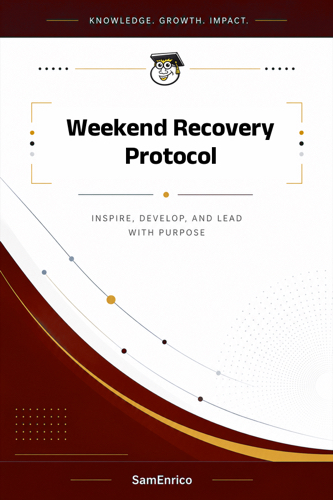
Weekend Recovery Protocol eBook
Design weekends that truly restore you for the wee
by Grimm Mao
Design weekends that truly restore you for the week ahead without chores catching up.
Formats
Free sample
Chapter 1: The Diagnostic Trap--–- It was 7:42 PM on a Sunday when Sarah realized she had lost another one.Not her keys. Not her phone. Not her mind—though that felt close. She had lost the weekend itself. Forty-eight hours had been right there, in her hands, on Friday afternoon.
She had plans. Vague, hopeful plans, but plans nonetheless. She would sleep in. She would finally start that novel sitting on her nightstand. She would call her sister back.
She would go for a long walk without her phone, just to feel the sun on her face and remember what it was like to not be needed by anyone for ninety consecutive minutes.Instead, here she was: sitting on her couch in yesterday's clothes, a half-empty mug of cold tea on the coaster she kept forgetting to use, scrolling through work emails she had promised herself she would not open until Monday. The novel had not been touched. Her sister's voicemail was still unreturned. The walk had been replaced by a frantic trip to the grocery store when she realized there was nothing for breakfast. And somewhere in the haze of Saturday morning, between the laundry and the dishwasher and the sudden urgent need to organize the junk drawer, the weekend had simply...
evaporated.She was not tired in the way people mean when they say "I'm tired." She was exhausted in the bone-deep, why-am-I-doing-any-of-this way. The way that makes you question whether you are living your life or merely performing a series of errands in a costume of yourself.Sarah is not real. But you already know her. You have been her. You might be her right now, reading this paragraph, feeling a low-grade pulse of recognition in your chest because you have just lived through the same weekend.
Different details, same result. Saturday promised everything. Sunday delivered nothing except the creeping dread of Monday morning.Here is the question that keeps Sarah—and you—up on Sunday night: Why?Not why does work exist. Not why do chores exist. You know the answer to those questions.
The real question is why your weekends, which contain exactly the same number of hours as everyone else's weekends, seem to disappear into a black hole of vague productivity that leaves you neither restored nor accomplished. You did things. You must have done things. But if someone asked you on Monday morning to name one joyful moment from the previous two days, your mind would go blank.This is not a character flaw. It is not laziness.
It is not a lack of discipline or a failure of willpower or evidence that you are somehow fundamentally broken in a way that other, more organized people are not.It is a design problem.And like all design problems, it has a diagnostic phase.The Sunday Scaries Are Not What You Think Let us name the thing that woke you up at 3 AM on Sunday night, even though you were exhausted. Let us name the thing that made your stomach tighten as you watched the clock tick toward 6 PM. Let us name the thing that has become so normalized in modern life that we have given it a cutesy nickname to make it hurt less.The Sunday Scaries.Pop culture tells you the Sunday Scaries are caused by a bad job. By a tyrannical boss. By a looming Monday morning meeting you did not prepare for.
By the soul-crushing weight of capitalism grinding you into dust one five-day workweek at a time.That explanation feels true. It is also almost entirely wrong.The Sunday Scaries are not caused by Monday. They are caused by Sunday. More specifically, they are caused by the absence of a clean boundary between rest and responsibility. Your anxiety spikes not because you have too much to do next week, but because you have not clearly signaled to your brain that last week is over and this weekend actually counted as rest.Oliver Burkeman, in his magnificent book Four Thousand Weeks, introduces a concept called "temporal scarcity." The idea is simple but devastating: we feel anxious about time not because we have too little of it, but because we have never clearly decided what we are not going to do with it.
An open schedule feels like freedom, but it actually feels like drowning. Your brain, desperate for structure, fills every empty moment with a should: I should be cleaning. I should be exercising. I should be calling my mother. I should be more productive with this precious free time.The Sunday Scaries are not a warning about Monday.
They are a retrospective verdict on your weekend design. They are your brain saying, "We did not actually rest, and now we are about to be thrown back into the arena, and we are running on fumes."This is the first and most important thing you need to understand: the anxiety you feel on Sunday night is not the problem. It is the symptom. The problem is a broken transition protocol between Friday and Saturday.The Hidden Cost of the Unmarked Boundary Think about your Friday evening for a moment. Not the idealized version where you leave work at exactly 5 PM, close your laptop with a satisfying click, and walk into a weekend of possibility.
Think about the actual Friday evening you just lived.Did you finish your last work task at 5:30 PM? 6:15? 7:00? Did you close your laptop immediately, or did you leave it open on the kitchen counter, screen slightly dimmed but not off? Did you check email one more time while waiting for water to boil?
Did you answer a Slack message while sitting on the couch, thinking, "It'll only take two seconds"?Those two seconds matter. Not because they stole two seconds of your time—you have billions of seconds. They matter because they sent a signal to your brain: The boundary is porous. Work can enter at any time. You are never truly off.The Zeigarnik Effect, discovered by Russian psychologist Bluma Zeigarnik in the 1920s, explains why this matters.
Zeigarnik found that people remember incomplete tasks far better than completed ones. Your brain holds open a mental tab for every unfinished thing, consuming cognitive resources in the background like a phone app you forgot to close.When you leave your laptop open, your brain keeps a tab open. When you tell yourself "I'll just reply to that one email," your brain adds another tab. When you spend Saturday morning thinking about the presentation you didn't finish, the dishes you didn't wash, or the text you didn't reply to, your brain is running on a browser with forty-seven tabs open. No wonder you are exhausted.
No wonder you cannot remember a single joyful moment from the weekend. You were never actually present for it.The phrase "energy leak" sounds abstract. Let me make it concrete. An energy leak is any moment during your weekend when you think about a work task or a chore when you are not actively doing that task. It is the thirty seconds you spend mentally composing an email while waiting for your coffee to brew.
It is the two minutes you spend worrying about a project deadline while brushing your teeth. It is the idle…
This is the end of the free sample. Get the eBook to keep going. Buy now
About this book
Details
- Author
- Grimm Mao
- Publisher
- SamEnrico
- Language
- English
- Genre
- Non-Fiction, Self-Help, Weekend Planning
- Released
- 2026-06-07
- Pages (approx.)
- 129
- Available as
- eBook, Audiobook

Read better in the ZLOADR app
Your eBooks on your phone or tablet. Sign in with your SamEnrico account and start reading.
More by Grimm Mao
 Disney Channel 2000s EraGrimm Mao$11.99
 Positive Assertion for ComplimentsGrimm Mao$11.99
 UK VAT Bad Debt Relief First Claim ManualGrimm Mao$11.99
 DoorDash Grocery Order PlaybookGrimm Mao$11.99
 F15 Eagle Pilot StoryGrimm Mao$11.99
 Laci Peterson Phone RecordsGrimm Mao$11.99Laci Peterson Phone RecordsGrimm Mao$11.99
 Citation Rules In Text Citations GuideGrimm Mao$11.99
 Resentment At WorkGrimm Mao$11.99
 The House of Wisdom Reborn: Samarkand’s Astronomers and the Revival of Lost KnowledgeGrimm Mao$11.99
 The Marble Plague: Michelangelo’s Divine CureGrimm Mao$11.99
 Silicon Valley's Secret Weapon: The Rise of the Unicorn FactoryGrimm Mao$11.99