
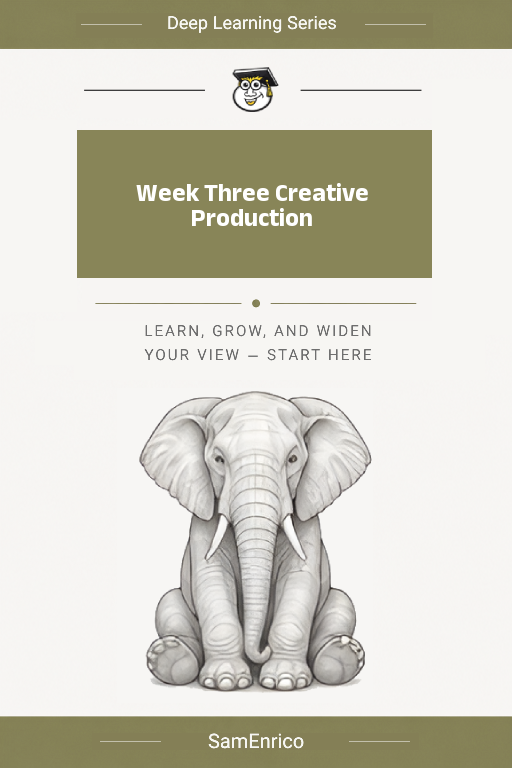
Non-FictionFirst 30 DaysWeek Three
Week Three Creative Production eBook
Creates ad images, videos, and copy for Facebook a
Creates ad images, videos, and copy for Facebook and Instagram during third week of campaign preparation.
Formats
Free sample
Chapter 1: The Native Lie...--Every marketer makes the same mistake. You have spent hours perfecting a single campaign. The offer is irresistible. The targeting is precise. You feel ready.
Then you open Meta Ads Manager, upload one creative, check both boxes for Facebook and Instagram, and hit publish. The next morning, the numbers are mediocre. You blame the creative. You blame the offer. You blame the algorithm.You blame everything except the actual problem: you committed the native lie.The native lie is the false belief that a single piece of content can perform equally well on Facebook and Instagram.
It cannot. The two platforms are not different distribution channels for the same content. They are different countries with different languages, different customs, and different expectations. Publishing the same ad on both is like walking into a business meeting in Tokyo wearing a tuxedo and speaking Spanish. You might technically be in the room, but no one understands you.This chapter dismantles the native lie completely.
Drawing from Gary Vaynerchuk's foundational work in Jab, Jab, Jab, Right Hook, we will establish why Facebook and Instagram demand fundamentally different creative approaches. You will learn the specific behavioral differences between users on each platform. You will master the Native Translation Matrix, a practical tool for transforming a single campaign concept into platform-specific assets. And you will complete the chapter with a clear audit process that ensures nothing leaves your desk until it speaks the native language of its destination.By the end of this chapter, you will never again publish the same creative on Facebook and Instagram. More importantly, you will understand why that single change can double or triple your campaign performance without spending another dollar on advertising.The Psychology of Platform Behavior Before we discuss formats, aspect ratios, or caption lengths, we must understand the fundamental psychological state of users when they open each application.
Behavior drives format. Format does not drive behavior.Facebook: The Newspaper Mindset Facebook users arrive with what we call the newspaper mindset. Think of someone sitting down with a morning paper. They expect headlines. They expect articles.
They expect to read, to learn, and occasionally to discuss. They are willing to click links because clicking links is what newspaper readers do. They move from the front page to section A to section B. They have time. They have attention span.This is not accidental.
Facebook's origin as a desktop-only platform trained an entire generation of users to consume long-form content. The platform's algorithm reinforces this behavior by rewarding posts that generate conversation in the comments. When users comment, reply, and debate, Facebook interprets that as high-quality engagement and shows the post to more people.The newspaper mindset user wants text. They want data. They want arguments.
They are comfortable with links because the link is the next paragraph of their newspaper. They will read 200 words. They will read 500 words. They will click through to a blog post or a case study because that is the natural extension of the experience.Instagram: The Magazine Mindset Instagram users arrive with a fundamentally different psychological state: the magazine mindset. Think of someone flipping through a glossy magazine in a waiting room.
They are not reading articles. They are scanning images. They stop when something catches their eye. They absorb quickly. They move on.
They rarely click links because links disrupt the scanning experience. They want to save, share, and admire, not leave.Instagram's origin as a mobile-only photo-sharing application trained users to prioritize visuals above all else. The algorithm rewards saves, shares, and time spent on the visual itself. Comments matter less. Conversation matters less.
What matters is whether a user stops scrolling, looks at the image or video, and then saves it for later or shares it with a friend.The magazine mindset user wants beauty. They want speed. They want emotion. They will not read 200 words. They will read 50 words if the visual is compelling enough to earn the effort.
They will almost never click a link in the caption. They expect the call to action to be "link in bio" or a comment trigger. This is not laziness. This is the native behavior of the platform.Why the Native Lie Persists If the difference is so clear, why do most marketers still publish identical content across both platforms? Three reasons.First, convenience.
Creating two versions of everything takes time. Time is scarce. The shortcut of uploading once and checking both boxes is seductive. But as every experienced marketer learns, shortcuts in creative production show up as poor performance in the ad account.Second, platform convergence. Over the past several years, Facebook has pushed Reels.
Instagram has pushed longer captions. The platforms have borrowed features from each other, leading many marketers to conclude that the platforms are becoming the same. This is a dangerous misinterpretation. Feature convergence is not user behavior convergence. Instagram users still behave like Instagram users even when Instagram adds a feature that originated on Facebook.Third, ego.
Marketers fall in love with their creative. When you have spent hours on a video or an image, you want to show it everywhere. The idea that your beautiful asset might be wrong for half of your audience is uncomfortable. But the native lie is not an attack on your skill. It is an observation about user psychology that you cannot change.
You can only adapt.The Native Translation Matrix The Native Translation Matrix is the practical tool that transforms the native lie into the native truth. For any single campaign concept, the matrix specifies exactly how the creative must change across five dimensions when moving from Facebook to Instagram.Dimension One: Format Facebook favors formats that support the newspaper mindset. Links perform well. Text posts perform well. Long-form videos (one to three minutes) perform well when they contain substantial information.
Carousels with four or more slides perform well because users are willing to click through multiple panels.Instagram favors formats that support the magazine mindset. Single images perform well. Reels perform best. Carousels with three slides maximum perform well because users have limited swiping patience. Link posts do not exist natively on Instagram.
Every link requires a workaround.Translation Rule: If your Facebook format is a link post or a text post, your Instagram version must be a Reel, a single image, or a short carousel. There is no exception.Dimension Two: Aspect Ratio Aspect ratio is the shape of your creative. It signals professionalism and platform knowledge instantly.Facebook accepts multiple aspect ratios, but 16:9 (widescreen) and 1.91:1 (cinematic) perform best in the feed. These wider ratios mimic the desktop experience and feel natural to newspaper mindset users.Instagram demands vertical or square ratios. 4:5 is the standard for feed posts.
9:16 is mandatory for Reels and Stories. Square (1:1) works for feed but feels dated to experienced users.Translation Rule: Never publish a 16:9 video on Instagram. Never publish a 9:16 video on Facebook feed. The platform will technically accept both. Your audience will punish you for both.Dimension Three: Caption Length Caption length is where the native lie causes the most damage.
Marketers write one caption, publish it everywhere, and wonder why engagement differs dramatically between platforms.On Facebook, captions of 125 words…
This is the end of the free sample. Get the eBook to keep going. Buy now
About this book
Details
- Author
- Wharton Danika
- Publisher
- SamEnrico
- Language
- English
- Genre
- Non-Fiction, First 30 Days, Week Three
- Released
- 2026-05-30
- Pages (approx.)
- 133
- Available as
- eBook, Audiobook

Read better in the ZLOADR app
Your eBooks on your phone or tablet. Sign in with your SamEnrico account and start reading.
More by Wharton Danika
 Voice Actor Theme Park VoiceWharton Danika$11.99
 Cleopatra Father Daughter RivalryWharton Danika$11.99
 Pandemic Career PauseWharton Danika$11.99
 The Carrier Screening GuideWharton Danika$11.99
 Four Days of Fury: The Dutch Smash the Spanish Armada's Shadow (1607)Wharton Danika$11.99
 Advanced SQL and Data ModelingWharton Danika$11.99
 Impact Investor Due DiligenceWharton Danika$12.99
 Understanding Zollinger–ellison SyndromeWharton Danika$17.99
 How to Start a Boards Made of Glass Fibre Business (Beginners Guide)Wharton Danika$11.99
You may also like
 Hong Kong Handover 1997Dunn Johnnie$11.99
 Zumba For Postnatal Recovery CourseNeal Christian$11.99
 Zumba for BeginnersLadner Nikia$11.99
 YouTube Comment Mining GuideHumes Pandora$12.99
 Worry Box MeditationCarlin Rudy$11.99
 Workplace Stress MeditationNguyen Lynn$11.99
 Workplace Stress and Sleep RepairHawley Ivory$11.99
 Workplace Perfectionism CureDelaney Jeffry$11.99
 Workplace Injustice Anger GuideWallen Isabelle$11.99
 Work Addiction and Burnout LinkGreenwood Ester$11.99
 Women in Yoga and WellnessBeattie Galina$11.99
 Women in Stand Up ComedyChun Evangeline$11.99