
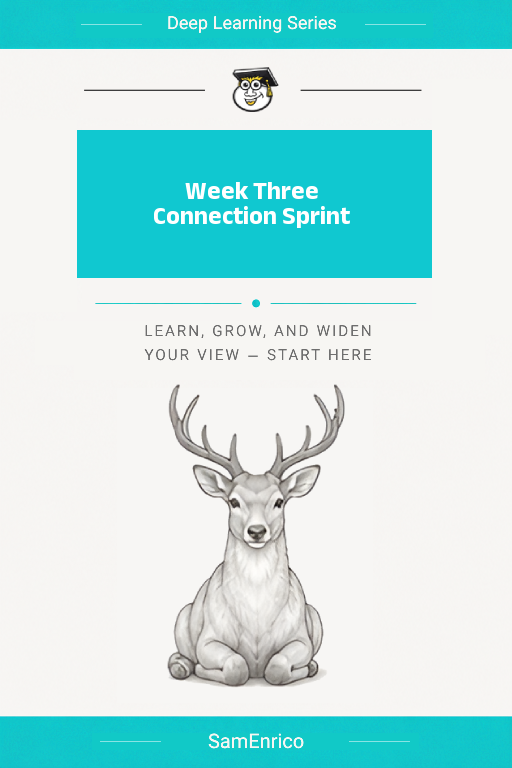
Non-FictionFirst 30 DaysWeek Three
Week Three Connection Sprint eBook
Sends connection requests to top 20 mentor prospec
Sends connection requests to top 20 mentor prospects with personalized notes during third week of mentorship search.
Formats
Free sample
Chapter 1: The Week Three Graveyard--–- The email sat open on my laptop for forty-seven minutes. I had written it, deleted it, rewritten it, adjusted the subject line three times, and then hovered my cursor over the send button like a parachutist looking down at a canyon. The recipient was a senior vice president at a company I admired. We had one mutual connection. I had spent two hours researching her career.
I had crafted what I believed was the perfect note – specific, flattering, brief. And then I closed my laptop without sending it.That was my third attempt that week. The first two notes – to different prospects – had been sent. They had not been replied to. They sat in outboxes across the internet like unopened bottles washed ashore on a deserted island.
I told myself that busy people needed time. I told myself that silence was not rejection. I told myself that next week would be different.But next week was not different. Next week was worse.By the end of the first month of my mentorship search, I had sent twenty-seven emails. I had received four replies.
Three of those were polite "no's." One was an automated out-of-office message from someone who would not return for two weeks. Zero conversations. Zero calls. Zero mentors.I was not alone in this graveyard. And neither are you.The Invisible Mass of Failed Searches The data on mentorship seeking is both revealing and depressing.
According to longitudinal studies of professional development programs, approximately ninety percent of individuals who actively seek a mentor outside of a formal organizational program abandon their search within the first thirty days. Let me repeat that statistic because it is the single most important number in this entire book. Ninety percent. Nine out of ten people who set out to find a mentor give up before they ever have a single meaningful conversation.But here is what makes that statistic even more haunting. The majority of that ninety percent do not quit in Week One, when enthusiasm is highest.
They do not quit in Week Two, when research feels productive and hope still floats. They quit in Week Three.I call this phenomenon the Week Three Graveyard.Why Week Three? The answer reveals something fundamental about human psychology and the hidden structure of failure. Weeks One and Two are dominated by what psychologists call "preparatory euphoria." You make lists. You identify prospects.
You read their Linked In profiles. You imagine the conversations you will have. Your brain releases dopamine in anticipation of future rewards – the same neurological response that makes planning a vacation almost as pleasurable as taking one. You feel productive. You feel like you are making progress.But somewhere in Week Three, the abstraction of planning collides with the reality of asking.
You have to actually send messages. You have to actually put yourself out there. And then you have to wait. And waiting, for most people, is where the dream dies.The silence that arrives in Week Three is unlike any other professional silence. A job application that goes unanswered is frustrating, but you expect it.
A cold email to a potential client that gets no reply is disappointing, but you move on. But a mentorship request that receives silence feels personal in a way that those other silences do not. You are not asking for a transaction. You are asking for a relationship. And silence in response to a relationship request feels like a judgment on your worth.This is the lie that the Week Three Graveyard perpetuates.
The silence feels like it means "you are not good enough," "you are bothering people," "you should stop trying." But the truth – the uncomfortable, liberating, actionable truth – is that the silence means nothing of the sort. The silence means your system is broken. And broken systems can be fixed.The Myth of the Natural Networker Before we fix the system, we have to kill a myth. It is a myth that has caused more professional suffering than almost any other. It is the myth of the Natural Networker.You know the type.
They are always portrayed in career advice articles and Linked In influencer posts as the person who can "work a room," who "lights up when they meet new people," who "genuinely enjoys small talk." The implication – usually unstated but always present – is that successful networkers are born, not made. You either have the gift of charisma, or you do not. And if you do not, you will always struggle.This myth is destructive in two ways. First, it is simply false. Second, it convinces people who are perfectly capable of successful outreach that they are fundamentally inadequate.Let me start with the evidence against the myth.
Susan Cain's seminal work Quiet examined the neuroscience and sociology of introversion and extroversion across thousands of subjects. Her findings upended decades of conventional wisdom about networking and professional success. The people who reported the most successful mentoring relationships in her research were not the extroverts. They were the introverts. Why?
Because introverts tend to prepare more thoroughly, listen more carefully, and follow up more thoughtfully than their extroverted counterparts. The "natural networker" – the person who thrives on spontaneous conversation – is actually at a disadvantage when it comes to the kind of deep, sustained relationship that mentorship requires.I have seen this play out hundreds of times in my own research and coaching. The client who panics before sending an email often writes a better email than the client who dashes off five messages in ten minutes. The person who researches a prospect for an hour before reaching out almost always gets a higher response rate than the person who fires off generic compliments. The introvert who dreads the phone call is often the same person who shows up to that call with a prepared agenda, a specific ask, and a pre-read document – all of which makes the mentor feel respected and valued.Charisma is not the currency of mentorship.
Thoughtfulness is.But the myth persists because we tell stories about the wrong successes. We celebrate the person who "just happened to sit next to a CEO on a flight" as if that were a replicable strategy. We admire the person who "sent a cold email and got a reply within an hour" without acknowledging that they sent forty other emails that got no reply at all. We mistake randomness for skill and survivorship bias for strategy.This book is for everyone who has ever felt that they are "not good at networking." It is for the person who rereads an email ten times before sending it. It is for the person who dreads the phrase "let's grab coffee" because they have no idea how to convert that vague invitation into a real conversation.
It is for the person who has spent hours scrolling through Linked In, building lists of potential mentors, and then closed the browser without taking action because they did not know what to say.You do not need to become a different person to succeed at this. You need a different system.Introducing the Sprint Methodology The system that works is called the Sprint Methodology.…
This is the end of the free sample. Get the eBook to keep going. Buy now
About this book
Details
- Author
- Grisham Arnita
- Publisher
- SamEnrico
- Language
- English
- Genre
- Non-Fiction, First 30 Days, Week Three
- Released
- 2026-06-01
- Pages (approx.)
- 122
- Available as
- eBook, Audiobook

Read better in the ZLOADR app
Your eBooks on your phone or tablet. Sign in with your SamEnrico account and start reading.
More by Grisham Arnita
 The State Expert Witness GuideGrisham Arnita$11.99
 Thyroid Disorder Pregnancy Loss HandbookGrisham Arnita$11.99
 The Prison Metta GuideGrisham Arnita$11.99
 Tobacco Industry ESG GuideGrisham Arnita$11.99
 The Dating Body Language GuideGrisham Arnita$11.99
 The Serpent’s Gambit: Narasimha’s Shadow WarGrisham Arnita$11.99
 Ghana Dropshipping Market GuideGrisham Arnita$12.99
 Understanding Schamberg's Disease Pigmentation DisorderGrisham Arnita$17.99
 Plant OperatorGrisham Arnita$11.99
 How to Become a Ordnance-artificer HelperGrisham Arnita$11.99
You may also like
 Hong Kong Handover 1997Dunn Johnnie$11.99
 Zumba For Postnatal Recovery CourseNeal Christian$11.99
 Zumba for BeginnersLadner Nikia$11.99
 YouTube Comment Mining GuideHumes Pandora$12.99
 Worry Box MeditationCarlin Rudy$11.99
 Workplace Stress MeditationNguyen Lynn$11.99
 Workplace Stress and Sleep RepairHawley Ivory$11.99
 Workplace Perfectionism CureDelaney Jeffry$11.99
 Workplace Injustice Anger GuideWallen Isabelle$11.99
 Work Addiction and Burnout LinkGreenwood Ester$11.99
 Women in Yoga and WellnessBeattie Galina$11.99
 Women in Stand Up ComedyChun Evangeline$11.99