
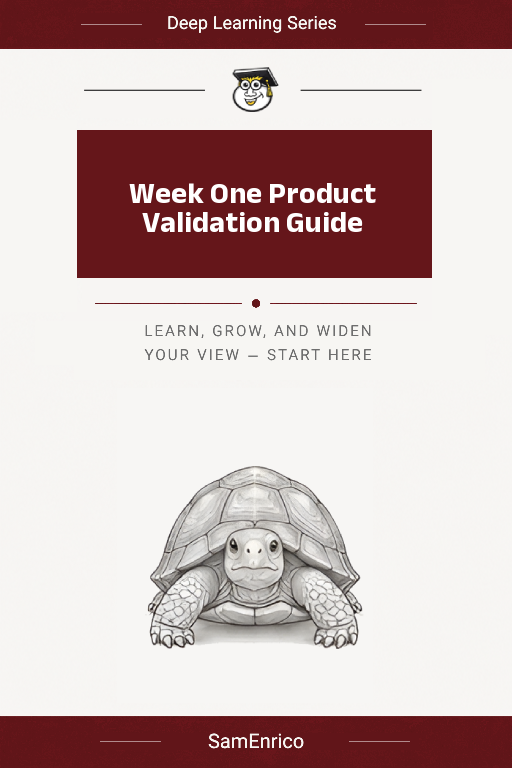
Non-FictionFirst 30 DaysMarket Validation
Week One Product Validation Guide eBook
Interview potential customers and pre sell your di
Interview potential customers and pre sell your digital product before building anything in first 7 days.
Formats
Free sample
Chapter 1: The $100,000 Lie--–You are about to make a very expensive mistake. I know because I made it myself, and the bank statement still makes me nauseous.In 2019, I had an idea. It was a good idea—at least, that is what I told myself every morning for nine months. I sketched wireframes on napkins. I hired a development team overseas.
I paid for a trademark, a logo, a website, and a legal entity. I named the company. I bought the domain. I scheduled a launch date.I did everything except talk to a single customer.On launch day, I sat in front of my computer at 9:00 AM, hit the "publish" button, and waited for the magic to happen. I had built a beautiful Saa S product.
It had user authentication, a payment gateway, a dashboard, analytics, email notifications, and a dark mode toggle because I thought dark mode made it look professional. I had spent forty-seven thousand dollars of my own savings.At 9:01 AM, the first visitor arrived. My mom.At 9:15 AM, the second visitor arrived. My best friend, who clicked around for thirty seconds and sent me a text that said "Looks cool!"At 5:00 PM, the final count was in: zero signups. Zero.
Not a single person who was not related to me or obligated to be nice to me had any interest in what I had built.I had built a Ferrari for a road that did not exist.That night, I did what any rational person would do. I doubled down. I told myself the problem was marketing. I told myself the problem was the price. I told myself the problem was the launch day—maybe everyone was busy.
I spent another three months and another twelve thousand dollars on ads, content marketing, and a "growth hacker" who promised me results. The results came: seven signups, zero paying customers, and a credit card bill that made me hide my phone from myself.I shut the company down on a Tuesday. I did not tell anyone. I just turned off the servers and went for a long walk. The only thing I had to show for a year of my life and nearly sixty thousand dollars was a lesson I could have learned in seven days.This book is that lesson, compressed into a single week.The Mistake That Everyone Makes The mistake I made has a name.
It is called feature validation, and it is the single most expensive cognitive bias in entrepreneurship.Feature validation asks one question: "Can I build this?"That question feels productive. It feels like progress. When you write code, design screens, or hire developers, you can see the output. You can touch it. You can point to it and say, "Look, I made a thing." That feeling is addictive.
It is also completely irrelevant to whether anyone will pay you.Problem validation asks a different question: "Does anyone need this badly enough to pay before it exists?"That question is terrifying. It requires talking to strangers. It requires hearing the word "no" repeatedly. It requires admitting that your brilliant idea might be nothing more than a solution in search of a problem. That discomfort is why most founders skip problem validation entirely.
They tell themselves that "building a quick MVP" is the same as validation. It is not. Building is the opposite of validation. Building is betting. Validation is checking the odds before you place the bet.The most successful founders I have worked with since my failure have one thing in common: they validate the problem before they write a single line of code.
They do not build anything until they have evidence—real evidence, not opinions—that someone will pay for the outcome. And they gather that evidence in seven days or less.Why Seven Days?You might be thinking: "Seven days is not enough time. I need to do market research. I need to build a prototype. I need to..."Stop.
That is the Excuse Monster talking. We will name that voice properly in a moment, but first, understand why seven days is the magic number.Seven days is the maximum amount of time a focused solo founder can sustain intense customer discovery without burning out. After seven days, fatigue sets in. You start rationalizing weak signals. You start convincing yourself that "maybe" means "yes." You lose the sharp edge of objectivity.
The seven-day window forces urgency. It prevents analysis paralysis. It compresses the timeline so tightly that you have no room for anything except action.There is also a psychological principle at work here called the deadline effect. When you give yourself a month to validate an idea, you will spend three weeks procrastinating and one week scrambling. When you give yourself seven days, you start immediately.
The clock is ticking. There is no time to overthink, no time to build anything, no time to do anything except talk to customers and record what they say.The seven-day promise is simple: at the end of this week, you will have a binary answer. You will either have evidence that you should build, or you will have evidence that you should abandon the idea and move on. There is no "maybe." There is no "let me do a little more research." There is a yes or a no. That clarity is worth more than any amount of code.The Robinhood Case Study: Validation Without Building Before we go further, let me show you what validation looks like when it is done right.In 2013, two Stanford graduates named Vlad Tenev and Baiju Bhatt had an idea.
They noticed that retail investors were paying ridiculous fees to trade stocks—seven to ten dollars per trade, sometimes more. Their idea was simple: commission-free trading.They did not build a trading engine. They did not integrate with brokerage APIs. They did not hire compliance lawyers. They did not raise money.
They built a single web page with a waitlist form and the headline: "Commission-free trading. Coming soon."Then they posted that link on a few online forums where retail investors hung out.Within one week, fifty thousand people joined the waitlist. Within three months, one million people had signed up. Tenev and Bhatt had validated that the problem—high trading fees—was real, urgent, and widespread. They had not built anything.
They had simply asked the market: "If someone solved this problem, would you want to know about it?" The market screamed yes.By the time Robinhood raised its first round of venture capital, the founders had something more valuable than a pitch deck. They had one million people who had already raised their hands and said, "I want this." The product was built later. The validation came first.Notice what Robinhood did not do. They did not ask their mothers if the idea was good. They did not run a survey.
They did not build a prototype. They created a simple, low-friction way for strangers to express interest, and they measured that interest. That is problem validation.Your Problem Hypothesis Before you can validate anything, you need to know what you are validating. This sounds obvious, but most founders cannot state their…
This is the end of the free sample. Get the eBook to keep going. Buy now
About this book
Details
- Author
- Bussey Verdell
- Publisher
- SamEnrico
- Language
- English
- Genre
- Non-Fiction, First 30 Days, Market Validation
- Released
- 2026-06-01
- Pages (approx.)
- 112
- Available as
- eBook, Audiobook

Read better in the ZLOADR app
Your eBooks on your phone or tablet. Sign in with your SamEnrico account and start reading.
More by Bussey Verdell
 Dairy and HGH ControversyBussey Verdell$11.99
 The Visual Interruption SignalBussey Verdell$11.99
 Tiny Goals MethodBussey Verdell$11.99
 The Nonprofit Salary Negotiation HandbookBussey Verdell$11.99
 Uber Airport Queue GuideBussey Verdell$11.99
 Benzo Vestibular RecoveryBussey Verdell$11.99
 Grief and Technology After Child LossBussey Verdell$11.99
 Burnout Recovery Creative OutletsBussey Verdell$11.99
 The Tiger Queen of Mandalay: How a Royal Consort Orchestrated a Prison BreakBussey Verdell$11.99
 Prince Yamato Takeru: The Legendary Warrior Who Shaped JapanBussey Verdell$11.99
 How to Produce Mechanised AgricultureBussey Verdell$11.99
 Growing AdlumiaBussey Verdell$11.99
You may also like
 Hong Kong Handover 1997Dunn Johnnie$11.99
 Zumba For Postnatal Recovery CourseNeal Christian$11.99
 Zumba for BeginnersLadner Nikia$11.99
 YouTube Comment Mining GuideHumes Pandora$12.99
 Worry Box MeditationCarlin Rudy$11.99
 Workplace Stress MeditationNguyen Lynn$11.99
 Workplace Stress and Sleep RepairHawley Ivory$11.99
 Workplace Perfectionism CureDelaney Jeffry$11.99
 Workplace Injustice Anger GuideWallen Isabelle$11.99
 Work Addiction and Burnout LinkGreenwood Ester$11.99
 Women in Yoga and WellnessBeattie Galina$11.99
 Women in Stand Up ComedyChun Evangeline$11.99