
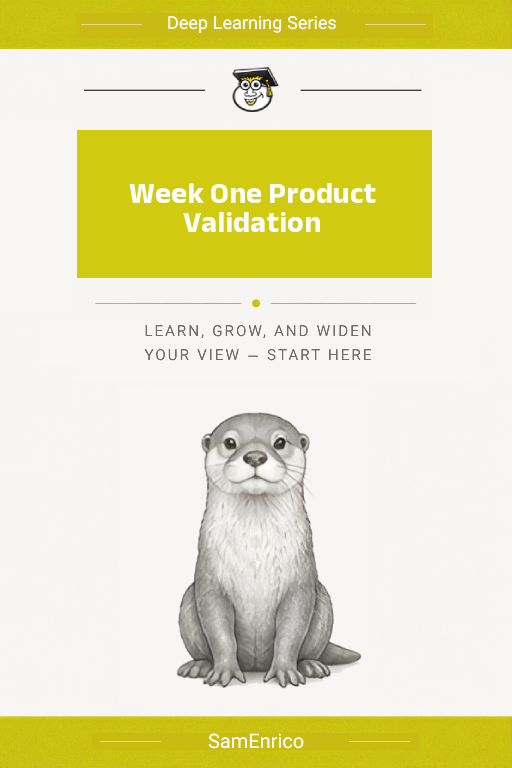
Non-FictionFirst 30 DaysMarket Validation
Week One Product Validation eBook
Identify profitable niche, survey target audience,
Identify profitable niche, survey target audience, and validate demand before building digital product.
Formats
Free sample
Chapter 1: The Empty Chair–- Most entrepreneurs don’t fail because they can’t build. They fail because they build the wrong thing.I learned this lesson in a coffee shop on a gray Tuesday morning, staring at a receipt for $47.83 and a laptop screen showing exactly zero new users. Three months of development. Two thousand lines of code. One beautifully designed dashboard.
And absolutely nobody who wanted it.The product was called Schedule Smart—an AI-powered calendar tool for freelance designers. I had built it because I assumed freelancers had the same calendar problems I did. I assumed they wanted automation. I assumed they would pay $29 a month. I assumed, assumed, assumed.Every assumption was wrong.That $47.83 receipt was for my “farewell coffee” with a beta tester who never became a customer.
He was polite. He said the interface was “really clean” and the features were “impressive.” Then he went back to using Google Calendar, same as before. When I asked why, he shrugged and said, “I guess I never really had that problem.”I had spent three months solving a problem that didn’t exist.This is the single most expensive mistake in digital product creation. It’s not marketing. It’s not pricing.
It’s not execution speed. It’s building something—a course, a software tool, a membership site, a template pack—based on what you think people need, rather than what they will actually pay for.This book exists to ensure you never make that mistake again. Or, if you’re just starting out, to ensure you skip the three months of misery and go straight to building something people actually want.The solution is brutally simple, emotionally difficult, and entirely learnable: you must shift from being an Idea Person to being a Problem Hunter.The Idea Person vs. The Problem Hunter Every digital product builder starts somewhere. But where you start determines almost everything about your odds of success.The Idea Person wakes up with a flash of inspiration.
They think: “What if I created a course about X?” or “There’s no tool for Y—I should build it.” They fall in love with the solution. They name it, design a logo in Canva, sketch out features, and maybe even start building. The Idea Person’s energy comes from creation. They feel productive. They feel smart.The Problem Hunter does something that looks suspiciously like doing nothing.
They spend their first week—sometimes their first month—asking questions. They find people who might have a problem. They listen. They take notes. They ask “why” five times in a row.
They don’t name anything. They don’t design anything. They don’t build anything. They hunt for pain.Here’s the uncomfortable truth: The Idea Person feels more productive. They have something to show for their time—a logo, a landing page, a prototype.
The Problem Hunter has only a notebook full of other people’s complaints. But at the end of that week, the Problem Hunter knows exactly what to build. The Idea Person has a beautiful solution to a problem nobody has.This book is for people who are willing to look unproductive for five days in exchange for never wasting months of their life again.The Empty Chair: A Mental Model The “Empty Chair” is a simple but ruthless mental model. Before you write a single line of code, record a single video lesson, design a single template, or create a single sales page, you imagine an empty chair beside your desk.In that chair sits your ideal customer. Not a generic “small business owner” or “busy mom” or “aspiring entrepreneur.” A specific person with a name, a job title, a monthly budget, a set of frustrations, and a history of failed attempts to solve their problem.Every decision you make—every feature you prioritize, every word you write, every price you set—must be made for that person.
Not for your ego. Not for your portfolio. Not for the investor you hope to impress. For the person in the empty chair.If you cannot describe that person in vivid, painful detail, you are not ready to build anything.Here’s the test: Close your eyes and describe your ideal customer. Can you name three specific problems they’ve complained about in the last week?
Can you describe their morning routine? Do you know how much money they lost last month because of the problem you want to solve? If you hesitated on any of these, put down your keyboard and finish this chapter first.Why Your Opinion Is Worthless This is the hardest lesson for most founders to accept: your opinion does not matter.Not a little bit. Not “it matters but you should also get feedback.” It does not matter at all.I don’t care if you’ve been in the industry for twenty years. I don’t care if you have a Ph D in the subject.
I don’t care if you’ve already built three successful products. Your opinion about what a customer should want is fiction until validated by someone who has no reason to be nice to you.Why? Because you are suffering from four cognitive biases that make you an unreliable judge of your own ideas:1. The Curse of Knowledge. Once you know something, you cannot imagine not knowing it.
You assume customers understand the value of your solution because you understand it. But they don’t have your context, your expertise, or your emotional investment.2. Confirmation Bias. You will naturally seek out evidence that supports your idea and ignore evidence that contradicts it. That one friend who said “that’s brilliant” will echo in your mind.
The seven who said nothing will be forgotten.3. The IKEA Effect. You value things more when you’ve built them yourself. The hours you spend sketching features, writing copy, or designing interfaces create an emotional attachment that clouds your judgment. You fall in love with your effort rather than the outcome.4.
The False Consensus Effect. You assume other people think like you do. If you would pay $200 for a solution to a problem, you assume others would too. But your pain tolerance, your budget, and your context are not universal.The only antidote is external, unbiased, behavioral data from strangers. Not friends.
Not family. Not colleagues who like you. Strangers who have no social incentive to be polite.Let me be specific: If you have not yet spoken to at least twenty strangers who experience the problem you want to solve, you do not have an opinion. You have a guess. And guesses are not a business plan.The Opinion Tax: What Assumptions Really Cost Let’s put a number on guesswork.Imagine you spend three months building a digital product based entirely on your assumptions.
You create a course with twenty modules. Or you code a Saa S tool with five core features. Or you design a template system with fifty assets.Then you launch to silence. Nobody buys. Or three people buy, ask for refunds, and leave one-star reviews saying “not what I expected.”You have just paid the Opinion Tax.Here’s the math: Three…
This is the end of the free sample. Get the eBook to keep going. Buy now
About this book
Details
- Author
- Craddock Marcelino
- Publisher
- SamEnrico
- Language
- English
- Genre
- Non-Fiction, First 30 Days, Market Validation
- Released
- 2026-06-01
- Pages (approx.)
- 132
- Available as
- eBook, Audiobook

Read better in the ZLOADR app
Your eBooks on your phone or tablet. Sign in with your SamEnrico account and start reading.
More by Craddock Marcelino
 Seve Ballesteros Passion BiographyCraddock Marcelino$11.99
 Burnout Perfectionism LinkCraddock Marcelino$11.99
 The Blog to Lead FunnelCraddock Marcelino$11.99
 Collaborative Storytelling For Innovation WorkbookCraddock Marcelino$11.99
 Feeling Disrespected Trigger GuideCraddock Marcelino$11.99
 The Shadow of the Red Square: The Unsolved Assassination of Leon TrotskyCraddock Marcelino$11.99
 The Maestro, the Mutiny, and the Masterpiece: James Cameron’s Unseen BattlesCraddock Marcelino$11.99
 Directus Contentful AlternativeCraddock Marcelino$12.99
 Cairn Terrier BreedingCraddock Marcelino$11.99
 Understanding Chronic BronchitisCraddock Marcelino$17.99
 How to Start a Hobby in PotteryCraddock Marcelino$11.99
You may also like
 Hong Kong Handover 1997Dunn Johnnie$11.99
 Zumba For Postnatal Recovery CourseNeal Christian$11.99
 Zumba for BeginnersLadner Nikia$11.99
 YouTube Comment Mining GuideHumes Pandora$12.99
 Worry Box MeditationCarlin Rudy$11.99
 Workplace Stress MeditationNguyen Lynn$11.99
 Workplace Stress and Sleep RepairHawley Ivory$11.99
 Workplace Perfectionism CureDelaney Jeffry$11.99
 Workplace Injustice Anger GuideWallen Isabelle$11.99
 Work Addiction and Burnout LinkGreenwood Ester$11.99
 Women in Yoga and WellnessBeattie Galina$11.99
 Women in Stand Up ComedyChun Evangeline$11.99