
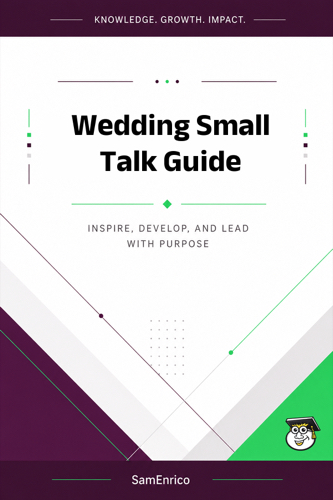
Wedding Small Talk Guide eBook
Chats with other guests during cocktail hour and r
Chats with other guests during cocktail hour and reception.
Formats
Free sample
Chapter 1: The Solo Superpower--–- The car door clicks shut, and suddenly you are alone. The venue looms ahead, glowing with warm light. Muffled laughter and the clink of glasses drift through the autumn air. Inside, dozens of guests are already mingling—old friends reuniting, cousins hugging, couples posing for photos. And you?
You recognize no one. Not the valet. Not the grandmother arranging her shawl by the entrance. Certainly not the groom’s college roommate who is already three drinks deep and telling a story about a disastrous camping trip. Your heart rate climbs.
Your palms feel damp. A small, insistent voice whispers: You don’t belong here. Everyone will notice. Everyone will know.This is the Wedding Small Talk Panic. It is as predictable as the bouquet toss and nearly as terrifying.
And if you are reading this book, you have likely felt it—perhaps at the last wedding you attended, perhaps at the one you are about to walk into, perhaps at every single social gathering you have ever entered alone. The good news is that this panic, while viscerally real, is based on a lie. The better news is that once you understand the lie, you can transform your solitude from a source of dread into your greatest advantage.Welcome to the first chapter of The Wedding Small Talk Guide. If you only read one chapter, make it this one. Because before you learn a single icebreaker, before you memorize a single script, before you worry about what to say when the uncle asks about your job, you need to understand one fundamental truth: walking into a wedding where you know no one is not a weakness.
It is a superpower.The Spotlight Effect: Why No One Is Actually Watching You Let us begin with the lie. The lie is called the Spotlight Effect, a term coined by psychologists Thomas Gilovich and Kenneth Savitsky. In a now-famous study, researchers asked college students to wear a embarrassing T-shirt featuring a large picture of the singer Barry Manilow. (For younger readers: imagine something approximately as uncool as a Nickelback t-shirt, but with more soft rock.) The students then walked into a room full of their peers. Afterwards, the researchers asked the students to estimate how many people in the room had noticed their shirt.
The students guessed that nearly half of the room had noticed. The actual number? Less than twenty percent.The Spotlight Effect is our brain’s tendency to overestimate how much others notice and remember about us. We feel as though a bright spotlight is shining on our every flaw, our every awkward pause, our every fumbled word. But the truth is that everyone else is standing under their own spotlight, worrying about their own performance.
The bride’s mother is worried about the seating chart. The best man is rehearsing his speech in his head. The woman standing by the bar is wondering if anyone can tell she spilled red wine on her sleeve. The man checking his phone is not judging you; he is trying to figure out if he can sneak out before the cake cutting.At a wedding, this effect is magnified. Weddings are emotionally charged environments.
People are thinking about the couple, about their own relationships, about whether they will cry during the vows, about how to avoid the pushy cousin who always asks about their dating life. They are not, I promise you, cataloging your social missteps. The spotlight you feel is largely imaginary.This is not just feel-good advice. It is a cognitive reframing tool. When you feel the panic rising in your chest, repeat this sentence to yourself: They are too busy worrying about themselves to worry about me.
Say it three times. Say it until your shoulders drop. Because the moment you stop believing you are being watched, you stop performing. And the moment you stop performing, you become free.The Baggage of Familiarity: Why Knowing Everyone Is Actually Harder Now let us talk about the superpower.You might assume that the people who have the easiest time at weddings are the ones who know everyone—the childhood friend who grew up next door to the bride, the cousin who attends every family reunion, the college roommate who still hosts Super Bowl parties for the old gang. But here is a secret that those people rarely admit: knowing everyone is exhausting.When you know everyone, you bring baggage.
Decades of it. Old grudges from the time you lent someone money and they never paid it back. Inside jokes that exclude anyone who wasn't there. Family politics that require you to sit far away from your uncle who voted for the wrong candidate. Exes scattered around the room like landmines.
Friends who are silently competing with you about salary, square footage, or the number of invitations to their kids' birthday parties that you have declined.Knowing everyone means you cannot be neutral. You have a history, and histories come with obligations. You have to greet every person with the appropriate level of enthusiasm—more for the college friend, less for the distant cousin, cautiously for the ex who you still follow on Instagram. You have to remember whose dog died, who just got divorced, who lost their job and doesn't want to talk about it. You are performing a complex social calculus for the entire evening, and you cannot afford a single misstep.The solo guest, by contrast, arrives as a blank slate.
You have no history with these people. You have no grudges, no inside jokes that alienate, no political arguments waiting to resurface. You owe no one a specific greeting. You do not need to remember anyone's traumatic life events because you do not know about them yet. Every single interaction is a fresh start.This is freedom.
And freedom, in a social setting, is power.Consider the difference between walking onto a tennis court where you have played a thousand matches against the same opponent versus walking onto a court where you have never played before. In the first scenario, you are trapped in patterns. Your opponent knows your weaknesses. Every rally feels predictable. In the second scenario, there is possibility.
You do not know what will happen. You are alert, curious, open.That is the solo guest at a wedding. You are not trapped in anyone's story about you. You get to write your story in real time, with each new person you meet.The Secret Advantage of Not Knowing Anyone Let us get specific. Here are four concrete advantages that the solo guest has over the guest who knows everyone.Advantage One: You Can Ask the Most Powerful Question in Small Talk When you approach someone at a wedding and say, "How do you know the couple?" you are asking a question that works for everyone.
But it works especially well when you are a solo guest. Why? Because you are not testing them. You are not trying to figure out if they are worth your time based on their answer. You are genuinely curious.
You have no prior knowledge. You are not checking their story against a shared history. This lack of agenda is…
This is the end of the free sample. Get the eBook to keep going. Buy now
About this book
Details
- Author
- Reddick Shonda
- Publisher
- SamEnrico
- Language
- English
- Genre
- Non-Fiction, Self-Help, Weddings
- Released
- 2026-06-06
- Pages (approx.)
- 126
- Available as
- eBook, Audiobook

Read better in the ZLOADR app
Your eBooks on your phone or tablet. Sign in with your SamEnrico account and start reading.
More by Reddick Shonda
 Corrections Officer Stress GuideReddick Shonda$11.99
 The Retirement Housing Tax Strategy GuideReddick Shonda$11.99
 The Car Wash GenerationReddick Shonda$11.99
 Listening in Long-Distance RelationshipsReddick Shonda$11.99
 Personal Branding for Remote WorkersReddick Shonda$11.99
 Social Anxiety in ChildrenReddick Shonda$11.99
 Paleo Family Meals GuideReddick Shonda$11.99
 Longwang’s Lost Pearl: The Dragon King’s SecretReddick Shonda$11.99
 Service Providers Guide to InfopreneursReddick Shonda$11.99
 How to Produce Light Bulb ChangersReddick Shonda$11.99
 Internal Layoff Communication GuideReddick Shonda$12.99
 New Mexico LLC for Non ResidentsReddick Shonda$12.99
You may also like
 Hong Kong Handover 1997Dunn Johnnie$11.99
 Zumba For Postnatal Recovery CourseNeal Christian$11.99
 Zumba for BeginnersLadner Nikia$11.99
 YouTube Comment Mining GuideHumes Pandora$12.99
 Worry Box MeditationCarlin Rudy$11.99
 Workplace Stress MeditationNguyen Lynn$11.99
 Workplace Stress and Sleep RepairHawley Ivory$11.99
 Workplace Perfectionism CureDelaney Jeffry$11.99
 Workplace Injustice Anger GuideWallen Isabelle$11.99
 Work Addiction and Burnout LinkGreenwood Ester$11.99
 Women in Yoga and WellnessBeattie Galina$11.99
 Women in Stand Up ComedyChun Evangeline$11.99