
Non-FictionSelf-HelpWedding EtiquetteSocial Events
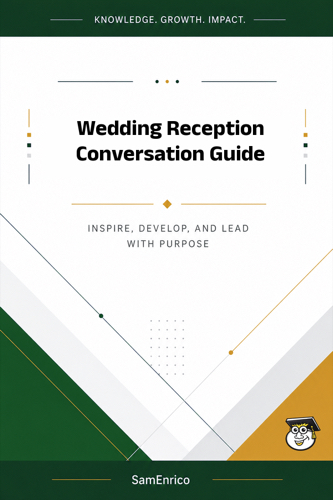
Wedding Reception Conversation Guide eBook
Talk with strangers at assigned tables and dance f
Talk with strangers at assigned tables and dance floor breaks without awkwardness.
Formats
Free sample
Chapter 1: The Assigned Table...--For most people, the first sign of trouble arrives as a small rectangle of cardstock tucked inside an envelope or taped to a welcome board. It has your name on it, usually in an elegant script, followed by a number. That number corresponds to a table. And that table is where you will spend the next three to four hours of your life, seated next to people you have never met, eating rubbery chicken, and attempting to produce something that resembles adult conversation. If the thought of this makes your stomach tighten, you are not broken.
You are not socially deficient. You are not the only person at the wedding silently praying for a quick and merciful dessert course. You are, in fact, the vast majority.The wedding reception is a peculiar social invention. Unlike a dinner party, where guests are usually friends of friends, or a work holiday party, where colleagues share at least a professional context, the wedding reception throws together a random assortment of humans whose only known commonality is that they once crossed paths with the couple getting married. That is it.
You might be sitting next to the groom’s college roommate, the bride’s second cousin, and the plus-one of a coworker. These people share no history, no inside jokes, no common vocabulary. And yet you are expected to talk to them. For hours. With background music playing and a photographer occasionally pointing a lens in your direction.This chapter exists to do one thing: convince you that the awkwardness you feel is not a personal failing but a predictable, normal, and even useful response to an unnatural situation.
Once you understand why the assigned table triggers anxiety, you can stop fighting yourself and start using that awareness to your advantage. The goal is not to become a charming extrovert who works the room like a politician. The goal is to survive the first five minutes without sweating through your shirt, and then—maybe—to actually enjoy the person sitting next to you.The Unique Terror of the Assigned Table Let us name the enemy. The assigned table is not the same as other forms of social discomfort. At a cocktail party, you can wander.
At a barbecue, you can hover near the grill. At a wedding reception, you are pinned in place for the duration of a multicourse meal. Leaving your table before the cake is cut is considered rude. Retreating to the bathroom for twenty minutes is noticed. You are, in effect, a captive audience member in a theater where the play is conversational improv and you have not been given a script.Psychologists have studied this phenomenon under various names: social scrutiny, evaluation apprehension, and the more colloquial "dread of being trapped." The specific fear is not that you will say something wrong—though that is part of it—but that you will run out of things to say and then be forced to sit in silence with a stranger who is also silently panicking.
That mutual panic creates a feedback loop. You see them look away, so you look away. You both reach for your water glasses at the same time, laugh nervously, and then the silence returns, heavier than before.Here is what the bestsellers like The Wedding MC and The Little Pink Book of Weddings get right: they acknowledge that guest comfort matters. They include sections on "Pre-Meal Announcements" and "Guest Comfort" that advise the couple to provide place cards, clear signage, and maybe a welcome drink. What they do not do is give you, the guest, any psychological tools to manage the moment between sitting down and the first course arriving.
They assume that because the couple has provided a nice table setting and a menu, the conversation will take care of itself. It will not.The assigned table is terrifying because it removes all your usual escape routes. At a party, you can check your phone without offense. At a wedding, checking your phone during dinner is seen as antisocial. At a bar, you can order another drink to buy time.
At a wedding, the bar might be on the other side of the room, and leaving your seat to visit it too often is noted. At a friend's house, you can offer to help in the kitchen. At a wedding, the kitchen is staffed by professionals who will politely but firmly shoo you away. You are stuck. And being stuck is precisely what your brain interprets as a threat.Why Your Brain Freezes (And Why That Is Not Your Fault)To understand why you freeze up at an assigned table, you have to understand a small piece of evolutionary psychology.
Your brain is wired to treat unfamiliar faces as potential threats until proven otherwise. This is not a character flaw; it is a survival mechanism that kept your ancestors from walking into enemy territory and saying hello to the wrong person. In a cave, caution saved lives. In a wedding reception, caution shows up as sweaty palms, a racing heart, and a sudden inability to remember your own name.The moment you sit down at an assigned table, your brain performs a rapid, unconscious risk assessment. It scans the faces around you for signs of danger.
Are these people smiling? Are they making eye contact? Do they look like they want to talk? If the answers are ambiguous, your brain defaults to a warning state. This is why you feel like you are "freezing up." You are not lacking social skills.
You are experiencing a low-stakes version of the fight-or-flight response, triggered by the ambiguity of unfamiliar social territory.Here is the crucial reframe: that freeze response is actually a gift, not a curse. It means you are paying attention. It means you are not bulldozing into conversations without reading the room. The guests who never feel awkward are often the ones who talk too loudly, interrupt, or dominate the table with stories no one asked to hear. Your discomfort is a sign of social intelligence.
You care about getting it right. That caring is what will make you a good conversation partner once the ice breaks.The problem is not the freeze. The problem is what you do during the freeze. Most people do one of three unhelpful things. First, they panic internally and start talking too fast, filling every silence with nervous chatter that exhausts everyone at the table.
Second, they retreat entirely, pulling out their phone or staring at the centerpiece, signaling to others that they are not interested in connecting. Third, they fake it, laughing too loudly at jokes they did not hear and nodding too enthusiastically at statements they do not understand. None of these strategies work. They all make the awkwardness worse because they add a layer of performance anxiety on top of the original social anxiety.The solution is not to eliminate the freeze. The solution is to sit with it.
Allow yourself five minutes of not having to speak. That is not rudeness. That is strategy.The Five-Minute Rule: Your Permission Slip to Be Quiet Here is the single most useful tool you will…
This is the end of the free sample. Get the eBook to keep going. Buy now
About this book
Details
- Author
- Meeks Shakita
- Publisher
- SamEnrico
- Language
- English
- Genre
- Non-Fiction, Self-Help, Wedding Etiquette, Social Events
- Released
- 2026-06-10
- Pages (approx.)
- 139
- Available as
- eBook, Audiobook

Read better in the ZLOADR app
Your eBooks on your phone or tablet. Sign in with your SamEnrico account and start reading.
More by Meeks Shakita
 Morning Routine Habit GuideMeeks Shakita$11.99
 Mindfulness For Anger WorkbookMeeks Shakita$11.99
 Walking Meditation for ChildrenMeeks Shakita$11.99
 Behavioral Experiments EatingMeeks Shakita$11.99
 The Last Letter of Cleopatra: A Love That Defied EmpiresMeeks Shakita$11.99
 The Lost Whalers of Antarctica: Secrets Beneath the IceMeeks Shakita$11.99
 Privacy Engineering and Data Protection SystemsMeeks Shakita$11.99
 Freemium Feature GatingMeeks Shakita$12.99
 One Page Pinterest Strategy WorkbookMeeks Shakita$12.99
 Understanding Gonadal Dysgenesis, Xy Female TypeMeeks Shakita$17.99
 How to Become a Cleaner IiMeeks Shakita$11.99
You may also like
 Hong Kong Handover 1997Dunn Johnnie$11.99
 Zumba For Postnatal Recovery CourseNeal Christian$11.99
 Zumba for BeginnersLadner Nikia$11.99
 YouTube Comment Mining GuideHumes Pandora$12.99
 Worry Box MeditationCarlin Rudy$11.99
 Workplace Stress MeditationNguyen Lynn$11.99
 Workplace Stress and Sleep RepairHawley Ivory$11.99
 Workplace Perfectionism CureDelaney Jeffry$11.99
 Workplace Injustice Anger GuideWallen Isabelle$11.99
 Work Addiction and Burnout LinkGreenwood Ester$11.99
 Women in Yoga and WellnessBeattie Galina$11.99
 Women in Stand Up ComedyChun Evangeline$11.99