
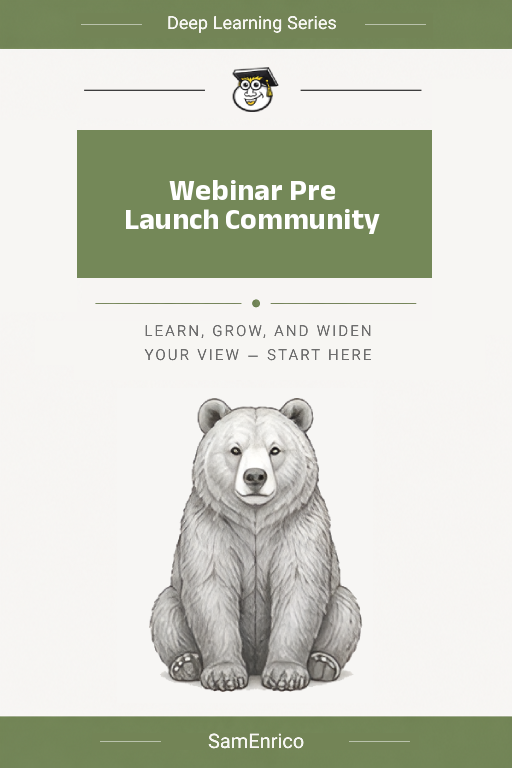
Non-FictionStartup GuideWaitlist Strategy
Webinar Pre Launch Community eBook
Use webinars to build community before launch. Edu
Use webinars to build community before launch. Educational content and product teasers.
Formats
Free sample
Chapter 1: The Launch Hangover--–- The first time I watched a product launch fail, I was sitting in a coffee shop across from a founder who had just emptied his savings account. His name was Marcus. He had spent eight months building a gorgeous project management tool for freelance designers. He had three hundred beta testers. His email list had six thousand names.
He had done everything right—at least according to every "how to launch" course he had ever bought.The day arrived. He pressed send on his launch email at 9:00 AM. By 9:15 AM, his Stripe dashboard showed three sales. By noon, seven. By midnight, twelve.
Twelve sales after eight months of work. His girlfriend bought two of them. His mom bought one.Marcus wasn't a failure. He was a victim of what I call the Launch Hangover—the crushing, disorienting aftermath of a traditional product launch that leaves you wondering where you went wrong when you followed all the rules.The rules lied.The Dirty Secret of the "Big Launch Day"For the past twenty years, the startup and online business world has been obsessed with a single, seductive idea: the Big Launch Day. You build in secret.
You work in isolation. You polish every pixel, every word, every feature until it shines. Then, on a single Tuesday morning, you throw open the doors, send the email, post on social media, and wait for the floodgates to open.But the floodgates don't open. They creak. They drip.
And then they slam shut.The dirty secret that no one tells you is this: The algorithms have changed, but the playbook hasn't.Amazon's sales rank algorithm doesn't care how many units you sell over six months. It cares about velocity—how quickly units move in the first 24 to 72 hours. Google's quality score for ads rewards immediate engagement, not long-term impressions. Social media algorithms show your launch post to roughly 2% of your followers unless it gets lightning-fast reactions. Every major platform is now optimized for speed of trust, not volume of reach.Here's what that means in plain English: selling 100 units in 3 hours is more powerful than selling 500 units over 6 months.
The algorithms interpret rapid, concentrated sales as a signal of relevance, quality, and social proof. They reward the launch that looks like a wildfire, not the one that looks like a slow burn.And yet, almost everyone builds their launch strategy around the slow burn—or worse, the cold start.The Cold Start Trap Let me define the Cold Start Trap with brutal clarity: You spend months building a product in silence, then try to sell it to people who have never heard of you.This is the default mode of the modern entrepreneur. You have an idea. You build it. You launch it.
You pray.But think about the psychology of that moment. You are asking a complete stranger—someone who woke up that morning with zero awareness of your existence—to stop scrolling, read your email, click a link, watch a video, trust you, enter their credit card information, and give you money. All in the span of about ninety seconds.That is not marketing. That is a magic trick. And magic tricks don't scale.The Cold Start Trap feels safe because it's familiar.
You tell yourself, "I'll build something great, and the market will recognize it." But the market doesn't recognize anything. The market is a crowded, noisy, distracted mob of people who are already overwhelmed by choices. Your "great" product is one of ten thousand emails in their inbox today.The only way to escape the Cold Start Trap is to reverse the order of operations. Don't build first and sell later. Build trust first, then build the product with that trusting audience.
But that requires a completely different mindset—one that most entrepreneurs have never been taught.The Velocity Principle: Why Speed Becomes Volume Let me show you the math behind the Velocity Principle, because once you see these numbers, you will never look at a launch the same way again.Imagine two products:Product A (The Traditional Launch):Sells 500 units over 6 months Average of 83 units per month Sales are steady but slow Algorithm interpretation: "Low urgency, moderate relevance"Product B (The Velocity Launch):Sells 100 units in 3 hours Then 200 more units over the next 6 months (300 total)Algorithm interpretation: "High urgency, high relevance, social proof confirmed"Despite selling fewer total units (300 vs 500), Product B will almost always outperform Product A in search rankings, recommended algorithms, and organic reach. Why? Because velocity is a signal that humans are making quick, confident decisions about this product. And algorithms are designed to amplify confidence.I've seen this play out dozens of times. A course creator launches with 200 sales in the first hour.
Amazon's algorithm ranks her book next to bestsellers within 48 hours. A Saa S founder gets 50 signups in two hours. Product Hunt's algorithm pushes him to the front page. A physical product brand sells out its first batch in a weekend. Etsy's algorithm shows the product to ten times more browsers the following week.Velocity creates visibility.
Visibility creates volume. Volume creates sustainability.But here's the question that keeps entrepreneurs up at night: How do you generate velocity on day one when you have no audience?The answer is almost paradoxical. You generate velocity on day one by starting long before day one. You generate velocity by building a pre-launch community that is already warm, already trusting, and already waiting for you to open the cart.The Pre-Launch Community: The Antidote to the Launch Hangover A pre-launch community is exactly what it sounds like: a group of people who gather around your topic, your expertise, and your upcoming product before that product exists for sale. They are not customers yet.
They are not even leads in the traditional sense. They are participants in the journey.The pre-launch community changes every variable in the launch equation:Traditional launch: You build alone → You announce → You sell to strangers Pre-launch community: You invite → You educate together → You co-create → You sell to friends When you sell to a stranger, you need a perfect landing page, a flawless demo, and a low price to overcome skepticism. When you sell to a friend—someone who has attended your webinars, answered your polls, and seen your unfinished product—you need none of those things. They already trust you. They already want you to succeed.
They are already emotionally invested.I want to tell you about a case study that changed how I think about this forever. A writer named Sarah wanted to launch a paid newsletter about sustainable investing. Instead of building the newsletter in secret, she ran a free, four-week webinar series called "The Sustainable Investor's Starter Kit." Each week, she taught one practical skill: how to read a company's ESG report, how to find fossil-fuel-free funds, how to talk to your financial advisor about values.She invited everyone to a private Slack group. She asked them what they struggled with most. She adjusted her curriculum based on their questions.
By week three, people were asking, "When can we pay you for this?" She hadn't mentioned a product once.On launch day, she sent one…
This is the end of the free sample. Get the eBook to keep going. Buy now
About this book
Details
- Author
- Douglass Rudolf
- Publisher
- SamEnrico
- Language
- English
- Genre
- Non-Fiction, Startup Guide, Waitlist Strategy
- Released
- 2026-06-01
- Pages (approx.)
- 134
- Available as
- eBook, Audiobook

Read better in the ZLOADR app
Your eBooks on your phone or tablet. Sign in with your SamEnrico account and start reading.
More by Douglass Rudolf
 The Art of Doing NothingDouglass Rudolf$11.99
 Fatherhood Isolation GuideDouglass Rudolf$11.99
 Desert Sleep PracticeDouglass Rudolf$11.99
 Stand Your Ground Assertiveness GuideDouglass Rudolf$11.99
 The Morning Creative Ritual GuideDouglass Rudolf$11.99
 Speed and Silk: The Rise of African Swimming Legends and Their Fashion RevolutionDouglass Rudolf$11.99
 Fastest MOOC Job CertificatesDouglass Rudolf$12.99
 Learn to Play the AlphornDouglass Rudolf$11.99
 Assembly AssociateDouglass Rudolf$11.99
 How to Start a Phosphates of Ammonium Carbonates Business (Beginners Guide)Douglass Rudolf$11.99
You may also like
 Hong Kong Handover 1997Dunn Johnnie$11.99
 Zumba For Postnatal Recovery CourseNeal Christian$11.99
 Zumba for BeginnersLadner Nikia$11.99
 YouTube Comment Mining GuideHumes Pandora$12.99
 Worry Box MeditationCarlin Rudy$11.99
 Workplace Stress MeditationNguyen Lynn$11.99
 Workplace Stress and Sleep RepairHawley Ivory$11.99
 Workplace Perfectionism CureDelaney Jeffry$11.99
 Workplace Injustice Anger GuideWallen Isabelle$11.99
 Work Addiction and Burnout LinkGreenwood Ester$11.99
 Women in Yoga and WellnessBeattie Galina$11.99
 Women in Stand Up ComedyChun Evangeline$11.99