
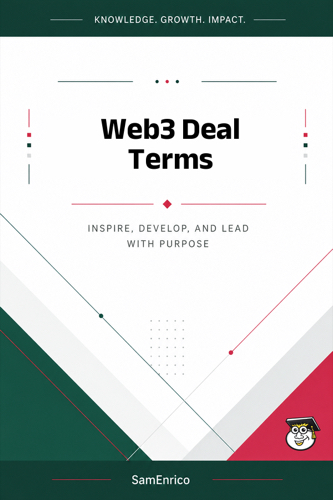
Non-FictionCapital & Valuation RegisterWeb3
Web3 Deal Terms eBook
Token warrant and crypto provisions from 200 block
Token warrant and crypto provisions from 200 blockchain financings.
Formats
Free sample
Chapter 1: Two Kinds of Rich--–- Imagine you are a founder. You have an idea for a decentralized protocol that could change how money moves across the internet. You have a team, a whitepaper, and a burning desire to build. You need capital. You go to a venture capital firm.
They love you. They offer you $5 million. But they give you a choice.Option one: You take the money as a traditional equity investment. The VC gets shares in your Delaware C corporation. They own 20% of your company.
If you sell the company for $100 million, they get $20 million. If you go public, they sell their shares. That is the end of the story.Option two: You take the same $5 million as a hybrid deal. The VC signs a SAFE for the equity side and a token warrant for the token side. They still get 20% of your equity.
But they also get the right to buy 20% of your future token supply at a nominal price. If your token launches and becomes valuable, they could make ten times more from the token than from the equity. And here is the kicker: if the token launches and the equity becomes worthless, they still have the token upside. If the equity succeeds and the token never launches, they still have the equity upside. They win either way.
You, as the founder, have just given away two pieces of your future instead of one.This is the choice that every web3 founder faces. Most founders do not even know they are making it. They sign the term sheet their lawyer hands them. They do not realize that a token warrant is not a minor add-on. It is a second bite at the apple.
It is a parallel economic interest that can dwarf the equity upside. And once you give it away, you cannot take it back.This chapter is called Two Kinds of Rich because that is what web3 offers: the old kind of rich (equity, acquisition, IPO) and the new kind of rich (tokens, TGE, exchange listing). Most founders want both. Most investors demand both. The tension between these two kinds of wealth creation is the central drama of web3 dealmaking.
Understanding that tension is the first step to not getting screwed.The Old World: Equity Financing Let us start with the familiar. In traditional venture capital, the deal is simple. An investor gives money to a company. In exchange, the investor receives equity—shares in that company. The company is almost always a Delaware C corporation.
It has a board of directors, a cap table, and a shareholders agreement. The investor becomes a shareholder with certain rights: voting rights (they get a say in major decisions), information rights (they see financial statements), pro rata rights (they can invest in future rounds to maintain their percentage), and liquidation preferences (they get paid before common stockholders if the company is sold).The exit is the goal. An exit is an IPO (Initial Public Offering) where shares are sold to the public, or an acquisition where another company buys the startup. In both cases, the investor sells their shares for cash. The valuation is determined by the market.
The documents are standard: a Stock Purchase Agreement, a Shareholders Agreement, and amendments to the Certificate of Incorporation. Every startup lawyer knows these documents. They have been refined over decades. They are predictable, enforceable, and well understood by courts.In this old world, the founder and the investor are aligned. Both want the company to grow in value.
Both want a successful exit. The only conflict is over valuation and control. The economic structure is straightforward: shares in, cash out.But web3 projects are different. Many web3 projects do not plan to go public. They do not plan to be acquired.
They plan to launch a token.The New World: Token Financing A token is a digital asset on a blockchain. It can represent many things: a unit of value (like a cryptocurrency), a right to use a network (like a utility token), or a vote in a decentralized organization (like a governance token). When a web3 project launches a token, it holds a Token Generation Event or TGE. Tokens are distributed to the team, to investors, to the community, and sometimes to the public through a sale or airdrop. Then the tokens are listed on cryptocurrency exchanges.
Investors can sell their tokens to anyone in the world, at any time, without waiting for an IPO or acquisition.This changes everything.First, the exit is not a single event. It is a continuous market. Investors can sell tokens the day after the TGE, or they can hold for years. There is no lockup (though lockups are common for early investors—see Chapter 6). Second, the valuation is not a single number negotiated with a lead investor.
It is determined by the market, second by second, on global exchanges. A token that launches at $1 could be worth $10 a month later or $0.10. Third, the investor does not necessarily own any equity. They may own only tokens. They have no voting rights in the corporate entity.
They have no board seat. They have no information rights. They have no liquidation preference. They have only the token, the market, and their hope that the price goes up.This creates a fundamental tension. The project needs capital to build.
The token does not exist yet. It cannot exist yet because the network is not built, the tokenomics are not finalized, and the regulatory landscape is uncertain. So the market invented bridging instruments: the SAFT (Simple Agreement for Future Tokens), the SAFE (Simple Agreement for Future Equity) with token warrant, and the token warrant itself.The Hybrid: Equity Plus Tokens The most common structure in web3 today is the hybrid. The investor gives money. In return, they get two things: a right to future equity (usually through a SAFE) and a right to future tokens (through a token warrant).
This is called a SAFE + token warrant structure. Approximately 70% of seed-stage web3 financings in our dataset use this structure. The remaining 25% is priced equity with token warrants (later-stage deals), and about 5% is pure token structures or other instruments. (See Chapter 2 for the history of why SAFTs fell to that 5%.)Why has the hybrid structure won? Because it gives investors the best of both worlds.
If the token launches and becomes valuable, they participate in that upside. If the token never launches or becomes worthless, they still have equity in the company. If the company is acquired, they get their liquidation preference. If the company goes public, they sell their shares. The investor cannot lose.
They have a free option on token upside, layered on top of traditional equity downside protection.For founders, the hybrid structure is a double-edged sword. It makes it easier to raise capital because investors love free options. But it also means you are selling two pieces of your future instead of one. The equity dilution is obvious: you give away a percentage of your company. The token dilution is less obvious.
Your token warrant holders are not buying tokens at market price. They are buying at a nominal price—often $0.001 or even…
This is the end of the free sample. Get the eBook to keep going. Buy now
About this book
Details
- Author
- Saunders Lester
- Publisher
- SamEnrico
- Language
- English
- Genre
- Non-Fiction, Capital & Valuation Register, Web3
- Released
- 2026-06-08
- Pages (approx.)
- 116
- Available as
- eBook, Audiobook

Read better in the ZLOADR app
Your eBooks on your phone or tablet. Sign in with your SamEnrico account and start reading.
More by Saunders Lester
 The IBS Alternative TherapiesSaunders Lester$11.99
 Toddler Nap Schedule GuideSaunders Lester$11.99
 The Las Vegas ResidencySaunders Lester$11.99
 Fibromyalgia Coping at WorkSaunders Lester$11.99
 Self Hypnosis for Sexual PerformanceSaunders Lester$11.99
 The Campaign Speech GuideSaunders Lester$11.99
 Reserve Fund For RentalsSaunders Lester$11.99
 Caregiver for VeteransSaunders Lester$11.99
 The Great Unraveling: How the Internet Broke DemocracySaunders Lester$11.99
 The Clockwork Whisper: The Secret Life of the Antikythera MechanismSaunders Lester$11.99
 The Silk and Gold Dynasty: Royal Fashion of the Kingdom of KongoSaunders Lester$11.99
 How to Start a Facilities Support Service BusinessSaunders Lester$11.99
You may also like
 Hong Kong Handover 1997Dunn Johnnie$11.99
 Zumba For Postnatal Recovery CourseNeal Christian$11.99
 Zumba for BeginnersLadner Nikia$11.99
 YouTube Comment Mining GuideHumes Pandora$12.99
 Worry Box MeditationCarlin Rudy$11.99
 Workplace Stress MeditationNguyen Lynn$11.99
 Workplace Stress and Sleep RepairHawley Ivory$11.99
 Workplace Perfectionism CureDelaney Jeffry$11.99
 Workplace Injustice Anger GuideWallen Isabelle$11.99
 Work Addiction and Burnout LinkGreenwood Ester$11.99
 Women in Yoga and WellnessBeattie Galina$11.99
 Women in Stand Up ComedyChun Evangeline$11.99